

You have deep expertise in your consulting niche, but your website sits invisible in search results while competitors with weaker credentials rank above you. This is one of the most common frustrations in consulting firm organic traffic growth, and it has a specific cause: most consulting firms invest in content without the strategic infrastructure to make that content visible. This guide walks you through the exact preparation, execution, and measurement steps that generate real, qualified organic traffic for consulting firms in 2026 — not vanity metrics, but the kind of traffic that fills your pipeline.
Table of Contents
- Key takeaways
- Laying the groundwork for organic traffic growth
- Executing organic traffic strategies that actually work
- Troubleshooting common pitfalls
- Measuring success the right way
- What I've learned about consulting firm SEO after working with dozens of firms
- How Manifestera helps consulting firms grow organic traffic
- FAQ
Key takeaways
| Point | Details |
|---|---|
| Fix technical issues first | Resolving indexing errors and Core Web Vitals problems can increase organic traffic by 15-35% before any new content is published. |
| Prioritize mid-funnel keywords | Targeting transactional and comparison queries drives more qualified leads than broad awareness terms. |
| Use visual assets strategically | Custom infographics and visuals can more than double organic traffic within six months when deployed correctly. |
| Measure pipeline impact, not just rankings | Track leads and conversions from organic traffic, not just keyword positions or session counts. |
| Treat SEO as a long-term system | Sustainable consulting firm organic traffic growth compounds over 12-24 months, not 4-6 weeks. |
Laying the groundwork for organic traffic growth
Before you publish a single new blog post or target a new keyword, your site needs to be in a condition that search engines can actually work with. Skipping this phase is one of the most expensive mistakes consulting firms make. You can produce excellent content and still see no traffic growth if your site has foundational problems blocking it.
Start with a full technical audit. The items to prioritize are:
- Indexing errors: Pages blocked by robots.txt, noindex tags, or canonical conflicts prevent Google from seeing your content at all.
- Core Web Vitals: Core Web Vitals improvements correlate with a 10-25% organic traffic increase within 8 weeks after fixing. Focus on Largest Contentful Paint (LCP) and Cumulative Layout Shift (CLS) first.
- Mobile usability: Over 60% of B2B research happens on mobile. If your consulting site renders poorly on a phone, rankings suffer.
- Internal linking gaps: Pages with no internal links are effectively invisible to crawlers.
Once technical issues are resolved, set up accurate tracking. Google Analytics 4 and Google Search Console together give you organic sessions, keyword impressions, and conversion events. Without this baseline, you cannot prove growth or diagnose problems.
The next step is competitive benchmarking. Pull your top three organic competitors in your consulting niche and compare their domain authority, top-ranking pages, and content depth. This tells you the gap you need to close and how long it realistically takes. Resolving indexing errors alone improves organic traffic by an average of 23% within six weeks for established consulting sites. That is often the fastest win available.
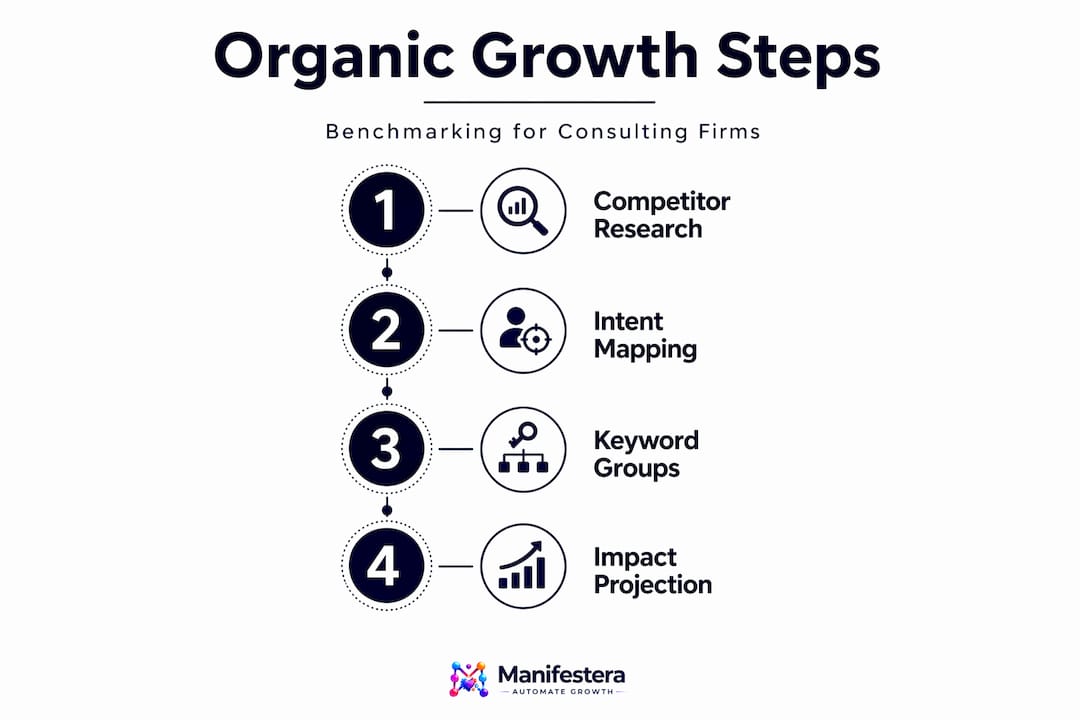
Finally, map your keyword universe. Group keywords by search intent: informational (what is X), navigational (your firm name), and transactional (hire X consultant, X consulting services). This mapping determines what you write and how you structure each page.
| Task | Priority | Expected impact |
|---|---|---|
| Fix indexing errors | High | +15-35% traffic in 4-8 weeks |
| Core Web Vitals improvements | High | +10-25% traffic in 8 weeks |
| Analytics and conversion tracking setup | High | Enables all future measurement |
| Keyword intent mapping | Medium | Guides content strategy direction |
| Competitive gap analysis | Medium | Sets realistic growth benchmarks |
Pro Tip: Run Google Search Console's Coverage report before anything else. Any page with a "Discovered, currently not indexed" status is a quick fix that often delivers immediate ranking improvements.
Executing organic traffic strategies that actually work
With your technical foundation in place, you can move into execution. The order of these tactics matters. Start where the highest leverage exists, not where the work feels most familiar.
-
Target mid-funnel keywords first. Generic keywords like "business consultant" have enormous competition and attract browsers, not buyers. Instead, target comparison and evaluation queries like "management consulting vs. strategy consulting for startups" or "best supply chain consultants for mid-market companies." These attract prospects who are actively considering hiring someone.
-
Publish with depth, not volume. Publishing 2-4 comprehensive posts weekly grows organic traffic 3.2x faster than daily thin-content publishing. For consulting firms with limited content budgets, this means fewer, stronger pieces rather than a constant stream of shallow articles.
-
Update your top existing pages. Many consulting firms have pages that already rank on page two or three of Google. Refreshing those pages with updated data, added depth, and better internal links often moves them to page one faster than creating new content.
-
Add custom visual assets. Custom infographics can increase organic traffic by up to 110% within six months. A single well-designed process diagram or data visualization can earn backlinks and shares that text alone never would.
-
Fix keyword cannibalization. If you have two pages targeting "financial advisory consulting services," they compete against each other and suppress both. Fixing keyword cannibalization produces quick ranking recoveries and is one of the most underused tactics in consulting firm SEO.
-
Build content clusters around your specializations. Create a pillar page for each core service area, then build supporting articles targeting related long-tail queries. This signals topical authority to Google and earns you rankings across dozens of related searches, not just one.
-
Pursue link building through earned authority. Guest contributions to industry publications, data-driven original research, and expert quotes in journalist requests all build backlinks without triggering Google penalties. Sustainable link building takes 4-6 months to impact rankings, so start this process in parallel with content work rather than waiting.
| Tactic | Timeline to impact | Difficulty |
|---|---|---|
| Fix keyword cannibalization | 2-4 weeks | Low |
| Update existing top pages | 4-6 weeks | Low-Medium |
| Mid-funnel keyword targeting | 6-12 weeks | Medium |
| Content cluster creation | 3-6 months | Medium-High |
| Custom visual assets | 3-6 months | Medium |
| Earned link building | 4-8 months | High |
Pro Tip: Before creating new content, run a site:yoursite.com search in Google for your target keyword. If two or more of your own pages appear, you have cannibalization to fix first.
Experience-led content that demonstrates genuine expertise is what search engines reward in 2026. Generic explainer content no longer earns top rankings in competitive consulting niches.
Troubleshooting common pitfalls
Even well-planned SEO campaigns hit problems. Recognizing these issues early prevents months of wasted effort.
- Traffic without leads: High organic sessions with low lead conversion usually means you are attracting the wrong keywords. Informational readers are not buyers. Audit which pages drive organic contact form submissions and double down on those topics.
- Over-reliance on blog volume: Many firms publish dozens of blog posts hoping something will rank. Without intent alignment and internal linking, most of those posts earn zero traffic. Fewer, stronger pages outperform content spam every time.
- Slow results from technical fixes: Core Web Vitals and indexing improvements take 4-8 weeks to register in Google's data. If you make changes and check rankings the next day, you will see nothing. Set a 60-day review window before drawing conclusions.
- Misaligned expectations: A consulting firm with a new domain and no backlinks should expect 12-18 months before significant organic traction. A site with Domain Authority above 20 can realistically achieve 10-20% monthly traffic growth in the first six months with good execution.
- AI-generated content that lacks depth: Search engines have become highly effective at identifying generic AI output that adds no unique perspective. Publishing that type of content at scale can actually suppress your site's rankings.
The shift toward AI search results adds another layer to this challenge. AI search and Generative Engine Optimization require consulting firms to focus on experience-led authority content that earns citations in AI-generated answers, not just traditional blue-link rankings.
The firms that win at organic search in 2026 are the ones aligning their SEO strategy with specific business outcomes, such as lead generation and pipeline value, rather than treating keyword rankings as the end goal.
Understanding where you are in the growth cycle shapes what you do next. A firm in the first six months needs to prioritize technical health and foundational content. A firm in month 12 needs to focus on topical depth, link acquisition, and conversion optimization. Applying the wrong tactics for your growth stage is a common reason campaigns stall.
Measuring success the right way
Tracking is where most consulting firms either lose visibility into their progress or celebrate the wrong things. Here is how to measure consulting firm organic traffic growth with clarity.
| Metric | What it tells you | Review frequency |
|---|---|---|
| Organic sessions | Volume of search-driven site visits | Weekly |
| Keyword ranking distribution | How many keywords rank in positions 1-10, 11-20 | Monthly |
| Organic leads generated | Contact forms, calls, and demo requests from organic traffic | Weekly |
| Organic conversion rate | Percentage of organic visitors who convert | Monthly |
| Backlinks acquired | New referring domains earned each month | Monthly |
| Core Web Vitals scores | Technical health signal for Google rankings | Monthly |
The most important metric on that list is organic leads generated, not organic sessions. You can triple your traffic and still have a failing SEO strategy if none of those visitors are potential clients.

Connect Google Analytics 4 goals to your contact forms and phone tracking to measure this accurately. Many consulting firms skip this setup and end up optimizing for traffic volume, which leads to the keyword intent mistakes described in the previous section.
For benchmarking, SEO campaigns for established consulting sites typically see 12-18% monthly growth in months 1-6. As your baseline traffic grows, that percentage naturally decreases even as absolute visitor numbers continue to rise. Do not mistake a slowing percentage for a failing strategy.
Pro Tip: Build a simple dashboard in Google Looker Studio connecting Search Console and GA4. Include organic sessions, top landing pages, and conversion events on one screen. Review it every Monday morning to spot trends before they become problems.
SEO is evolving into an operating system for business growth, not a standalone marketing tactic. The firms that treat it this way, reviewing data regularly and adjusting based on outcomes, build traffic assets that compound in value over years.
What I've learned about consulting firm SEO after working with dozens of firms
Working with consulting firms across professional services, I've noticed a consistent pattern. The ones who struggle the longest are the ones obsessed with rankings. They check their keyword positions daily and panic when a page drops three spots. The ones who grow consistently are the ones asking a different question: "Is this bringing in better clients?"
What I've found is that most consulting firms are sitting on untapped authority. They have real expertise, genuine client results, and original methodologies. That is exactly what SEO now rewards. But that expertise needs to be translated into content that matches how their prospective clients search, not how their consultants talk internally.
The uncomfortable truth is that AI-generated content shortcuts have flooded the web with mediocre articles, and Google's response has been to weight experience signals more heavily. Firms that publish content demonstrating real-world consulting experience, with specific examples, original data, and honest opinions, are outranking firms with larger content budgets but less substance.
My view is that consulting firm SEO done right is a 12-to-24-month investment that produces compounding returns. The firms that quit at month four never see the inflection point. Stay systematic, measure the right things, and your organic channel becomes the most cost-efficient lead source in your marketing mix.
— Manifestera
How Manifestera helps consulting firms grow organic traffic
If you recognize the gaps described in this article but do not have the internal bandwidth to close them, Manifestera builds and executes the full system for you.
Manifestera's SEO services for consulting firms cover every layer of organic traffic growth: technical audits and Core Web Vitals fixes, intent-mapped keyword research, experience-led content creation, custom visual asset development, and earned link building through authoritative outreach. Every strategy is tied to measurable outcomes, including leads generated and pipeline impact, not just rankings. Whether you are based in Manhattan or serving clients nationwide, Manifestera delivers data-driven organic growth programs built around your specific consulting niche. Contact Manifestera today to get a personalized growth plan backed by real performance data.
FAQ
How long does consulting firm organic traffic growth take?
Most consulting firms with an established domain see meaningful organic traffic growth within 6-12 months of implementing a structured SEO strategy. Sites with Domain Authority above 20 can achieve 12-18% monthly growth in the first six months.
What keywords should consulting firms target for organic traffic?
Consulting firms should prioritize mid-funnel transactional and comparison keywords over broad awareness terms. Queries like "hire a supply chain consultant for manufacturing" attract prospects actively evaluating vendors, not casual readers.
Why is my consulting firm's organic traffic not growing despite publishing content?
The most common cause is keyword cannibalization, technical indexing errors, or publishing content that does not match how your prospective clients search. Audit for competing pages targeting the same keyword and fix any indexing errors before adding new content.
How do custom visuals impact organic traffic for consulting firms?
Custom visual assets like infographics can increase organic traffic by up to 110% within six months by earning backlinks and additional search impressions from image-based queries.
How should consulting firms measure SEO success beyond rankings?
Track organic leads generated, organic conversion rate, and pipeline value attributed to organic traffic. Rankings are a leading indicator, but organic contact form submissions and calls are the metrics that connect SEO to revenue.