

Running a business with limited marketing spend doesn't mean you're stuck on the sidelines. A well-built low-budget digital marketing strategy can generate real traffic, real leads, and real revenue, even if your monthly budget is closer to $200 than $2,000. The key is knowing which channels deliver the highest return per dollar spent, setting up the right measurement tools from day one, and focusing your energy on owned channels that compound over time. This guide walks you through exactly that, with specific tools, tactics, and benchmarks to track your progress.
Table of Contents
- Key takeaways
- Your low-budget digital marketing foundation
- Content and SEO on a tight budget
- Social media and community engagement
- Email marketing: your highest-ROI channel
- Affordable paid advertising that performs
- Manifestera's perspective on budget-first marketing
- Ready to grow without overspending?
- FAQ
Key takeaways
| Point | Details |
|---|---|
| Start with tracking | Set up GA4 and Google Tag Manager before spending a single dollar on ads. |
| Own your audience | Email and SEO-driven content are the highest-ROI channels for small budgets. |
| Organic social wins through specificity | Answering exact audience problems outperforms broad promotional posts every time. |
| Email automation multiplies results | Automated flows like abandoned cart generate disproportionate revenue from minimal send volume. |
| Paid ads work small | Narrow targeting and geo-focused campaigns let you stretch low daily budgets further than most expect. |
Your low-budget digital marketing foundation
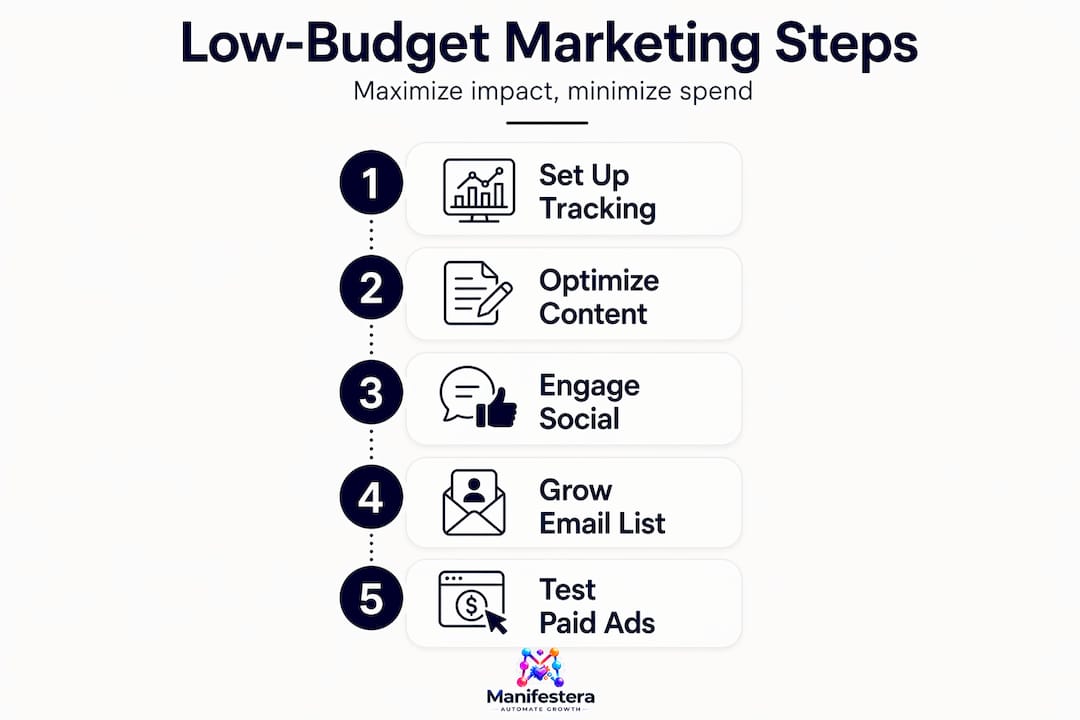
Before you write a single post or run a single ad, you need measurement in place. This is the step most small business owners skip, and it's the reason many of them can't tell you which channel actually drove their last ten customers.
Start with Google Analytics 4 (GA4) and Google Tag Manager (GTM). Both are free. GTM acts as a central hub where you install one snippet of code on your website, and from there you can deploy tracking for GA4, Meta Pixel, Google Ads, and more without touching your site's code again. The efficiency of a single GTM container managing all your pixels is significant for small teams with no dedicated developer.
Inside GA4, you want to track key conversion events: form submissions, phone clicks, purchases, or any action that signals a lead. Non-technical marketers can configure this in an afternoon using GTM's Form Submission triggers and GA4's recommended events like "generate_lead`. Mark these as key events inside GA4 so they feed into your reporting dashboards.
Pro Tip: Validate your tracking before launching any campaigns. GA4 has a DebugView feature that shows events firing in real time. Many small businesses track only partial funnels, which creates attribution errors and leads to bad spending decisions later.
Here is a quick overview of free and low-cost tools to have in your stack:
| Tool | Purpose | Cost |
|---|---|---|
| Google Analytics 4 | Website traffic and conversion tracking | Free |
| Google Tag Manager | Centralized tag and pixel management | Free |
| Google Search Console | Keyword rankings and indexing status | Free |
| Canva | Social media graphics and content design | Free / $15 per month |
| Mailchimp or Brevo | Email list building and automation | Free tier available |
| Buffer or Later | Social media scheduling | Free tier available |
Getting this stack in place costs nothing except a few hours of setup time. It is your foundation for every decision that follows.
Content and SEO on a tight budget
Content marketing and search engine optimization (SEO) are the cornerstones of affordable digital marketing. Unlike paid ads, the traffic you earn through SEO compounds over time. A blog post you publish today can generate visitors for the next three years without any additional spend.
The highest-ROI content types for small budgets are blog posts targeting long-tail keywords, FAQ pages built around specific customer questions, and location-specific landing pages. If you serve a local market, local SEO delivers better conversion rates and lower costs than national campaigns, because the searchers are closer to a buying decision and the competition is typically far weaker.

Keyword research without paid tools
You do not need an expensive keyword tool to start. Use Google Search Console to see what queries are already sending traffic to your site. Then use Google's autocomplete and "People also ask" sections to find question-based keywords your audience is actively searching. Focus on user intent: someone typing "best HVAC contractor Brooklyn" is ready to buy, while someone typing "how does HVAC work" is still in the education phase. Target the buyers first.
How to optimize content you already have
Before writing new content, audit your existing pages. Identify posts that rank on page two of Google, update them with better answers to the search query, add internal links to related content, and refresh any outdated statistics. This is one of the fastest ways to get measurable organic traffic gains with zero ad spend.
Pro Tip: Build at least 30% of your content around evergreen topics: questions your audience will always ask, regardless of the season or news cycle. These pages become your most consistent traffic drivers and they support every stage of the sales funnel.
Here are the core content and SEO practices that deliver results on a minimal budget:
- Publish at least two optimized blog posts per month targeting specific search queries
- Add schema markup to FAQ and product pages to improve click-through rates in search results
- Build internal links between related posts to distribute authority across your site
- Claim and optimize your Google Business Profile for local search visibility
- Repurpose every blog post into social media content and an email newsletter section to multiply its reach
Social media and community engagement
Organic social media has a reputation for being slow. That reputation is partly deserved, but it misses the real opportunity: communities where your potential customers are already asking questions right now.
A well-documented case study from the developer community showed that 3,200 users in 10 days were acquired with zero ad spend by monitoring Reddit for specific keyword mentions and posting genuinely useful answers. The approach worked because the responses were specific, not promotional. They solved a real problem the person already had.
Pro Tip: Do not announce your product. Instead, find threads where people are already complaining about the exact problem your product solves. Answer the question completely. Your link or brand mention becomes a natural conclusion, not a pitch.
Organic vs. paid social: a direct comparison
| Factor | Organic social | Paid social |
|---|---|---|
| Cost | Free | $5 to $20 per day minimum |
| Time to results | Weeks to months | Days |
| Audience control | Limited | High (targeting by interest, location, behavior) |
| Scalability | Low (time-intensive) | High (budget scales reach) |
| Best use | Building trust, answering questions | Retargeting, lead generation |
When you do use paid social, keep your targeting narrow. A Meta campaign targeting a specific city, age range, and interest category will always outperform a broad national campaign at the same spend. One Mumbai-based strategist ran a Meta campaign with a CPM of just $0.104, reaching approximately 3,700 unique users per dollar spent. The key was surgical audience segmentation, not a large budget.
Low-cost social tools and metrics worth tracking:
- Tools: Meta Business Suite (free), Reddit (free), LinkedIn (free), Google Business Profile (free)
- Metrics to track: Engagement rate, link clicks, reach per post, cost per click on paid campaigns
- Tactics: Build a custom audience from your email list for retargeting, test two ad creatives with a $5 per day budget before scaling
Email marketing: your highest-ROI channel
If you are only going to invest deeply in one marketing channel, make it email. Email marketing delivers $36 to $42 in ROI for every $1 spent. No other channel in digital marketing consistently produces those numbers at small-business scale.
Building your list costs almost nothing. Add a lead magnet to your website (a free checklist, guide, or discount), use a free email tool like Mailchimp or Brevo, and start collecting subscribers from day one. The list you build is an asset you own outright, unlike social media followers who exist at the discretion of an algorithm.
Segmentation is where most small businesses leave money on the table. Sending the same email to everyone on your list reduces open rates and conversions. Group subscribers by how they joined your list, what pages they visited, or what they purchased. Even basic segmentation doubles response rates in most cases.
Automation is the multiplier. Email automation workflows generate 37% of sales from just 2% of total email send volume. Abandoned cart sequences and post-purchase follow-up flows are the two highest-revenue drivers. Set them up once and they run continuously without any ongoing effort.
Pro Tip: Use a platform like Brevo or Klaviyo that includes automation in its free or low-cost tier. Paying for a premium email platform before you have 1,000 subscribers is one of the most common budget mistakes in digital marketing on a budget.
Email marketing best practices to implement now:
- Welcome new subscribers immediately with a three-part onboarding sequence
- Clean your list every 90 days by removing contacts who have not opened in six months
- Write subject lines under 50 characters for better mobile open rates
- Always include one clear call to action per email, not three or four competing ones
- Monitor your spam complaint rate and keep it below 0.1% to protect deliverability
Affordable paid advertising that performs
Paid advertising on a small budget works when you treat every dollar as a test, not a guarantee. The goal in the first 30 days is learning which audiences, creative formats, and keywords convert. Spending is secondary.
Start with Google Ads on exact-match keywords tied to high purchase intent. Phrases like "plumber near me" or "best accountant in [city]" signal someone ready to buy. Geo-target your campaigns tightly to your actual service area. This reduces wasted impressions and keeps your cost per click manageable. For practical guidance on structuring these campaigns, small business Google Ads management follows a clear process that keeps daily spend under control.
For Meta Ads, start with a retargeting campaign before anything else. Install the Meta Pixel through GTM, wait until you have at least 500 website visitors, and then run a retargeting ad to that warm audience. Warm audiences convert at three to five times the rate of cold audiences and cost significantly less to reach. You can explore Facebook Ads campaign structuring built specifically for small budgets to see what this looks like in practice.
Linking your GA4 and Google Ads accounts is non-negotiable. When GA4 conversion data flows into Google Ads, the algorithm can optimize toward actual leads or sales rather than just clicks. This single connection often reduces cost per acquisition by 20 to 40% within the first two weeks.
- Set a daily budget no higher than $10 to $15 when testing new campaigns
- Run exactly two ad variations per campaign to identify which creative wins
- Check performance every 48 hours, not every few hours (the algorithm needs time to learn)
- Once one ad wins, pause the other and test a new variation against the winner
- Scale only after you have confirmed a cost per acquisition that makes business sense
- Never let a campaign run without at least one conversion event tracked in GA4
Manifestera's perspective on budget-first marketing
I've worked with dozens of small business owners who come to us convinced that they need a bigger budget before they can compete. Almost every time, the real problem isn't the budget. It's the absence of measurement.
What I've learned is this: the businesses that grow on tight budgets are the ones that know exactly where every dollar goes. They have GA4 set up correctly. They track every form submission and phone click. They know their cost per lead down to the decimal. That level of clarity lets you make decisions confidently, even when you're spending $300 a month instead of $3,000.
The other thing I've seen consistently is that owned channels outperform rented ones at every budget level. Email lists and organic search rankings are yours. A social media following exists at the pleasure of a platform's algorithm. I've watched businesses invest months into a social platform only to see their reach cut in half after an algorithm change. The ones that invested equally in email and SEO? They barely noticed.
My honest take on cost-effective marketing strategies: start with the two or three channels you can execute consistently and measure accurately. Spreading thin across six channels with no measurement is how budgets disappear without results. One well-tracked channel beats six poorly tracked ones every time.
— Manifestera
Ready to grow without overspending?
Building a digital marketing foundation that generates consistent leads without a large budget is exactly what Manifestera specializes in. We work with small and medium-sized businesses nationwide to build tracking systems, SEO frameworks, and paid campaigns that produce measurable returns from day one.
Whether you need AI-powered automation to capture and nurture leads while you focus on running your business, or a targeted SEO strategy that builds organic traffic month over month, Manifestera delivers data-driven results at a scale that fits your goals. Get in touch with our team to find out what a performance-focused marketing plan looks like for your specific market.
FAQ
What is the best low-budget digital marketing strategy?
The best approach combines email marketing, SEO-driven content, and organic social media engagement, with tracking in place from the start. These three channels deliver the highest ROI per dollar with the least technical complexity for small businesses.
How much should a small business spend on digital marketing?
Most small businesses can see measurable results starting at $300 to $500 per month, especially when the majority is allocated to owned channels like email and content rather than paid ads. Paid advertising becomes more efficient once baseline conversion tracking is configured.
Does email marketing really outperform paid ads for small budgets?
Yes. Email marketing consistently delivers $36 to $42 for every $1 spent, which is significantly higher than typical PPC returns. Automation workflows amplify this further, since automated sequences generate 37% of email sales from just 2% of send volume.
How do I track results without a big analytics budget?
GA4 and Google Tag Manager are both free and give you full-funnel tracking when configured correctly for conversion events. This setup takes an afternoon and eliminates the guesswork from every marketing decision going forward.
Can small businesses get results from paid social on minimal budgets?
Yes, with narrow targeting and a retargeting-first approach. Start by building a custom audience from your existing website visitors or email list, then run ads to that warm audience before testing cold audiences. This approach produces far better conversion rates at lower spend.