

Running Meta Ads in New York City without precise audience segmentation is like handing out flyers on every corner of Manhattan and hoping the right people pick them up. You burn budget fast, reach tourists who will never book your service, and watch your cost per lead climb while results stay flat. NYC's sheer density, borough-by-borough diversity, and transient population make broad targeting uniquely punishing here compared to smaller markets. This guide gives you a practical, data-backed framework to segment your Meta audiences with the specificity NYC demands, so every dollar you spend works harder toward real, measurable growth.
Table of Contents
- Understanding Meta Ads audience segmentation for NYC service businesses
- Preparing your data and defining your ideal customer
- Executing geographic and behavioral targeting in Meta Ads for NYC
- Monitoring, optimizing, and benchmarking for NYC success
- The overlooked keys to winning NYC Meta ad segmentation
- Ready to turn NYC segmentation into real growth?
- Frequently asked questions
Key Takeaways
| Point | Details |
|---|---|
| Target NYC residents | Use 'people living in' with borough or radius filters to avoid wasted spend on tourists. |
| Clean data boosts match | Well-maintained CRM data with multiple fields delivers up to 80% audience match rates. |
| Geography and behaviors | Layer geographic and behavior targeting instead of micro-segmenting by ZIP for better ROI. |
| Benchmark KPIs carefully | Expect 20%+ higher CPMs in NYC than US medians, and optimize for 3-6x ROAS where possible. |
| Iterate for NYC speed | Refresh creative and exclusions every 2 weeks to keep ahead in NYC’s dynamic ad market. |
Understanding Meta Ads audience segmentation for NYC service businesses
With the challenge defined, let's clarify how Meta Ads lets you dial in your ideal NYC audience.
Meta's targeting system offers several distinct segmentation layers, and each one plays a different role for NYC service providers. Understanding how they interact is the foundation of any efficient campaign.
The core segmentation options are:
- Location targeting: Target by ZIP code, radius around a point, or city/borough. This is your first filter in NYC.
- Demographics: Age, gender, household income, education level, and life events like "recently moved."
- Interests: Categories Meta infers from user activity, such as home improvement, fitness, or financial planning.
- Behaviors: Actions users take, like frequent travelers, small business owners, or homeowners.
- Custom audiences: Lists you upload from your own CRM, email database, or website visitors.
- Lookalike audiences: Meta finds new users who resemble your best existing customers.
The targeting mechanics within Meta include a critical choice for NYC businesses: "people living in this location" versus "recently in this location." For a service business, you almost always want residents, not tourists passing through Midtown or visitors at a hotel in Flushing. Selecting "people living in" filters out that noise immediately.
Why location matters more in NYC than anywhere else
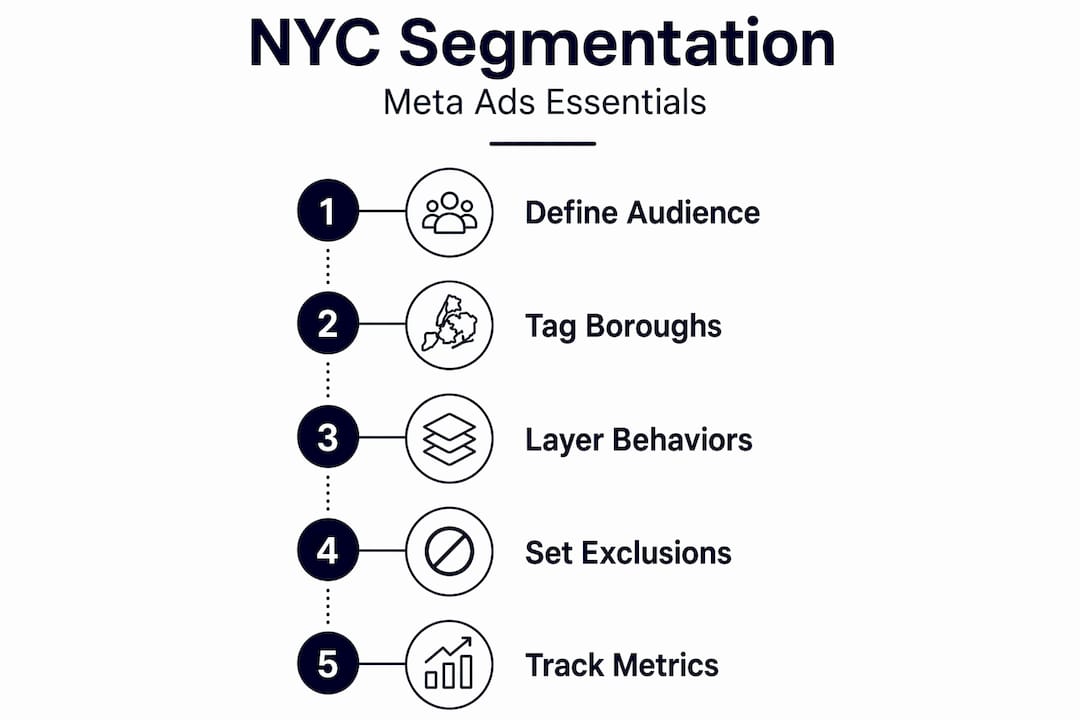
NYC is not one market. It is five boroughs, dozens of distinct neighborhoods, and wildly different income levels and lifestyle patterns within a single ZIP code. A plumbing company targeting all of Brooklyn with one ad set is wasting impressions on Red Hook warehouse districts when their sweet spot is Park Slope homeowners. A financial advisor in Midtown may only realistically serve clients within a 3-mile radius due to commute patterns and local trust preferences.
| Targeting approach | Best use case | NYC-specific risk |
|---|---|---|
| City-wide (all of NYC) | Brand awareness campaigns | Very high CPMs, tourist waste |
| Borough-level | Mid-funnel, service awareness | Still broad; income variance high |
| ZIP code clusters | Lead generation, local services | Over-fragmentation kills scale |
| Radius (1-3 miles) | Hyperlocal services, walk-in traffic | May miss adjacent high-value areas |
| Custom + Lookalike | Retargeting, scaling proven audiences | Requires clean, updated CRM data |
Common segmentation mistakes NYC service businesses make:
- Targeting all of NYC to "maximize reach" without filtering for residents
- Duplicating ad sets across overlapping ZIP codes, which inflates frequency and costs
- Ignoring the tourist and commuter population that skews your data
- Using interest targeting alone without layering in behavioral qualifiers
- Building custom audiences from stale CRM data, which tanks match rates
For NYC Meta Ads tips that go beyond the basics, the combination of location precision and behavioral layering is where real efficiency lives. Custom and lookalike audiences built from your own CRM data consistently improve performance for service businesses, especially when refreshed monthly to maintain 60-80% match rates.
Preparing your data and defining your ideal customer
Before launching segmentation, you need to ensure your own audience data is complete and up-to-date.
Your CRM is your most valuable asset in Meta Ads. The quality of your custom audiences depends entirely on the quality of the data you feed into Meta's system. Incomplete or outdated records produce low match rates, which means Meta struggles to find the right people and your lookalike audiences become less accurate.
The most important data fields for high match rates:
- Email address (primary identifier, highest match weight)
- Phone number (strong secondary identifier, especially mobile)
- First and last name (helps Meta cross-reference profiles)
- City and ZIP code (critical for NYC neighborhood accuracy)
- Customer value or segment tag (helps you build tiered lookalikes)
Here is an example of how a fictional NYC home services company might structure their CRM export before uploading to Meta:
| Field | Example value | Quality standard |
|---|---|---|
| jane.doe@email.com | Lowercase, no spaces | |
| Phone | +12125550192 | E.164 format with country code |
| First name | Jane | No titles or suffixes |
| Last name | Doe | No special characters |
| ZIP code | 11215 | 5-digit format |
| Customer tier | High-value | Internal tag for segmentation |
Step-by-step process for cleaning and preparing your data:
- Export your full CRM contact list and remove duplicate entries based on email and phone.
- Standardize all phone numbers to E.164 format (+1XXXXXXXXXX for US numbers).
- Convert all email addresses to lowercase to avoid formatting mismatches.
- Remove contacts with missing email AND missing phone, as Meta cannot match them.
- Segment your list by customer value, recency of purchase, or service type before uploading.
- Save the file as a UTF-8 encoded CSV to prevent character errors during upload.
- Upload to Meta Audiences Manager and review the estimated match rate before activating.
NYC has a notoriously transient population. People move between boroughs, relocate out of state, and change contact details frequently. A list you built 18 months ago may have a match rate below 40%, which severely limits your custom audience size and the quality of any lookalike built from it. Refreshing your data monthly keeps match rates in the 60-80% range that drives real performance.
Pro Tip: Segment your CRM upload into at least three tiers: high-value customers, one-time buyers, and leads who never converted. Build separate lookalike audiences from each tier. Your high-value lookalike will almost always outperform a blended list, and it gives you a clear signal for budget allocation. You can explore more about audience data insights to build this tiered approach effectively.

Executing geographic and behavioral targeting in Meta Ads for NYC
Now, with data and persona defined, let's translate that into efficient, real-world segmentation with Meta's targeting tools.
Setting up your geographic and behavioral targeting correctly is where theory becomes results. Here is a step-by-step approach built for NYC service businesses.
Step-by-step geographic targeting setup:
- Open Meta Ads Manager and navigate to the audience section of your ad set.
- Set location to "United States" and then add specific cities, ZIP codes, or drop a pin with a radius.
- For borough-level targeting, input the primary ZIP codes for your target borough rather than selecting the borough name, which is less precise.
- Choose "people living in this location" to exclude tourists and recent visitors.
- If you serve multiple boroughs, create separate ad sets per borough rather than combining them. This lets you control budget and messaging independently.
- Layer a radius (1-3 miles) around your business address for hyperlocal campaigns targeting walk-in or same-day service customers.
Behavioral targeting for NYC service sectors:
Meta's behavioral categories are particularly useful for service businesses. For a home services company, layer in "homeowners" under the housing category. For a financial services firm, add "small business owners" or income brackets above $75K. For a health and wellness provider, combine neighborhood ZIP targeting with interest categories like "fitness" or "preventive health."
The targeting options available through Meta allow you to stack these behavioral filters on top of your geographic base, which narrows your audience to people who are both in the right place and in the right mindset.
"Reducing ZIP over-segmentation in NYC decreased CPL by 32% and increased CTR by 51%."
This result is not theoretical. A real NYC case study in higher education showed that CPL dropped from $161 to $109 by moving away from granular ZIP-by-ZIP targeting and instead using broader geographic zones combined with interest and behavioral filters. The audience size increased enough for Meta's algorithm to optimize effectively, and the cost savings were immediate.
Pro Tip: When you tighten geography, you risk shrinking your audience below Meta's recommended threshold of 100,000 people for effective optimization. Instead of adding more ZIP codes to compensate, layer on behavioral and interest qualifiers. This keeps your audience focused without starving the algorithm. For more on this approach, review creative testing strategies that pair well with tighter geographic targeting.
Monitoring, optimizing, and benchmarking for NYC success
Having launched segmented ads, it's crucial to measure and adjust your strategy for ongoing results in a competitive NYC landscape.
Segmentation does not end at setup. The real work is in reading your data, comparing it against reliable benchmarks, and making disciplined adjustments every week.
The essential KPIs to track for NYC service businesses:
- CPA (Cost Per Acquisition): What you pay for each new customer or lead. Your north star metric.
- CPM (Cost Per Thousand Impressions): Reflects how competitive your audience is. NYC CPMs run high.
- CTR (Click-Through Rate): Indicates how well your creative resonates with the audience you've built.
- ROAS (Return on Ad Spend): Revenue generated per dollar spent. Target 3x or higher for service businesses.
- CVR (Conversion Rate): The percentage of clicks that become leads or customers. Reveals landing page and offer quality.
NYC-specific performance expectations:
The median Meta benchmarks across industries are CPA of $38.17, CPM of $13.48, ROAS of 1.93x, and CVR of 1.57%. In NYC, expect every one of those numbers to be harder to hit. CPMs alone run at least 20% above the US median in competitive NYC markets, meaning you pay more just to show your ad.
Stat callout: NYC CPMs are typically 20%+ above the U.S. median, making audience precision a direct cost-control lever.
That premium makes segmentation not just a performance strategy but a financial necessity. Every wasted impression in a high-CPM environment costs more than it would in a lower-competition market.
How to use test results to refine your segmentation:
- Run A/B tests on audience segments every two weeks. Compare borough-specific ad sets against each other.
- Use Meta's audience overlap tool to identify and eliminate duplicate targeting between ad sets.
- Build exclusion lists from recent converters, existing customers, and low-quality lead segments to stop paying for people who already bought or who never will.
- Rotate creative every 10-14 days to combat ad fatigue, which hits faster in NYC's high-frequency ad environment.
- Monitor frequency. If your frequency exceeds 3.0 within a week, your audience is too small or your budget is too high for that segment.
Consistent creative testing and disciplined exclusions are how NYC service businesses push toward 3-6x ROAS in competitive verticals. It is not one big optimization. It is a series of small, data-driven improvements compounding over time. Check your Meta ad performance benchmarks regularly to stay calibrated against what's achievable in your specific service category.
The overlooked keys to winning NYC Meta ad segmentation
With metrics in hand, experience points the way to continuous improvement most guides overlook.
Most articles on Meta Ads segmentation stop at the setup phase. They tell you to use custom audiences, pick the right interests, and monitor your KPIs. That advice is correct but incomplete. What actually separates businesses that get marginal results from those that scale efficiently in NYC is something we call the "NYC velocity effect."
NYC neighborhoods change faster than anywhere else in the country. A neighborhood that was price-sensitive 18 months ago may now be gentrifying rapidly, shifting the income profile of your audience. A creative that resonated with Astoria residents in Q1 may feel stale and irrelevant by Q3 as local trends shift. Stale data and stale creative get punished faster in NYC because the market moves faster.
"In NYC, creative iteration and disciplined exclusions often outperform the fanciest audience models."
We have seen this repeatedly. A client with a moderately segmented audience but fresh, locally relevant creative consistently outperforms a client with a technically perfect audience model running the same creative for three months. The algorithm rewards engagement signals, and engagement drops when creative ages.
The second overlooked key is proactive exclusions. Most advertisers build inclusion lists carefully and ignore exclusions entirely. In NYC, where your ad can reach the same person across multiple overlapping ad sets, exclusions are a cost-control mechanism. Build exclusions for recent purchasers, current customers, and people who have already converted on a specific offer. This alone can reduce wasted spend by 15-25% in a mature campaign.
The hard-won lesson is simple: review every ad set every two weeks. Double down on what is working by increasing budget incrementally (no more than 20% at a time to avoid resetting the learning phase). Sunset what is not working without sentiment. NYC rewards discipline and speed, not loyalty to underperforming creative or audiences.
For advanced Meta ad insights on how to build this iterative optimization system, the combination of creative rotation schedules, exclusion list management, and benchmark-driven performance reviews is the framework that drives consistent results in this market.
Ready to turn NYC segmentation into real growth?
Audience segmentation on Meta is one of the highest-leverage activities a NYC service business can invest in, but it requires consistent execution, clean data, and a deep understanding of how this city's market behaves differently from anywhere else.
Manifestera specializes in exactly this. As NYC digital advertising experts, we build granular, borough-level audience strategies for service businesses across every vertical, combining AI-powered audience modeling, CRM-driven custom audiences, and real-time performance dashboards. We do not run generic campaigns. We build systems tailored to how your specific customers move through NYC and how they make decisions. If you are ready to stop guessing and start scaling, reach out to Manifestera for a tailored strategy session built around your market, your data, and your growth goals.
Frequently asked questions
What is the best way to target only NYC residents with Meta Ads?
Use "people living in this location" combined with borough or radius targeting to prioritize actual residents over tourists and commuters. This targeting setting is the single most effective filter for NYC service businesses running lead generation campaigns.
How often should I refresh my custom audience data for best results?
Refresh your CRM-driven custom audience data every month to maintain match rates above 60%. NYC's high population turnover means monthly refreshes are more critical here than in most other US markets.
What are typical Meta Ads costs and results for NYC service businesses?
Expect CPMs and costs per lead running at least 20% above the US average, with median ROAS around 1.93x as a baseline. Well-optimized service campaigns in NYC can reach 3-6x ROAS with disciplined segmentation and creative testing.
Is interest or ZIP code targeting more effective for NYC service providers?
Combining interest and behavioral targeting with broader ZIP or radius zones consistently produces lower cost per lead than micromanaging individual ZIP codes. Over-segmenting by ZIP shrinks your audience and limits Meta's ability to optimize efficiently.