

Having a website does not mean customers can find you. That is the core truth behind NYC business online visibility explained properly. Thousands of small businesses across the five boroughs have functional websites and still lose customers to competitors with better Google rankings, more complete profiles, and more location-specific content. 46% of all Google searches carry local intent, which means a massive share of your potential customers are searching right now for exactly what you offer. The question is whether your business shows up when they do.
Table of Contents
- Key Takeaways
- NYC online visibility explained: the core components
- Hyper-local keywords and borough-level content
- Making your Google Business Profile work harder
- Web accessibility as an SEO and legal requirement
- A practical roadmap for improving online visibility
- My honest take on NYC visibility challenges
- How Manifestera helps NYC businesses get found
- FAQ
Key Takeaways
| Point | Details |
|---|---|
| A website alone is not enough | You need active local SEO, a complete Google Business Profile, and location-specific content to get found. |
| Neighborhood-level keywords win | Generic city keywords underperform; targeting specific boroughs and neighborhoods drives higher-converting traffic. |
| GBP activity affects rankings | Regular posts, photos, and review responses on your Google Business Profile directly influence your Map Pack position. |
| Accessibility is both legal and strategic | WCAG 2.1 Level AA compliance reduces lawsuit risk and improves your search engine performance simultaneously. |
| Paid ads accelerate organic efforts | Running Google Ads alongside SEO captures immediate demand while your organic rankings build over time. |
NYC online visibility explained: the core components
Online visibility means your business appears when a potential customer searches for what you sell in a location near you. For NYC businesses, that definition gets much more specific. You are not just competing nationally. You are competing against every similar business in your borough, your neighborhood, and sometimes your block.
Three components form the foundation of local online visibility:
- Local SEO: This is the practice of optimizing your website so search engines understand where you are and who you serve. It includes technical elements like NAP (Name, Address, Phone number) consistency across all directories, mobile page speed, structured data markup (also called schema), and location-specific page content. Local SEO differs from general SEO because proximity and relevance to the searcher matter far more than domain authority alone.
- Google Business Profile (GBP): GBP is often more critical than your website for local discovery. It powers the Map Pack, the three-business listing that appears above organic results on most local searches. An unclaimed or inconsistently maintained profile hands that real estate to your competitors.
- Content marketing: Publishing content that demonstrates local knowledge is one of the fastest ways to build authority with Google. Strategic local content can boost organic traffic by up to 300%, according to research focused specifically on NYC markets. Google's algorithm rewards content that shows Experience, Expertise, Authoritativeness, and Trustworthiness. Locals know things outsiders do not, and that knowledge can be a genuine competitive advantage in content.
97% of consumers search online before hiring a local service. That number alone should reshape how you think about every dollar you invest in your business. If your digital presence is weak, the majority of potential customers never even reach your door.
Pro Tip: Set up Google Search Console for free and connect it to your website. It shows you exactly which search queries are bringing people to your site, and more importantly, which searches your site appears for but is not getting clicks. That gap is where your next content opportunity lives.
Hyper-local keywords and borough-level content
Most NYC business owners make the same early mistake: targeting "best plumber New York City" or "top restaurant NYC" as their main keywords. These phrases are not wrong, but they are extremely competitive and often attract the wrong audience. A customer in Astoria, Queens is not looking for a plumber in Staten Island.
Long-tail keywords with specific local intent have lower search volume but dramatically higher conversion rates. Someone searching "emergency HVAC repair Williamsburg Brooklyn" is ready to call. Someone searching "HVAC repair NYC" may just be browsing.
Here is how to build a hyper-local keyword strategy that actually works:
- Map your service areas by neighborhood and borough. If you serve multiple neighborhoods, you need a page or post for each one. A law firm with clients in both the Bronx and Brooklyn should have separate location pages targeting each borough with unique, non-duplicate content.
- Use neighborhood-specific modifiers. Terms like "near Prospect Park," "in the Financial District," or "serving Flushing, Queens" give your content specificity that broad city terms cannot match.
- Research what local customers actually ask. Tools like Google's autocomplete, the "People Also Ask" section in search results, and forums like Reddit's NYC-specific communities reveal the real language your customers use.
- Create content clusters. A pillar page might cover "home renovation services in Brooklyn" broadly. Supporting posts then go deep on specific services in specific neighborhoods. These link back to the pillar page, building topical authority that tells Google you are the definitive local resource on this topic.
- Reference local landmarks and community context. A post about catering services that mentions specific venues in your neighborhood, local events, or well-known community organizations reads as authentically local to both search engines and human visitors.
Your NYC digital marketing strategy should treat each borough almost like a separate market, because for search purposes, it often is.
Making your Google Business Profile work harder
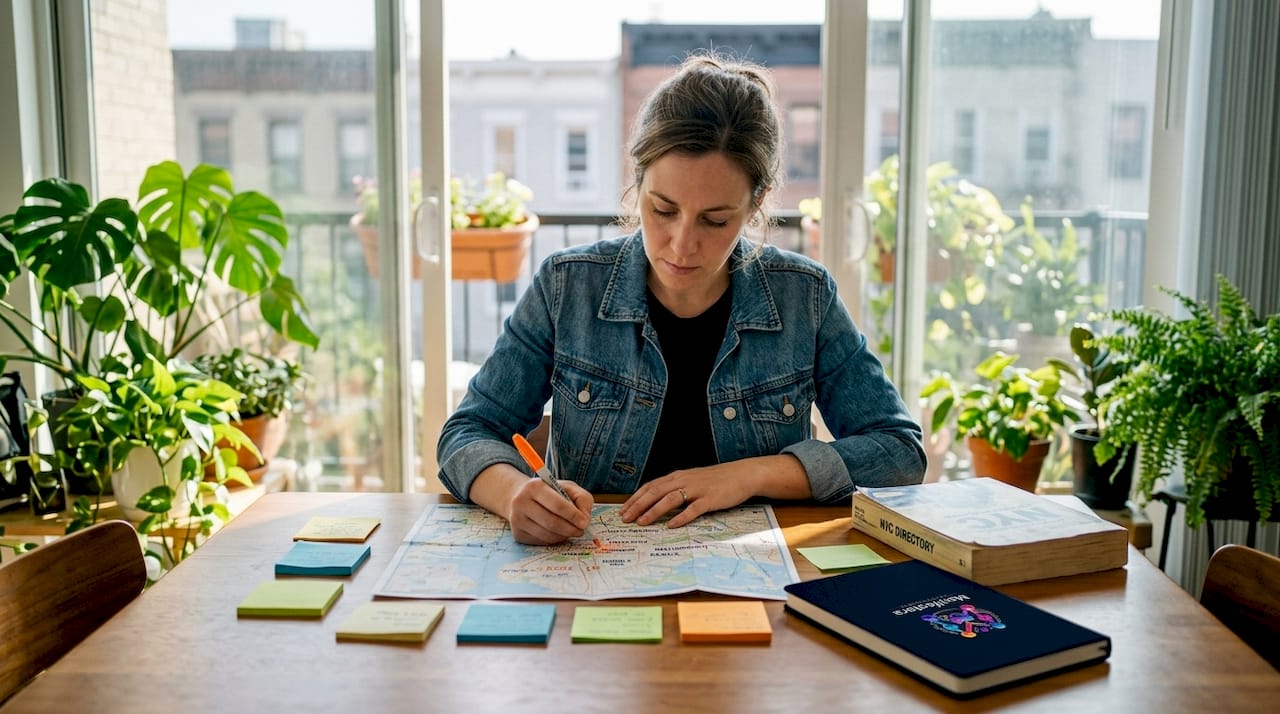
Between 76% and 88% of consumers who search for a local business on their smartphone visit that business within 24 hours. Your Google Business Profile is frequently the first and only thing those customers see before they decide whether to contact you. Treating it as a one-time setup is one of the most common NYC small business online visibility mistakes there is.
Here is what an active, well-optimized GBP looks like in practice:
- Accurate NAP data at all times. Your business name, address, and phone number must match exactly across your website, GBP, and every directory listing. Even minor inconsistencies like "St." versus "Street" confuse Google's location signals.
- Photos and videos updated regularly. Businesses with photos receive significantly more direction requests and website clicks than those without them. Post interior shots, exterior shots, team photos, and product images. Update them seasonally.
- Customer reviews, requested and managed. Ask satisfied customers directly to leave a Google review. Respond to every review, positive or negative, professionally and within 48 hours. Your responses are public, and how you handle criticism says more to prospective customers than the complaint itself.
- GBP posts used consistently. The posts feature inside GBP functions like a mini social feed. Use it for seasonal promotions, new product announcements, community events you sponsor, or timely local updates. Posts keep your profile active, which correlates with stronger Map Pack rankings.
- Categories and attributes set correctly. Choose your primary category carefully. It carries the most weight in determining which searches trigger your profile. Add every relevant secondary category and fill in all available attributes like "women-owned," "outdoor seating," or "serves dine-in."
Pro Tip: After you add new photos or post an update to your GBP, click through to your profile on both desktop and mobile to see what customers actually see. Profiles display differently across devices, and catching a formatting issue before thousands of people see it takes two minutes.
Web accessibility as an SEO and legal requirement
This is the section most NYC business owners skip, and it is the one that can cost them the most. About 64% of web accessibility lawsuits target small businesses specifically. New York courts have been particularly active in enforcing the Americans with Disabilities Act as it applies to websites, with hundreds of cases filed annually in the Southern District of New York alone.
WCAG 2.1 Level AA is the accessibility standard that courts and regulators most commonly reference. It covers a range of requirements:
- All images must have descriptive alt text so screen readers can interpret them
- Videos must include captions
- Your site must be navigable by keyboard alone, without a mouse
- Color contrast between text and background must meet minimum ratios
- Forms must have clearly labeled fields with accessible error messages
"Accessible websites are easier for search engines and assistive technology to process." — Website accessibility small business research
This matters for visibility because Google's crawler essentially reads your site the way a screen reader does. Using tools like WAVE to audit your site identifies accessibility failures that frequently overlap with SEO problems: missing alt text hurts image indexing, poor heading structure hurts content parsing, and slow load times created by unoptimized media hurt both users with disabilities and your Core Web Vitals score. Fixing accessibility issues often delivers an immediate and measurable SEO lift.
A practical roadmap for improving online visibility
You do not need to do everything at once. What you do need is a logical sequence so your effort compounds rather than scatters.
| Tactic | Primary Benefit | Effort Level |
|---|---|---|
| Audit and fix NAP consistency | Improves local search trust signals | Low |
| Claim and complete GBP | Captures Map Pack real estate | Low |
| Conduct hyper-local keyword research | Targets high-conversion searches | Medium |
| Publish borough/neighborhood content | Builds local topical authority | Medium |
| Fix accessibility issues | Reduces legal risk, improves SEO | Medium |
| Run Google Ads for priority services | Generates immediate leads | Medium/High |
| Build review generation system | Boosts trust and GBP rankings | Ongoing |
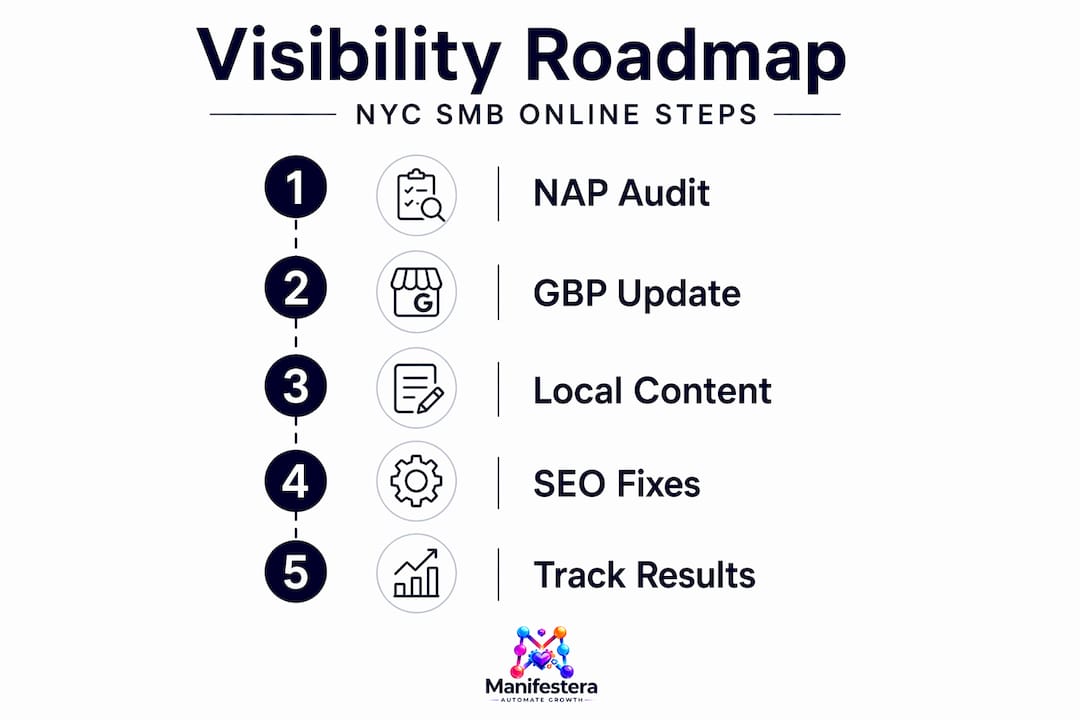
Start with the audit. Check your website, GBP, and major directory listings (Yelp, Bing Places, Apple Maps) for NAP consistency. A mismatch that has existed for two years is still actively working against you. Fix it before spending money on anything else.
Next, prioritize your GBP. High-quality content and crawlable sitemaps are what allow you to surface in both traditional and AI-driven search results. Your GBP is the single fastest local visibility win available to most NYC small businesses because the barrier to entry is low and the impact is immediate.
From there, build your content with local intent at its core. Answer the questions your neighborhood customers are actually asking. Create essential website pages that cover your services by location, include customer testimonials with location context, and establish your credibility with Google's E-E-A-T criteria.
Paid advertising, specifically Google Ads, supplements your organic work while rankings build. Users trust organic results 75% more than paid ads, so paid should never fully replace SEO. However, for a new campaign or a new service offering, Google Ads gets you in front of buyers immediately while your organic presence catches up.
Pro Tip: Track every phone call and form submission that comes from your Google Business Profile separately from your website. GBP has its own analytics dashboard, and most business owners are shocked to see how many conversions come directly from their profile rather than their site. This data helps you prioritize where to invest time.
My honest take on NYC visibility challenges
I've worked with NYC small businesses long enough to see the same patterns repeat. Most owners understand that they need to "do SEO" but treat it as a task to check off rather than a system to maintain. They claim their GBP once, never touch it again, and wonder why a newer competitor with an active profile outranks them.
What I've found is that the businesses that win local search in NYC are not necessarily the ones with the biggest budgets. They are the ones that treat their digital presence the same way they treat their physical storefront: kept current, responsive to customers, and reflective of what makes them genuinely different.
The growing role of AI in search makes this even more pressing. Maintaining high-quality textual content is no longer just about ranking in the ten blue links. AI overviews, voice search, and generative search experiences all pull from structured, credible, locally-relevant content. If your site is thin, inconsistent, or inaccessible, you will be invisible in the next evolution of search, not just the current one.
My honest advice: commit to twelve months of consistent effort across GBP, local content, and technical SEO before judging the results. Businesses that do this consistently do not just improve their rankings. They build a digital asset that compounds in value over time.
— Manifestera
How Manifestera helps NYC businesses get found
Manifestera works exclusively with small and medium-sized businesses across New York City's boroughs, building the kind of locally-targeted digital presence that translates into real calls, bookings, and walk-ins. Whether you are a service business in Brooklyn, a retail shop in Manhattan, or a contractor working across multiple neighborhoods, the approach is the same: data-driven, neighborhood-specific, and built around what actually moves your revenue.
The agency's local SEO services cover everything from technical site audits and NAP correction to hyper-local content strategies and Google Business Profile management. For businesses that need immediate results alongside long-term growth, Manifestera also manages Google Ads campaigns calibrated for local intent and ROI. If you want a partner that understands your market and builds visibility that lasts, explore Manifestera's NYC-specific solutions to see what is possible for your business.
FAQ
What does online visibility mean for NYC businesses?
Online visibility means your business appears in search results, maps, and directories when local customers search for your products or services. For NYC businesses, this specifically includes ranking in the Google Map Pack, organic search results, and local directories.
How is local SEO different from regular SEO?
Local SEO focuses on proximity, NAP consistency, and location-specific content to rank in geographically relevant searches. Regular SEO targets broader rankings where location is not a primary factor.
Why is my Google Business Profile more important than my website?
For local discovery, your Google Business Profile often generates more calls and direction requests than your website does directly. GBP powers the Map Pack placement that appears before organic results, making it the first thing most mobile searchers interact with.
What are the biggest NYC small business online visibility mistakes?
The most common mistakes include inconsistent NAP data across directories, an inactive or unclaimed Google Business Profile, targeting broad city-level keywords instead of neighborhood-specific terms, and neglecting web accessibility compliance.
How long does improving online visibility in NYC take?
Technical fixes like NAP consistency and GBP optimization show results within weeks. Content-driven local SEO typically takes three to six months to build meaningful organic rankings, with results compounding as your topical authority grows.