
Running a small or mid-sized business in New York City means competing for attention in one of the most crowded markets on earth. Picking the wrong seasonal marketing campaigns NYC examples abound, but not every approach fits your budget, timeline, or neighborhood. This guide cuts through the noise. You will find a clear evaluation framework, real 2026 NYC campaign examples, a side-by-side comparison, and specific criteria to help you decide which approach will generate the strongest return for your business.
Table of Contents
- Criteria for selecting effective seasonal marketing campaigns in NYC
- Community-driven retail crawls boost local engagement and sales
- Experiential pop-ups create immersive brand connections
- Large retailers' year-long seasonal campaigns underscore omnichannel tactics
- Comparison of NYC seasonal marketing campaigns: community crawls, pop-ups, and retail spectacles
- Why early, data-driven, and community-focused campaigns win in NYC's complex market
- Boost your NYC seasonal campaigns with Manifestera's automated growth solutions
- Frequently asked questions
Key Takeaways
| Point | Details |
|---|---|
| Plan early strategically | Start seasonal campaign preparations 4-12 weeks in advance depending on event scale for best results. |
| Leverage community events | Neighborhood retail crawls with passport programs effectively boost local SMB engagement and sales. |
| Use data for personalization | Segment customers using purchase and intent data to deliver relevant seasonal offers improving ROI. |
| Incorporate experiential marketing | Pop-up events and immersive experiences create stronger brand connections than traditional ads. |
| Adopt omnichannel tactics | Continuous year-round activation with in-store and digital components maximizes seasonal campaign success. |
Criteria for selecting effective seasonal marketing campaigns in NYC
Before you look at any specific campaign, you need a filter. The best seasonal marketing campaigns NYC businesses run share a few non-negotiable traits.
Start your planning early. Preparing 4 to 6 weeks before major holidays and using data-driven personalized segmentation meaningfully improves campaign success rates. For larger events like Black Friday or a summer launch, push that window to 8 to 12 weeks. Late planning forces reactive decisions and kills margin.
Use customer data to segment your audience. Generic promotions waste ad spend. When you know which customers bought last Mother's Day, which ones respond to email versus SMS, and which zip codes drive your foot traffic, you can build messaging that actually converts. NYC's marketing strategy insights reinforce this point consistently: personalization at the neighborhood level outperforms broad city-wide blasts.
Here is a practical checklist for evaluating any seasonal campaign before you commit:
- Timing fit: Does the campaign launch at least 4 to 6 weeks before the seasonal moment?
- Audience relevance: Is it targeted to a defined customer segment, not the general public?
- Channel integration: Does it run across email, social, and in-store or online simultaneously?
- Intent alignment: Does the offer match what shoppers are actively seeking right now?
- Attribution setup: Can you track results beyond platform self-reports?
On that last point, shoppers seek quality, value, and relevance, and brands win by recognizing intent early with what Optimove calls "positionless marketing," meaning you meet customers where they are rather than pushing them through a fixed funnel.
Numbered steps to build your campaign evaluation process:
- Pull last year's sales data for the target season.
- Identify your top 3 customer segments by purchase behavior.
- Map each segment to a channel preference (email, Instagram, Google).
- Set a campaign budget with a clear cost-per-acquisition target.
- Install attribution tracking before the campaign launches, not after.
Pro Tip: If your attribution is only reading platform dashboards, you are likely double-counting conversions. Use a third-party attribution tool to get an accurate picture of which channel actually drove the sale.
With a solid evaluation framework in place, let's examine standout NYC seasonal marketing campaigns that exemplify these criteria.
Community-driven retail crawls boost local engagement and sales
One of the most underrated holiday marketing ideas NYC small businesses can use costs almost nothing to enter and delivers measurable foot traffic. Neighborhood retail crawls are exactly that.
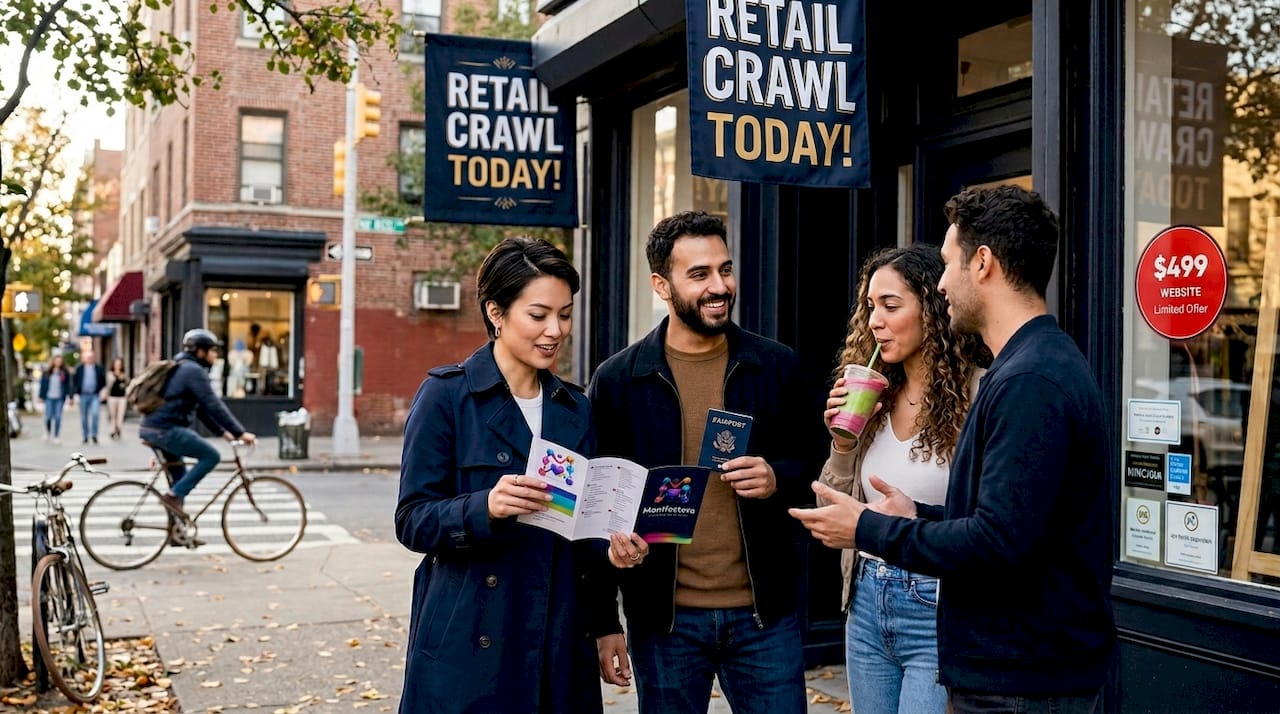
Greenpoint's Spring Retail Crawl doubled its participating businesses from 24 in 2022 to 45 in 2026, using passport-stamp programs and weekday-only discounts to drive consistent engagement. That is 87% growth in four years, built almost entirely on community coordination and low-cost incentive design.
The mechanics are simple and replicable:
- Shoppers receive a physical or digital "passport" and collect stamps at each participating store.
- Completing a set number of stamps unlocks tiered prizes: limited branded merchandise, gift bundles, or grand prize packages.
- Weekday-only discounts push traffic into slower business days, which benefits every merchant in the crawl.
- Nonprofit partnerships add a cause-aligned layer that motivates shoppers who respond to community giving.
"The crawl gives our shop visibility we could never afford on our own. Customers who have never walked through our door come in specifically because of the passport program." This kind of organic discovery is the cornerstone of community-based seasonal marketing.
Across the East River, Astoria's Spring Retail Crawl, now a decade old with 25 participating businesses, drives shopper engagement through collectible stamps redeemable for unique local prizes. A decade of consistency has made it a neighborhood institution, not just a marketing event.
What makes this model work for NYC seasonal promotional examples is the low barrier to entry. You pay a small participation fee, prepare your in-store offer, and immediately tap into the crawl's existing promotional infrastructure. The community does much of the marketing for you.
Pro Tip: If no crawl exists in your neighborhood, organize one. Start with 5 to 8 businesses, build a simple digital passport using a free QR code tool, and pitch a local nonprofit as your giving partner. Early-stage events scale fast when the community sees real prizes and real participation.
Having explored neighborhood-centric campaigns, let's consider how experiential pop-up events can create immersive seasonal marketing experiences.
Experiential pop-ups create immersive brand connections
Interactive seasonal marketing NYC brands have used pop-ups to turn a product launch into a cultural moment. Done right, a pop-up does not just sell. It creates a memory.
Cozeware's Spring Wishes campaign combined $50 to $80 discounts on ductless AC units with a TikTok pop-up activation in Union Square in March 2026. The brand used the physical event to demonstrate cooling products in real time while TikTok's platform amplified reach to a national audience. The result: product awareness and direct sales in a single activation.
Beetles Gel Polish's "Taste of Spring" event used multi-sensory manicure stations and tea service to convert customers effectively, with 2 to 3 months of planning behind it. The sensory pairing of beauty and hospitality created a dwell time that a standard retail environment cannot replicate.
Here is what both campaigns did right:
- Secured prime NYC locations at least 2 to 3 months in advance.
- Partnered with a trending platform (TikTok) or a lifestyle concept (tea service) to extend reach beyond the event itself.
- Offered exclusive event discounts that created urgency without permanently eroding price perception.
- Built social content into the experience so attendees became brand ambassadors.
Steps to plan your own pop-up:
- Identify your seasonal moment and lock in a location 10 to 12 weeks out.
- Choose one platform or media partner to amplify the event (TikTok, a local influencer, a neighborhood publication).
- Design one sensory element that makes the experience shareable.
- Create an exclusive offer available only at the event.
- Set up a post-event email capture to convert attendees into repeat customers.
Pro Tip: Your pop-up location matters more than your booth design. Union Square, the Meatpacking District, and Williamsburg's Bedford Avenue all draw high foot traffic with distinct demographics. Match the location to your target customer, not just to availability.
From experiential events, we turn next to how large-scale NYC department stores integrate multifaceted seasonal marketing for continuous consumer engagement.
Large retailers' year-long seasonal campaigns underscore omnichannel tactics
You do not need Macy's budget to learn from Macy's playbook. The best seasonal campaigns NYC retailers run at scale reveal principles that translate directly to smaller operations.
Macy's 51st Flower Show, themed "Homegrown," featured large floral installations, a Valentino Beauty collaboration, and dedicated Mother's Day events across its Herald Square flagship. The campaign blended in-store experience, luxury brand partnerships, and a major holiday anchor to drive omnichannel growth.
The more instructive move, though, came from Macy's broader strategy. Macy's CEO noted that weekly "Celebration Saturdays" featuring styling sessions and product demos extend cultural visibility beyond biannual events while reducing discount reliance. That last part matters. Less discounting, more experience.
Shifting from price-led promotions to experience-led marketing protects your margin while building the kind of loyalty that survives a competitor's sale.
Key tactics from this approach that NYC SMBs can adapt:
- Anchor to a major holiday but extend the campaign window by 2 to 3 weeks on either side.
- Partner with a complementary brand to share costs and audiences.
- Create a recurring weekly event (a demo, a class, a tasting) that gives customers a reason to return without a discount.
- Curate limited-edition merchandise tied to the seasonal theme to drive urgency.
- Track in-store dwell time alongside sales data to measure experiential impact.
With these exemplary campaigns covered, compare features side-by-side to help you identify the best seasonal marketing approach.
Comparison of NYC seasonal marketing campaigns: community crawls, pop-ups, and retail spectacles
Understanding these differences is where the seasonal e-commerce campaign NYC guide gets practical. Use this table to match your resources to the right format.
| Campaign type | Cost level | Lead time needed | Best season | Primary benefit | Key challenge |
|---|---|---|---|---|---|
| Community retail crawl | Low | 4 to 6 weeks | Spring, fall | Local foot traffic, community trust | Requires neighbor coordination |
| Experiential pop-up | Medium | 8 to 12 weeks | Spring, summer | Brand awareness, social buzz | Location and logistics complexity |
| Omnichannel retail spectacle | High | 12 to 16 weeks | Year-round | Brand loyalty, omnichannel reach | Substantial budget and team required |
What this table tells you: if you are a single-location retailer in Astoria or Greenpoint, the crawl is your highest-ROI entry point. If you have a product that benefits from demonstration and you can secure a strong location, a pop-up delivers disproportionate awareness per dollar spent. The omnichannel spectacle is aspirational for most SMBs, but its principles (recurring events, brand partnerships, experience over discounts) are fully portable.
Factors to weigh when choosing your format:
- Your team's capacity: Pop-ups require event management skills. Crawls require community relationship-building.
- Your product type: Physical, sensory products (beauty, food, home goods) perform best in experiential formats.
- Your existing audience size: A crawl builds a new audience. A pop-up rewards and expands an existing one.
- Your margin structure: If your margins are thin, avoid deep discount campaigns. Focus on experience-led formats that protect price integrity.
Understanding these comparisons prepares you to choose the right seasonal campaign tailored to your NYC business goals.
Why early, data-driven, and community-focused campaigns win in NYC's complex market
Here is the uncomfortable truth most marketing guides skip: the majority of NYC small businesses that run seasonal campaigns fail not because their creative is weak, but because they start too late and measure too little.
We have seen businesses launch Black Friday campaigns in the third week of November. By then, the ad auction is flooded, CPMs (cost per thousand impressions) are at their seasonal peak, and your best customers have already committed their budgets to brands that reached them in October. Starting 8 to 12 weeks out is not conservative. It is the minimum for a competitive campaign.
The second failure point is attribution. Most SMBs rely entirely on what Google or Meta tells them about campaign performance. Those platforms have a structural incentive to show you impressive numbers. Attribution beyond platform self-reports lets SMBs optimize budgets and grow sales with better channel data integration. When you install a third-party attribution tool 60 to 90 days before your season peaks, you enter the campaign with clean baseline data and the ability to shift spend dynamically as results come in.
The third factor is community. NYC is not one market. It is dozens of hyper-local markets stacked on top of each other. A campaign that resonates in Park Slope may fall flat in Jackson Heights. Embedding local partnerships, neighborhood causes, and recognizable community figures into your seasonal messaging is not just good optics. It is the mechanism that makes your campaign feel relevant rather than generic. Use AI-powered segmentation to personalize seasonal messaging based on purchase history and intent signals, then layer in marketing data optimization tips to refine targeting by neighborhood and behavior.
Finally, resist the discount spiral. The brands that win long-term in NYC's competitive SMB landscape are the ones that train customers to value the experience, not the price drop.
Boost your NYC seasonal campaigns with Manifestera's automated growth solutions
Knowing which campaign type fits your business is only half the equation. Executing it with the right timing, targeting, and attribution is where most SMBs leave money on the table.
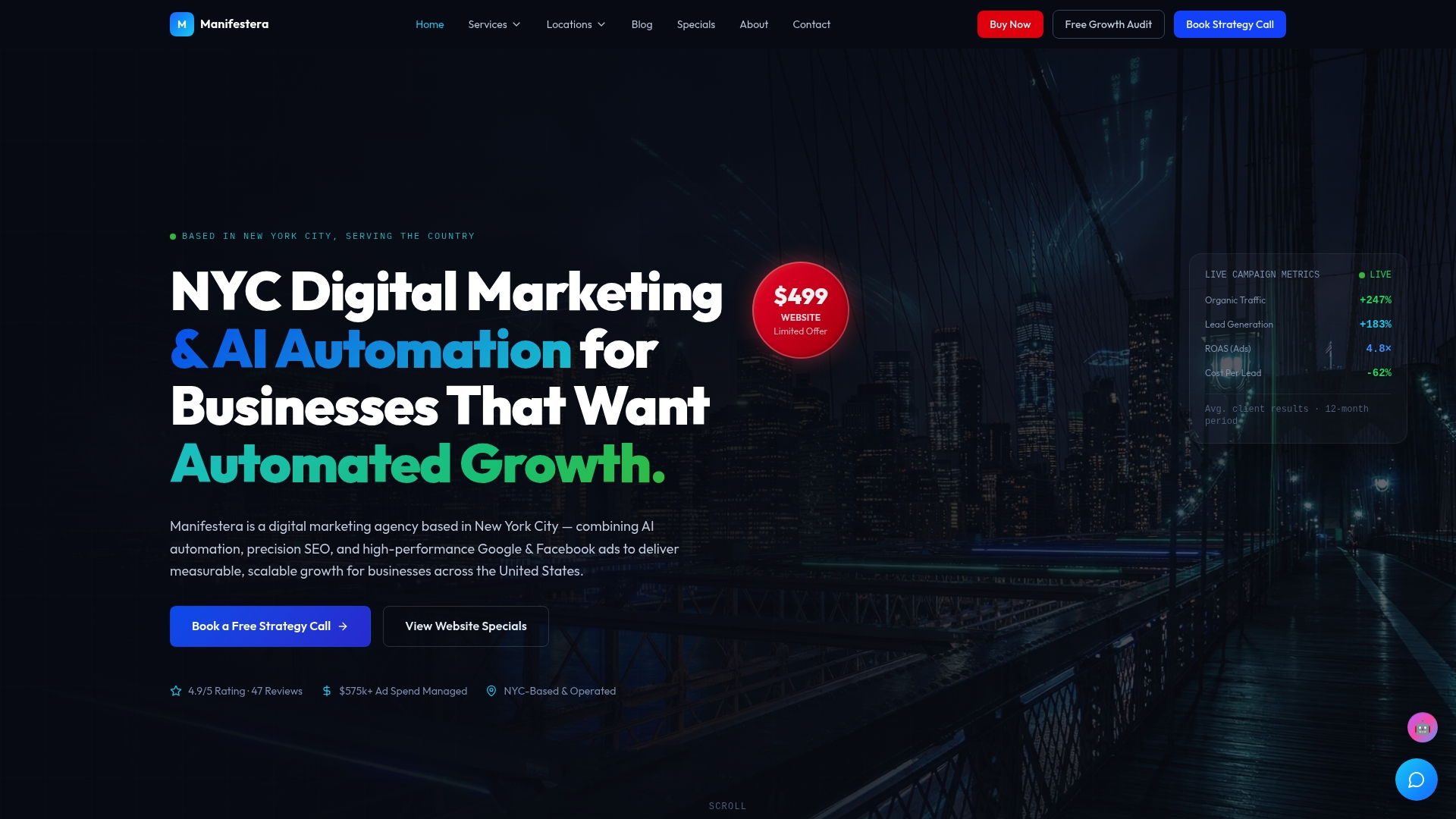
Manifestera is a digital marketing agency NYC businesses rely on for exactly this kind of execution. Their AI-powered automation handles audience segmentation, ad management across Google and Facebook, and real-time attribution so you always know which channel is driving results. Right now, Manifestera offers a $499 website special that gives you a fully optimized digital foundation to launch your next seasonal campaign from. Their NYC-specific market expertise means your campaigns are built around local consumer behavior, not generic national templates. If you are ready to stop guessing and start growing, this is the right next step.
Frequently asked questions
What are effective seasonal marketing strategies for NYC small businesses?
Community retail crawls, experiential pop-ups, and omnichannel campaigns tailored to local demographics and timed well in advance are proven effective in NYC. Greenpoint and Astoria retail crawls show that even low-budget, community-organized events significantly boost SMB engagement and foot traffic.
How far in advance should NYC SMBs plan seasonal marketing campaigns?
Plan at least 4 to 6 weeks out for medium campaigns and 8 to 12 weeks out for major events like Black Friday. Major campaigns require this extended runway to ensure creative, inventory, and ad spend are all ready before competition peaks.
What role does data-driven marketing play in seasonal campaign success?
Data-driven segmentation and attribution let you send personalized messages and allocate budget to channels that actually convert. Brands win by recognizing intent early with positionless marketing, and using attribution tools improves channel spend decisions that can drive up to 76% sales growth.
How can small businesses leverage NYC community events for marketing?
Participating in or organizing neighborhood retail crawls with passport programs and prizes builds engagement, foot traffic, and brand visibility at low cost. Community retail crawls in Greenpoint and Astoria consistently increase local sales and introduce participating businesses to entirely new customer segments.
What is the most budget-friendly seasonal marketing tactic for NYC SMBs?
Neighborhood retail crawl participation is the most cost-effective tactic with strong local ROI. Greenpoint's crawl grew 87% since 2022 by using weekday-only discounts and community donation tie-ins, proving that community coordination beats paid media spend at the local level.