

Most businesses assume referral marketing automation is just a fancy way to schedule email blasts asking customers to spread the word. It is not. What is referral marketing automation, really? It is an end-to-end system that handles referral link creation, prospect tracking, reward delivery, and performance reporting automatically, without manual intervention at each step. When configured correctly, it turns your happiest customers into a self-sustaining acquisition channel. This guide breaks down exactly how it works, what tools you need, and how to avoid the most common mistakes that waste budget and trust.
Table of Contents
- Key takeaways
- What referral marketing automation actually means
- How automated referral programs work in practice
- The real benefits of referral marketing automation
- Common pitfalls and best practices
- How to choose and implement referral marketing software
- My take on referral automation (and where most businesses go wrong)
- Ready to automate your referral growth?
- FAQ
Key takeaways
| Point | Details |
|---|---|
| Automation replaces manual tracking | Software handles link generation, CRM routing, reward issuance, and reporting without human error. |
| Timing drives conversion | Triggering referral asks right after positive customer events consistently outperforms generic scheduled requests. |
| AI improves lead quality | CRM-integrated AI identifies the best moment to prompt a referral, increasing both volume and quality. |
| Fraud detection is non-negotiable | Building fraud prevention into your program from day one protects ROI and maintains customer trust. |
| Software selection determines success | Choosing between plug-and-play and API-first solutions depends on your business size and integration needs. |
What referral marketing automation actually means
Referral marketing automation is the practice of using software to run every step of a referral program without requiring your team to manually track who referred whom, what reward was earned, or whether a conversion qualified. Think of it as a closed-loop pipeline: a customer gets a unique referral link, shares it, and the system tracks every click, signup, and purchase tied to that link. When a qualifying conversion happens, the software triggers the reward automatically. No spreadsheets. No chasing down support tickets.
The four core components that define a true referral automation system are:
- Referral link generation: Each participant receives a unique, trackable URL tied to their identity in the CRM.
- Behavior-triggered communications: Emails, in-app messages, or SMS invitations fire based on specific customer actions, not a generic calendar schedule.
- Reward delivery: Coupons, gift cards, cash, or account credits are issued automatically once conversions are confirmed and validated.
- Real-time reporting: Dashboards surface metrics like referral velocity, conversion rates, and reward costs without manual exports.
Referral automation eliminates manual tracking errors and enables real-time reward issuance, replacing guesswork with consistent rule-based processing. That consistency is what builds trust with your referring customers. They know that if they send someone your way, the reward will arrive on time, every time.
Pro Tip: Before evaluating any referral marketing software, map out every manual step your team currently performs in your referral process. That list becomes your automation checklist.
How automated referral programs work in practice
Understanding referral systems at a conceptual level is useful, but seeing the step-by-step flow is where the mechanics click. Here is how a modern automated referral program runs from start to finish:
- Enrollment trigger: A customer completes a qualifying action, such as a first purchase or subscription activation, and the system automatically enrolls them in the referral program.
- Referral link creation: Software generates a unique tracking URL tied to that customer's CRM profile and delivers it via email or in-app notification.
- Sharing and tracking: The customer shares their link. Every click, page visit, and resulting action is logged in real time against their referral record.
- Conversion qualification: When a referred prospect completes the desired action, the system checks it against predefined rules, such as minimum order value or geographic eligibility, before flagging it as a valid conversion.
- Reward issuance: Once the conversion clears validation, the system triggers the reward automatically: a discount code, account credit, or digital gift card lands in the referrer's inbox without any human approval required.
- Fraud review: Automated fraud detection flags suspicious patterns, like self-referrals or duplicate accounts, before rewards are paid out.
- Reporting update: The dashboard updates in real time, giving you full visibility into which customers drive the most referrals, which channels convert best, and what your cost per acquisition looks like.
The role of CRM integration here is significant. AI agents analyzing CRM data can determine the optimal timing for referral requests, improving both lead quality and conversion rates. A customer who just left a five-star review is a far better referral candidate than one who emailed support with a complaint last week. The system knows the difference and acts accordingly.
Pro Tip: Connect your referral platform to your CRM before launching. Programs with AI and CRM integrations achieve faster speed-to-contact and higher conversion rates because response times drop dramatically.

The real benefits of referral marketing automation
The business case for automation goes well beyond saving your team time on manual follow-ups. The numbers tell a compelling story.
| Benefit | Impact |
|---|---|
| Revenue growth | Brands with automated referral campaigns see 86% revenue growth year-over-year |
| Conversion rate lift | Post-purchase triggers increase referral conversions by 4-12% |
| Operational savings | Automation eliminates manual tracking, reducing staff time and human error significantly |
| Trust and reliability | Consistent rule-based reward delivery builds referrer confidence and repeat participation |
What separates automation from manual referral programs is precision. Sending a referral invitation two minutes after a successful purchase, when a customer's enthusiasm is at its peak, produces results that a weekly batch email never will. Timely referral prompts after positive events outperform generic scheduled requests by a wide margin, and that gap is nearly impossible to close without automation.
"Automation ensures rewards are issued consistently and referral journeys tracked in real-time, reducing human error and building trust with every participant." — ReferralCandy
Fraud prevention is another underappreciated financial benefit. When reward delivery is rule-based and validated, bad actors cannot game the system manually. This protects your campaign budget and ensures that every dollar spent on rewards goes to a genuinely earned conversion.
Common pitfalls and best practices
Plenty of businesses launch an automated referral program and see underwhelming results. The problem is rarely the software. It is usually one of these avoidable mistakes:
- Skipping fraud detection setup: Most businesses overlook fraud detection from the start, which leads to reward abuse and eroded ROI. Set up validation rules before your first referral link goes live, not after you notice suspicious activity.
- Using generic timing: Sending referral invitations on a fixed weekly schedule ignores where each customer is in their journey. Behavior-triggered invitations, fired after a purchase, renewal, or glowing review, convert far better than calendar-based blasts.
- Ignoring referral velocity as a metric: Most teams track conversion rate and cost per acquisition but overlook referral velocity, meaning how quickly referrals move through the pipeline. A slow pipeline indicates friction in the sharing or signup process that automation can often fix.
- Choosing software that does not fit your stack: A plug-and-play referral tool might get you live in a day but limit your ability to customize rewards or integrate deeply with your CRM. An API-first platform gives you full control but requires developer time. Know which trade-off you can afford before committing.
- Neglecting the referrer experience: Your automated system should feel personal to the customer receiving it. Generic messaging kills participation. Use the customer's name, reference their specific purchase, and make the reward feel relevant to what they already value.
The most effective programs treat referral automation as a living system. You review the metrics, identify where participants drop off, adjust the trigger logic or messaging, and test again. Set a monthly review cadence and commit to it.
How to choose and implement referral marketing software
Selecting the right platform is where many businesses lose momentum. The market ranges from lightweight plug-and-play tools designed for e-commerce to enterprise-grade platforms built for custom integrations across complex tech stacks.
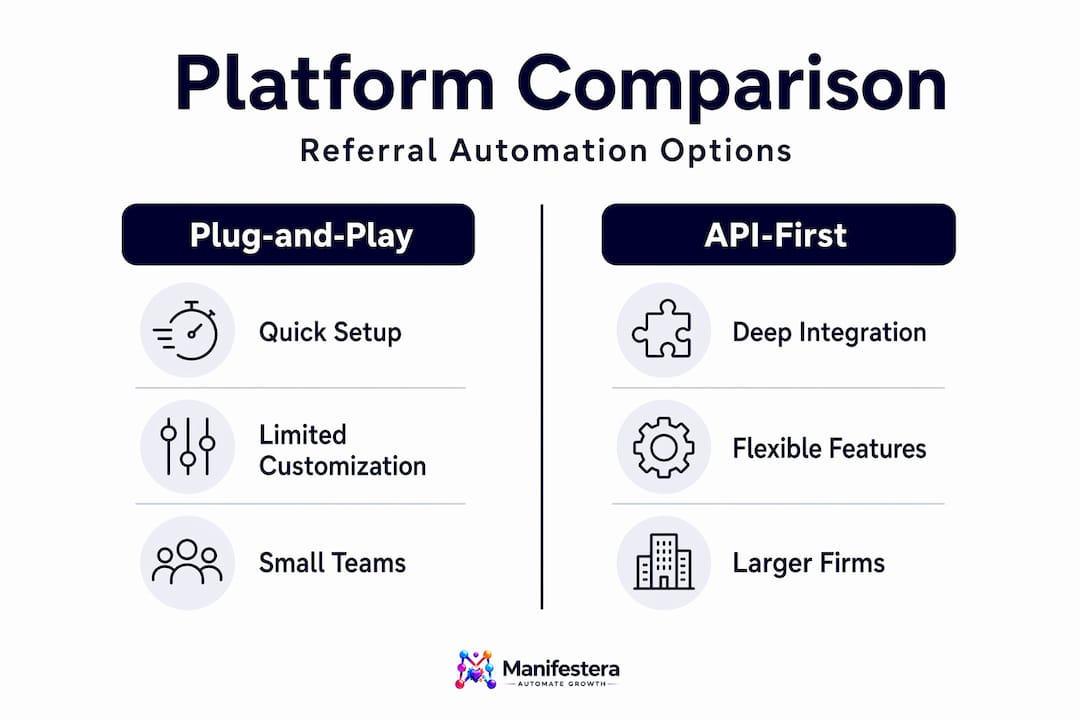
| Factor | Plug-and-play tools | API-first platforms |
|---|---|---|
| Setup time | Hours to days | Weeks, requires developers |
| Customization | Limited reward types and branding | Full control over rules, rewards, UX |
| CRM integration | Basic or via Zapier | Native, deep bi-directional sync |
| Pricing | Often free tiers; paid from ~$49/month | Paid plans from ~$349/month |
| Best for | Small businesses, fast launches | Mid-market and enterprise programs |
Businesses should choose referral software based on their specific needs, balancing ease of use against the depth of customization they require. A local service business running its first referral program does not need enterprise-grade infrastructure. A SaaS company with 50,000 active users and a complex commission structure absolutely does.
Once you select your platform, implementation follows a clear sequence. First, define your conversion event, the specific action that qualifies a referral as successful. Second, set your reward structure and make sure it is programmed into the validation rules. Third, connect the platform to your CRM and test the data flow with a small internal group before going live. Fourth, align your marketing and customer success teams on messaging so every customer touchpoint reinforces the program. Fifth, launch with a defined pilot period, typically 30 to 60 days, and use that window to validate your trigger logic and reward redemption rates before scaling.
My take on referral automation (and where most businesses go wrong)
In my experience working with growth-focused businesses, referral marketing automation gets dismissed far too often as a "nice to have" rather than a core acquisition channel. I've seen companies spend aggressively on paid advertising while their existing customers, who would happily refer friends, receive zero structured prompt to do so.
What I've found is that the gap between a mediocre referral program and a high-performing one almost never comes down to the size of the incentive. It comes down to timing and personalization. The businesses that crack referral automation are the ones that treat it as a behavioral trigger system connected to their CRM, not a broadcast channel.
I've also seen the consequences of skipping fraud detection. One mid-size e-commerce brand I observed lost a significant portion of their referral budget in the first month because self-referrals were not blocked at setup. That is a painful and entirely preventable lesson.
My honest advice: invest in automation early, before your referral volume gets large enough to make manual processes feel manageable. Because by the time it feels unmanageable, you have already left revenue on the table and eroded trust with referrers who did not receive their rewards on time. The AI and CRM integrations available at Manifestera today make this accessible for businesses of almost any size. There is no reason to delay.
— Manifestera
Ready to automate your referral growth?
Referral marketing automation works best when it is built on a foundation of smart data, precise triggers, and AI that knows when to act. At Manifestera, we design and implement automated growth systems that connect referral programs to your CRM, your ad campaigns, and your customer journey from end to end.
Whether you are launching your first referral program or looking to fix one that is not performing, our team builds the infrastructure that turns customer advocacy into measurable acquisition. Explore how Manifestera's automation services can help you generate more referred leads at a lower cost per acquisition, without adding headcount or complexity to your existing operations.
FAQ
What is referral marketing automation?
Referral marketing automation is software that manages the full referral process automatically, including link generation, prospect tracking, reward delivery, and fraud prevention, without manual steps between each stage.
How does referral marketing work when automated?
Automated referral programs trigger invitations based on specific customer behaviors, track every referral link in real time through CRM integration, and issue rewards automatically once a valid conversion is confirmed.
What are the main benefits of referral marketing automation?
The primary benefits include significant revenue growth, with some brands seeing 86% year-over-year increases, improved conversion rates from behavior-triggered invitations, and reduced operational costs compared to managing referrals manually.
How do I choose the right referral marketing software?
Match the platform to your business size and integration needs. Plug-and-play tools work well for smaller businesses wanting fast setup, while API-first platforms suit companies that need deep CRM integration and custom reward logic.
When should I trigger a referral invitation?
Trigger referral requests immediately after a positive customer event, such as a completed purchase or a subscription renewal. Timing referral requests after positive events consistently yields higher conversion rates than sending invitations on a fixed schedule.