

If you run a small or medium-sized business in New York City, you already know competition is unlike anywhere else. Every block has three competitors, every customer has dozens of choices, and every dollar you spend on marketing needs to work harder. That is exactly why NYC businesses need SEO. Not as a trendy add-on, but as the foundation of a sustainable customer acquisition system. SEO gives your business consistent, organic visibility in front of people actively searching for what you sell, without paying for every single click.
Table of Contents
- Key takeaways
- Why NYC businesses need SEO more than anywhere else
- Core SEO components every NYC business should know
- Why SEO delivers better ROI than paid ads for NYC SMBs
- Local SEO: your edge in NYC's hyper-dense market
- Putting SEO strategies into practice for your NYC business
- My take on why NYC SMBs keep undervaluing SEO
- How Manifestera helps NYC businesses grow with SEO
- FAQ
Key takeaways
| Point | Details |
|---|---|
| SEO beats paid ads on cost | Inbound leads from SEO cost 61% less than outbound methods, making it the smarter long-term spend for SMBs. |
| Local SEO drives real foot traffic | Nearly 50% of Google searches have local intent, and 72% of those searchers visit a store within 5 miles. |
| Google Business Profile matters | Optimizing your Google Business Profile is one of the top local ranking factors for map pack visibility. |
| SEO compounds over time | Unlike ads that stop the moment you pause your budget, SEO builds lasting content assets that keep generating leads for years. |
| NYC requires a local-first approach | Keyword research, citations, and backlinks must reflect NYC neighborhoods and borough-level intent to outrank local competitors. |
Why NYC businesses need SEO more than anywhere else
New York City is the most search-competitive local market in the United States. A Brooklyn-based HVAC company does not just compete with other HVAC companies. It competes with aggregator sites, national directories, and dozens of local operators all targeting the same customer. If your website does not show up on the first page of Google when someone searches "HVAC repair near me in Brooklyn," that customer goes to someone who does.
The importance of SEO for NYC becomes clear when you consider how local customers actually find businesses here. Most people do not walk down the street looking for a sign. They pull out their phone and search. They look for reviews, check Google Maps, read your website, and make a decision before they ever contact you. SEO controls how you show up at every one of those touchpoints.
General SEO improves your site's overall visibility in organic search results. Local SEO specifically targets customers in a defined geographic area. For NYC businesses, you need both. General SEO builds domain authority and helps you rank for broader terms. Local SEO gets you into the Google Maps "3-pack," the three business listings that appear above organic results when someone searches with local intent. Getting into that 3-pack in NYC can be the difference between a full appointment calendar and crickets.
SEO also builds brand credibility in a way paid ads simply cannot. When your business consistently appears in organic search results, customers trust you more than if they only see you in a sponsored slot. In a city where New Yorkers are famously skeptical of marketing, organic credibility is an edge you cannot ignore.

Core SEO components every NYC business should know
Understanding the building blocks helps you ask better questions and make smarter investments. Here are the core components relevant to any NYC SMB:
- Keyword research with local intent. You want to target phrases that include neighborhood names, borough references, and NYC-specific qualifiers. "Best accountant in Astoria, Queens" converts at a much higher rate than "best accountant." Tools like Google Search Console and Google Keyword Planner reveal what your actual customers type.
- Content that answers local questions. Blog posts, service pages, and FAQs that address real NYC customer concerns perform better than generic content. A restaurant supply company in the Bronx should publish content about NYC health code requirements, not just product descriptions.
- On-page SEO. This means writing unique title tags and meta descriptions for every page, using header tags correctly, and making sure your site loads fast. Google rewards better user experience with higher rankings.
- Technical SEO. Your site needs to be crawlable by Google's bots, free of broken links, and mobile-friendly. In NYC, where most searches happen on mobile devices, a slow or broken mobile experience costs you rankings and customers.
- Link building through local partnerships. When a reputable NYC business or local publication links to your site, Google treats those as votes of confidence. Reach out to local chambers of commerce, neighborhood blogs, and industry associations for citations and backlinks.
Pro Tip: Before building new content, run a technical audit of your existing site. Fixing crawl errors, duplicate pages, and slow-loading images often produces faster ranking improvements than publishing new content.
Why SEO delivers better ROI than paid ads for NYC SMBs
This is where the math gets compelling. Inbound leads via SEO cost 61% less than outbound lead generation methods. For a business spending $3,000 per month on Google Ads in NYC, where cost-per-click rates in competitive industries can exceed $15 per click, that difference adds up fast.
The close rate gap is even more striking. SEO-generated leads close at 14.6%, compared to 1.7% for outbound methods like cold calls or direct mail. The reason is simple: a person who finds you by searching a specific query is already looking for what you sell. They have done the mental work of deciding they have a need. You just have to show up at the right moment.
"Paid advertising is renting visibility. SEO is building equity. When you stop paying rent, you lose the apartment. When you build equity, the asset keeps working even while you sleep."
Here is a simplified view of how SEO investment compares to paid ads over time:
| Time Period | Paid Ads (Monthly $2,000 budget) | SEO Investment ($2,000/month) |
|---|---|---|
| Month 1-3 | Immediate traffic, high cost per lead | Site audit, content setup, early ranking gains |
| Month 6 | Consistent traffic only while paying | Organic traffic building, leads increasing |
| Month 12 | Traffic stops if budget pauses | Compounding rankings, lower cost per lead |
| Month 24 | Total spend: $48,000, no residual asset | Growing traffic with lasting content assets |
The compounding effect of SEO means each blog post, each optimized service page, and each new backlink you earn adds to your domain authority. That authority makes future content rank faster and easier. Research shows SEO can deliver $22 ROI for every $1 spent over a full investment cycle. No ad campaign can offer that kind of long-term leverage.
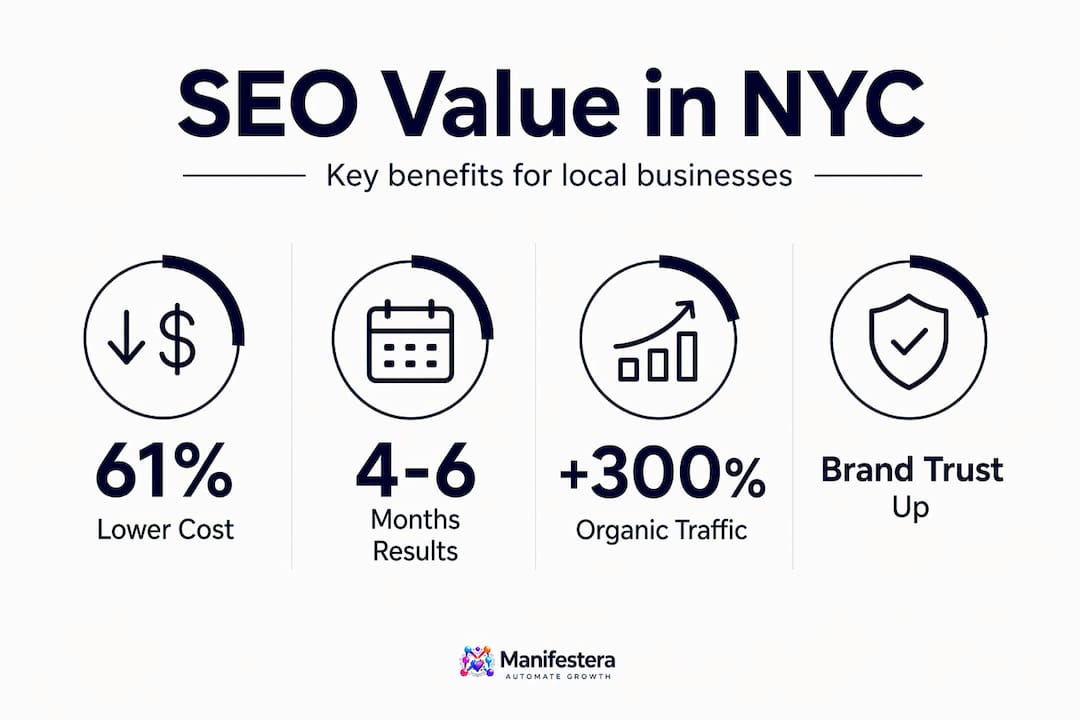
SEO budgets also scale with your business size, from roughly $500 per month for smaller SMBs to $5,000 per month for more competitive markets. That flexibility makes it accessible even for businesses just starting their digital marketing journey.
Local SEO: your edge in NYC's hyper-dense market
Local SEO is not just a subset of general SEO. For brick-and-mortar businesses, service-area businesses, and any company whose customers are physically located in NYC, it is the most direct path to new customers.
Here is how to treat local SEO as a system rather than a checklist:
- Claim and optimize your Google Business Profile. Google Business Profile optimization is the single highest-impact local SEO action you can take. Add complete and accurate business information, choose the right categories, upload real photos, post updates regularly, and actively respond to reviews.
- Maintain consistent NAP across all directories. NAP stands for Name, Address, and Phone number. Every directory listing, Yelp page, and social profile needs to display exactly the same information. Inconsistencies confuse Google and reduce your local ranking potential.
- Build location-specific pages on your website. If you serve multiple NYC boroughs, create dedicated pages for each location. A plumber serving both Manhattan and the Bronx should have separate, detailed service pages for each borough.
- Gather and respond to reviews. Reviews are trust signals that improve local map rankings and directly influence buying decisions. Ask satisfied customers to leave Google reviews consistently, and respond to every one, positive or negative.
- Target "near me" search phrases. 72% of local searchers visit a store within 5 miles. Phrases like "coffee shop near me in Williamsburg" or "tax accountant Upper East Side" signal high purchase intent. Build content and optimize pages around these terms.
Pro Tip: Add schema markup (structured data) to your website. This tells Google exactly what your business is, where it operates, and what it offers. Businesses using schema markup appear more prominently in local search results with rich snippets like star ratings and business hours.
Putting SEO strategies into practice for your NYC business
Knowing why SEO matters is step one. Knowing where to start is step two. Here is a practical framework NYC SMBs can apply right now:
- Start with a keyword gap analysis. Identify the search terms your competitors rank for that you do not. Focus first on keywords with clear local intent and moderate competition, where you can realistically rank within 3 to 6 months.
- Audit your website technically. Use free tools like Google Search Console to find crawl errors, mobile usability issues, and slow-loading pages. Fix these before investing in new content.
- Create localized content consistently. Publish at least two to four pieces of content per month that target NYC-specific questions. Cover topics your customers actually search, such as "how to find a licensed contractor in Queens" or "what to look for in a Brooklyn accounting firm."
- Build local citations. Submit your business to authoritative local directories including Yelp, Google Business Profile, Bing Places, and NYC-specific directories like the NYC Department of Consumer and Worker Protection business listings.
- Track your metrics monthly. Monitor organic traffic, keyword rankings, click-through rates, and conversions. Treating SEO as an asset-building system means you measure progress methodically and adjust based on data, not guesswork.
For businesses in the early stages of SEO, the Manifestera SEO guide offers a practical breakdown of how to structure your strategy from technical foundations through content execution.
My take on why NYC SMBs keep undervaluing SEO
I've worked with NYC business owners across industries, from boutique law firms in Midtown to family-owned restaurants in Jackson Heights. The pattern I see over and over again is that they know SEO matters, but they treat it like a nice-to-have rather than a core business asset.
The honest reason is that SEO takes time. Most business owners want results in 30 days, and ads give you that illusion. But what I've seen is that the businesses paying for ads without building organic traffic are on a treadmill. The moment the budget tightens, the leads dry up. The businesses that invested in SEO 12 or 18 months ago are now generating leads at a fraction of the cost, and they have the competitive advantage of established rankings that are genuinely difficult for newcomers to displace.
What I've learned working specifically in NYC's market is that the density of competition here actually creates opportunity for businesses willing to go narrow. If you specialize your content and local SEO around a specific neighborhood or service niche, you can dominate that pocket even without a massive budget. A florist in Park Slope who owns the local search rankings for "wedding flowers Park Slope Brooklyn" does not need to compete with FTD nationwide. That is a smarter, more profitable play.
My recommendation: stop thinking of SEO as an expense line and start treating it as a piece of infrastructure, just like your lease or your equipment. The businesses that invest in organic SEO for the long term build durable advantages that paid media simply cannot replicate.
— Manifestera
How Manifestera helps NYC businesses grow with SEO
Manifestera is a New York City-based digital marketing agency built specifically for SMBs that want to grow without burning through ad spend. The team specializes in local SEO for NYC businesses, including Google Business Profile optimization, technical site audits, neighborhood-level content strategy, and high-quality link building through local citations and partnerships.
Whether your business is based in Manhattan, the Bronx, or anywhere across the five boroughs, Manifestera's data-driven approach delivers measurable improvements in organic traffic, local rankings, and lead generation. Every engagement includes real-time analytics dashboards so you always know exactly what your SEO investment is producing. If you are ready to stop renting visibility and start building it, Manifestera is the partner built for that work.
FAQ
Why do NYC businesses need SEO over paid advertising?
SEO builds lasting visibility that compounds over time, while paid ads stop generating traffic the moment your budget runs out. For NYC SMBs managing tight budgets, SEO's lower cost per lead and higher close rates make it the more sustainable long-term investment.
How long does SEO take to show results in NYC?
Most NYC businesses see meaningful organic traffic improvements within 4 to 6 months of consistent SEO work, with compounding results through months 12 to 24. Competitive industries and high-density markets may take longer, which is why starting early is the strategic advantage.
What is local SEO and why does it matter for NYC businesses?
Local SEO optimizes your business to appear in location-based search results and the Google Maps 3-pack. With nearly 50% of Google searches carrying local intent, and 72% of local searchers visiting a nearby store, local SEO directly drives foot traffic and phone calls for NYC businesses.
How much should an NYC small business spend on SEO?
SEO budgets for small to medium-sized businesses typically range from $500 to $5,000 per month depending on market competitiveness and goals. NYC's dense market often warrants investing toward the mid to upper range to achieve meaningful ranking improvements against established competitors.
Does SEO help build trust with NYC customers?
Yes. Businesses that consistently appear in organic search results and maintain accurate, well-reviewed Google Business Profiles earn significantly more credibility than those relying solely on paid ads. In NYC's market, where buyers are research-driven, organic visibility directly builds brand trust and customer loyalty.