

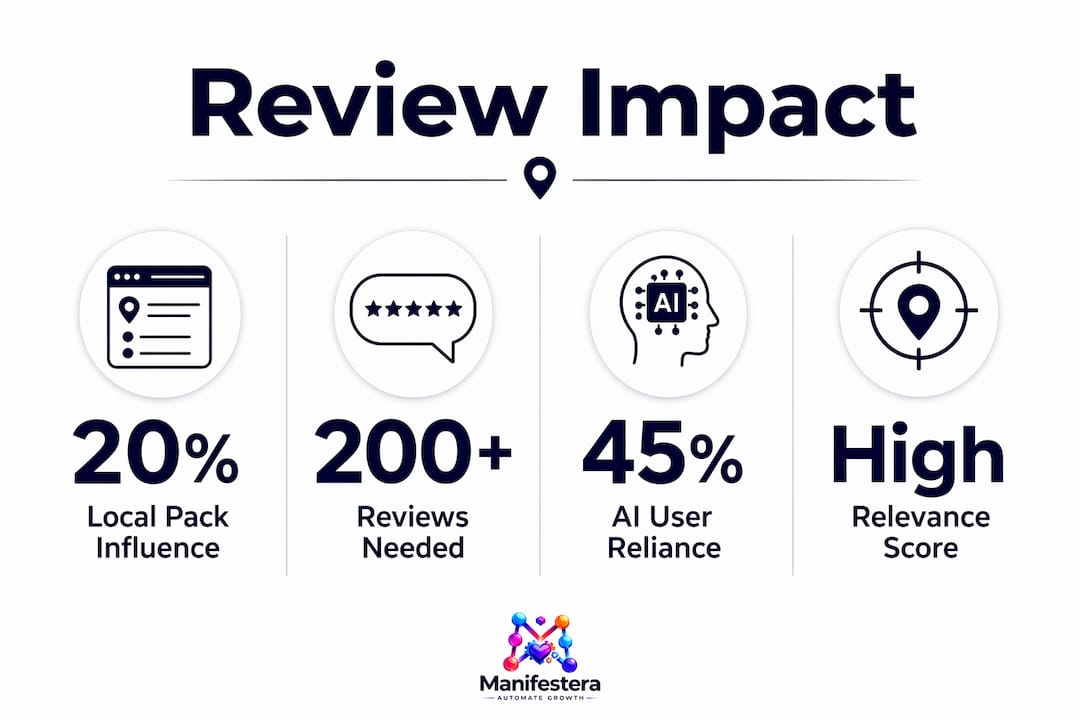
Online reviews are the single most controllable ranking factor in NYC local SEO. According to Whitespark's 2026 survey of 47 SEO experts, review signals now account for 20% of Google Local Pack ranking influence, placing them among the top three ranking factors overall. For NYC businesses competing in dense markets like Manhattan, Brooklyn, or Astoria, that weight is the difference between appearing in the Local Pack and being invisible. Understanding the role of reviews in NYC SEO means treating customer feedback not as reputation management, but as a direct input into your search ranking system.
How do reviews influence google's local pack rankings?
Google's Local Pack is the map-based block of three business listings that appears at the top of local search results. Review signals account for 20% of Local Pack ranking influence in 2026. That makes reviews more impactful than website authority for many local queries.
Three specific review factors drive that influence:
- Volume: The total number of reviews signals business activity and consumer trust. In competitive NYC categories, 200+ reviews typically secures a top-3 Local Pack placement.
- Recency: Google weights fresh reviews more heavily than older ones. A business with 50 reviews from the past 90 days outranks one with 500 reviews from three years ago.
- Sentiment and keyword content: Google reads the actual text of every review. Review text analyzed for keywords reinforces your service and location signals directly inside the algorithm.
Here is how those three factors compare in practical impact:
| Review Factor | SEO Impact | NYC Example |
|---|---|---|
| Volume (200+ reviews) | High: supports top-3 Local Pack placement | A Brooklyn plumber with 250 reviews outranks a competitor with 80 |
| Recency (last 90 days) | High: freshness signals active business | A Midtown restaurant collecting 10 reviews per month ranks above a static profile |
| Keyword-rich text | Medium-High: reinforces service and location relevance | "Best HVAC repair in Flushing, Queens" in a review text boosts that exact query |
Pro Tip: Ask customers to mention the specific service they received and the NYC neighborhood where they found you. A review that says "best Thai food in Astoria" is more valuable for local rankings than a generic five-star rating with no text.
Why do NYC consumers rely on reviews before choosing a business?
Consumer behavior in NYC makes review management non-negotiable. 97% of US consumers read reviews for local businesses, and 41% read them every single time they search. That near-universal behavior means your review profile is the first real impression most potential customers form.
The impact goes beyond trust. Reviews directly affect the behavioral signals that feed back into SEO rankings:
- Click-through rate (CTR): A business with a 4.8-star rating and 300 reviews draws more clicks from search results than a competitor with 3.9 stars and 40 reviews. Higher CTR signals relevance to Google.
- Visit intent: Consumers who read positive reviews are more likely to visit or call, increasing engagement metrics that Google tracks through Google Business Profile.
- Review recency as a trust filter: 74% of consumers only trust reviews written in the last three months. A stale review profile loses both consumer confidence and algorithmic freshness signals simultaneously.
"Reviews strongly influence user behavior metrics essential for SEO, including click-through rates and visit intent." — BrightLocal, Local Consumer Review Survey 2026
The connection between consumer behavior and SEO is direct. When more people click your listing and visit your business because of strong reviews, Google interprets that as a signal that your business is the most relevant result. Reviews are not just social proof. They are a feedback loop that continuously reinforces your ranking position.
What role do AI tools play in NYC business discovery through reviews?

AI-powered discovery is reshaping how NYC consumers find local businesses. 45% of consumers now use AI tools like ChatGPT for local business recommendations in 2026, up from just 6% in 2025. That is a sevenfold increase in one year. NYC businesses that ignore this channel are already losing visibility.
Here is how AI tools use your reviews to make recommendations:
- Natural language extraction: AI systems pull phrases directly from review text to answer conversational queries. A review that says "the fastest dry cleaner in Hoboken" becomes source material for an AI recommendation when someone asks "Where can I get same-day dry cleaning near me?"
- Quality scoring: AI tools assess review volume, average rating, and recency to rank business quality. A thin review profile gets deprioritized regardless of how good your website is.
- Keyword alignment: Google's AI pulls natural language phrases from reviews as conversational answers, increasing your chance of appearing in featured snippets and AI-generated rich results.
- Credibility filtering: AI systems favor businesses with a mix of detailed positive reviews and occasional critical feedback. Authentic reviews with some negative feedback reinforce credibility rather than undermining it.
The practical implication for NYC businesses is clear. Your Google Business Profile reviews are now training data for AI recommendation engines. A Brooklyn coffee shop with 400 detailed reviews describing its "single-origin espresso in Williamsburg" will surface in AI recommendations far more often than one with 50 generic five-star ratings.
How should NYC businesses build a review strategy that boosts SEO?
A consistent, structured review program is what separates businesses that dominate local search from those that plateau. A disciplined review management program with consistent collection and weekly responses produces measurable ranking improvements over 12–18 months. The key is treating reviews as an ongoing system, not a one-time campaign.
Setting a collection cadence
Request reviews on a fixed schedule. For most NYC service businesses, that means asking every customer at the point of service completion. Restaurants can use receipt prompts or follow-up texts. Service providers like contractors or salons should send a review request within 24 hours of job completion. Volume parity with your top competitors is the baseline goal. Check the Local Pack for your primary keyword and count the reviews of the top three listings. That number is your minimum target.
Coaching customers on review content
Generic reviews hurt less than no reviews, but detailed reviews win rankings. Train your team to guide customers toward specific language. A prompt like "Would you mind mentioning the service you got and which part of the city you're in?" takes five seconds and produces review text that Google can use as a keyword signal. For a Bronx auto shop, a review mentioning "brake pad replacement in Fordham" is worth ten times more for local rankings than "great service, highly recommend."
Responding to every review
Responding to reviews, including negative ones, signals active engagement to Google's algorithm. Respond to every review within 48 hours. For positive reviews, thank the customer and reference the specific service or location. For negative reviews, acknowledge the issue, offer a resolution, and keep the tone professional. This practice also demonstrates to prospective customers that you run an attentive business.
Pro Tip: When responding to reviews, naturally include your primary service keyword and neighborhood. A response that says "Thank you for trusting us with your HVAC installation in Park Slope" reinforces those exact terms for Google's indexing.
Monitoring competitor review profiles
Check your top three Local Pack competitors monthly. Track their review volume, average rating, and recency. If a competitor jumps from 150 to 220 reviews in 60 days, they are running an active solicitation campaign. Match or exceed that pace. NYC local search is a moving target. Staying ahead requires knowing where the bar is set.
Key takeaways
Online reviews are a direct ranking input in NYC local SEO, not a passive reputation metric. Treating them as a managed system produces compounding search visibility gains over time.
| Point | Details |
|---|---|
| Reviews drive 20% of Local Pack rankings | Review signals are a top-3 ranking factor per Whitespark's 2026 data. |
| Recency matters as much as volume | 74% of consumers only trust reviews from the last three months, and Google agrees. |
| Review text carries keyword weight | Customers mentioning services and NYC neighborhoods directly boost local relevance signals. |
| AI tools now read your reviews | 45% of consumers use AI for local recommendations; detailed review text feeds those results. |
| Consistent responses improve rankings | Replying to every review within 48 hours signals engagement to Google's algorithm. |
What Manifestera has learned about reviews and NYC rankings
After working with NYC businesses across Manhattan, Brooklyn, and Queens, one pattern stands out clearly. The businesses that treat reviews as a ranking system, not a reputation score, consistently outperform competitors with better websites and larger ad budgets.
The conventional advice says "just ask for reviews." That is incomplete. The businesses that move up in the Local Pack are the ones coaching customers on what to write, responding to every review with keyword-aware language, and tracking competitor review velocity monthly. Those three habits compound over 12–18 months into a review profile that Google and AI tools cannot ignore.
One counterintuitive finding: a perfect 5.0 rating with 30 reviews often ranks below a 4.6 rating with 280 reviews. Volume and recency outweigh perfection. A few honest critical reviews, handled professionally, actually build more trust with both consumers and algorithms than a suspiciously flawless profile. Authenticity is a signal that AI systems are increasingly good at detecting.
The businesses that struggle most are the ones that run a review push once, collect 40 reviews, and stop. Six months later, those reviews are stale. The freshness signal decays, the ranking drops, and the business wonders why. Reviews require the same ongoing attention as any other NYC SEO growth strategy. Build the system, run it consistently, and the compounding effect takes care of the rest.
— Manifestera
Ready to turn your reviews into a ranking engine?
Manifestera works with NYC businesses to build review programs that produce real ranking results, not just star ratings. From Google Business Profile optimization to keyword-aware response templates and competitor review tracking, our local SEO services are built specifically for the competitive NYC market.
If your business is not appearing in the Local Pack for your primary service keywords, your review profile is likely part of the problem. Manifestera's NYC-focused SEO team will audit your current review standing, benchmark it against your top competitors, and build a structured program to close the gap. Explore how we help local businesses dominate NYC local search and turn customer feedback into consistent organic growth.
FAQ
How much do reviews affect local SEO rankings?
Review signals account for 20% of Google Local Pack ranking influence in 2026, making them a top-3 ranking factor. Volume, recency, and review text content all contribute to that weight.
How many google reviews does an NYC business need to rank?
In competitive NYC categories, 200 or more reviews typically supports a top-3 Local Pack placement. The exact threshold varies by industry and neighborhood competition level.
Do negative reviews hurt your SEO?
Negative reviews do not automatically hurt rankings. Authentic reviews with some critical feedback reinforce credibility with both consumers and AI systems. Responding professionally to negative reviews also signals engagement to Google.
Can AI tools like ChatGPT find my business through reviews?
Yes. 45% of consumers use AI tools for local recommendations in 2026. AI systems pull natural language phrases from your review text to match conversational queries, so detailed reviews with specific service and location mentions increase your AI-driven visibility.
How often should NYC businesses ask for reviews?
Request reviews consistently after every customer interaction. A weekly or monthly cadence for follow-up outreach, combined with consistent review responses, produces the strongest long-term SEO results.