

Small business branding online is the deliberate process of crafting a consistent, authentic identity that defines who you are and how customers perceive you across every digital channel. The industry term for this practice is brand identity management, and it covers everything from your logo and color palette to your tone of voice and the story you tell on your Google Business Profile. Building a brand online follows a proven sequence: research your market, define your voice, create your visual assets, and apply them consistently everywhere customers find you. Small business owners who skip this process compete on price alone. Those who get it right compete on trust, recognition, and loyalty. Tools like Shopify's brand kit builder, Buffer's branding guides, and Google Business Profile give you the infrastructure to execute this without an agency budget.
What are the essential components of small business branding online?
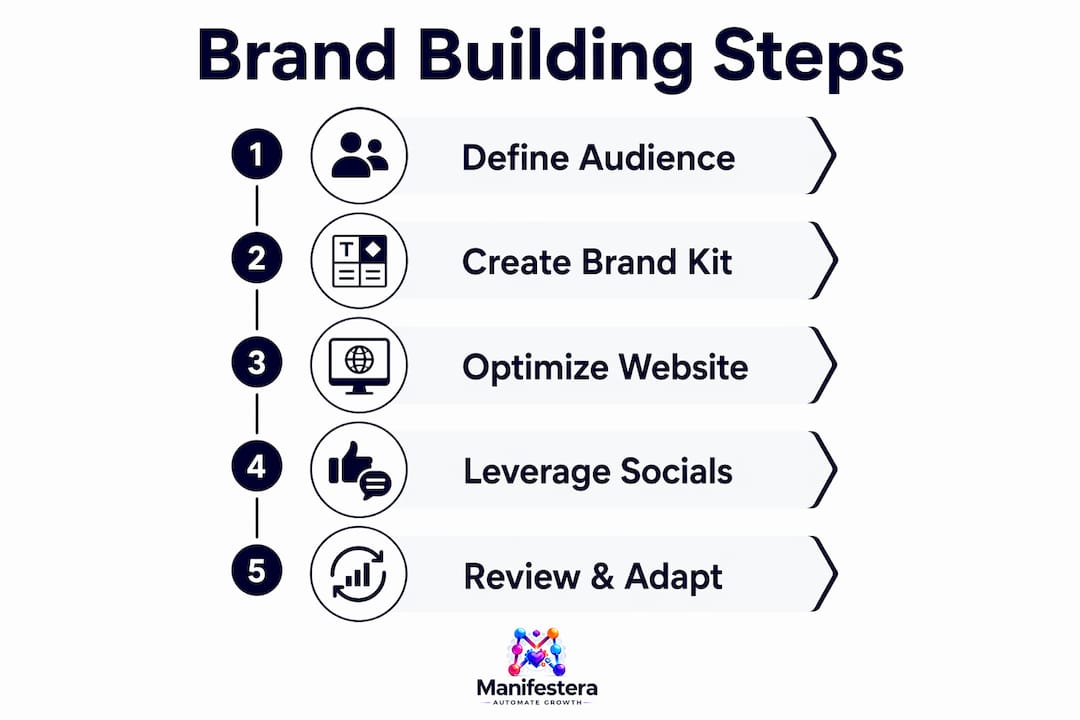
Strong brand identity starts with defining your mission, values, and target audience before you design a single asset. This foundation determines every decision that follows, from the words on your homepage to the colors in your Instagram posts. Without it, you end up with visuals that look professional but say nothing specific to the people you are trying to reach.
The core components of online branding for small businesses are:
- Brand purpose and mission. Why does your business exist beyond making money? A one-sentence mission statement gives your marketing a clear direction.
- Target audience definition. Who specifically are you serving? Age, location, income, problems, and goals. The more precise you are, the more resonant your messaging becomes.
- Brand voice and tone. Are you authoritative and formal, or friendly and conversational? Your voice should stay consistent across your website copy, social captions, and email subject lines.
- Visual identity. This includes your logo, primary and secondary color palette, typography choices, and any recurring graphic elements. These create instant recognition.
- Brand story. A short narrative explaining who you are, what you do, and why it matters. This appears on your About page, your Google Business Profile description, and your social media bios.
- Brand kit and style guide. A document that captures all of the above so anyone creating content for your business stays on-brand without guessing.
Your brand voice deserves particular attention. A local law firm and a local bakery both need consistent voices, but those voices are completely different. The law firm speaks with precision and confidence. The bakery speaks with warmth and personality. Neither is wrong. Both are deliberate. Brand kits define logo usage, colors, fonts, and tone of voice to prevent confusion and build recognition across platforms.
Pro Tip: Keep your brand kit to a single shareable document, ideally a PDF or Notion page, with your logo files, hex color codes, font names, and three to five voice guidelines. A brand kit that takes ten minutes to read actually gets used.

How can small businesses build a strong online brand on a budget?
Budget-conscious branding requires time and strategic thought more than money. The most expensive mistake small business owners make is spending on design before they have clarity on their audience and message. A beautifully designed logo attached to an unclear value proposition does not convert customers.
Start with these low-cost steps:
- Write your mission and audience profile first. This costs nothing and informs every asset you create afterward.
- Use Canva or Shopify's free logo maker to create a simple, clean logo. Avoid overly complex designs that do not scale well on mobile screens.
- Build your brand story in a Google Doc. Write two to three paragraphs explaining your origin, your purpose, and what makes you different. This becomes your About page, your pitch, and your social bio.
- Claim and complete your Google Business Profile. This is free, takes under an hour, and is one of the highest-visibility brand touchpoints for any local business.
- Create three to five social media post templates in Canva. Consistent visual templates eliminate the need to redesign every post from scratch.
The principle here is prioritization. Your website and Google Business Profile are the two assets customers check before making a purchase decision. Invest your time there first. Social media aesthetics matter, but they matter less than having a clear, credible home base. You can explore low-budget marketing strategies that complement your branding work without requiring significant spend.
Pro Tip: Treat your brand as a living document. Start with a minimal brand kit, apply it for 90 days, then review what is working and what feels off. Iterative refinement beats waiting for perfection before launching.
Why is consistency across online touchpoints critical for small business branding?
Consistent brand presentation across your website, social media, email, and ads builds customer trust and reduces confusion. When your Instagram uses one color palette, your website uses another, and your Google Business Profile has an outdated logo, customers subconsciously question your credibility. That doubt costs you conversions.
Here is what consistent versus inconsistent branding looks like in practice:
| Touchpoint | Consistent branding | Inconsistent branding |
|---|---|---|
| Website and social media | Same logo, colors, and tone across both | Different logo versions, mismatched colors |
| Google Business Profile | Matches website name, address, and description | Outdated info, different business name format |
| Email marketing | Uses brand fonts and color palette | Generic template with no visual connection |
| Paid ads | Reflects brand voice and visual style | Off-brand stock photos, generic copy |
| Customer responses | Consistent tone matching brand personality | Varies by who is responding |
The platforms you must prioritize are your website, Google Business Profile, Facebook or Instagram (whichever is primary for your audience), and any email marketing you send. Optimizing your Google Business Profile by completing every field, selecting precise categories, and adding current photos directly supports brand credibility in local search results. Think of your Google Business Profile as your digital storefront. If the sign out front does not match the sign inside, customers notice.
To maintain consistency without constant manual effort, build approval workflows for any content created by team members or contractors. A simple checklist asking "Does this use our brand colors, fonts, and voice?" catches most off-brand content before it goes live.
Pro Tip: Audit your online presence every quarter. Search your business name on Google, check your social profiles, and review your website header and footer. You will catch outdated logos, old phone numbers, and inconsistent bios faster than any customer will.
How to create and apply a practical brand kit for your online business
A brand kit is the operational cornerstone of your online identity. Without one, every piece of content becomes a guessing game. Operationalizing brand assets through templates and workflows is the step most small businesses skip, and it is exactly why their branding looks inconsistent despite having a designed logo.
Follow these steps to build and implement a brand kit that actually gets used:
- Collect your logo files. Save your logo in at least three formats: full color, single color (white), and a simplified icon version. Export as PNG with transparent background and SVG for scalability.
- Document your color palette. List your primary color, one or two secondary colors, and a neutral. Record each as a HEX code (for web), RGB value (for digital design), and CMYK (for print if needed).
- Name your fonts. Specify your heading font, body font, and any accent font. Note where to download them for free, such as Google Fonts.
- Write your voice guidelines. List three to five adjectives that describe your brand voice. Add two to three example sentences showing the tone in practice. Include a short list of words or phrases you never use.
- Create content templates. Build Canva templates for your most common content types: a square social post, a story graphic, an email header banner, and a website hero image. Lock the brand colors and fonts in each template.
- Store everything in one place. Use Google Drive, Dropbox, or Notion. Share the link with anyone who creates content for your business.
The payoff is speed and consistency. When a team member needs to create a promotional post, they open the template, swap the text, and publish. No guesswork, no off-brand colors. For a deeper look at how branding connects to your broader digital presence, brand strategy frameworks offer useful structural guidance.
Pro Tip: Add a one-page "brand don'ts" sheet to your kit. Show examples of logo misuse, wrong color combinations, and off-brand language. Seeing what not to do is often more instructive than seeing what to do.
What practical steps should small businesses take to strengthen online brand visibility?
Visibility is the measurable result of consistent branding applied across the right channels. Brand evaluation through audits measuring awareness, perception, and online metrics helps small businesses identify gaps and refine their approach over time. Start with a brand audit before adding new channels or campaigns.
Key steps to strengthen your online brand visibility:
- Conduct a brand audit. Search your business name on Google and review every result on the first page. Check your website, Google Business Profile, Yelp listing, Facebook page, and any directory listings for consistency in name, logo, description, and contact details.
- Optimize your Google Business Profile completely. Fill in every available field: business description, hours, services, products, and attributes. Upload at least ten photos including your storefront, team, and products. Respond to every review, positive or negative, using your brand voice.
- Clarify your website messaging. Your homepage headline should answer three questions in under five seconds: what you do, who you serve, and why customers should choose you. If a first-time visitor cannot answer those questions without scrolling, your messaging needs work.
- Standardize your social media profiles. Use the same profile photo (your logo or a consistent headshot), the same bio language, and the same website URL across every platform where you have a presence.
- Track brand metrics. Monitor direct website traffic (people who type your URL directly), branded search volume in Google Search Console, and review ratings across platforms. These numbers tell you whether your brand is gaining recognition.
You can also review top digital marketing channels to understand which platforms deliver the highest return for small business brand building. For NYC-based businesses, local online visibility tactics tied to your Google Business Profile can significantly accelerate brand recognition in your neighborhood.
Key takeaways
Effective small business branding online requires a defined audience, a consistent visual and verbal identity, and disciplined application across every customer-facing digital channel.
| Point | Details |
|---|---|
| Start with audience and purpose | Define your mission and target customer before creating any visual assets. |
| Build and use a brand kit | Document your logo, colors, fonts, and voice guidelines in one shareable file. |
| Prioritize website and Google Business Profile | These two channels are your highest-visibility brand touchpoints and first impression assets. |
| Consistency builds trust | Uniform branding across all platforms reduces customer confusion and increases conversion confidence. |
| Audit and iterate regularly | Review your online presence every quarter and refine based on brand awareness metrics. |
Why most small business brands stay invisible online
At Manifestera, we work with small business owners across the country, and the pattern we see most often is this: a business has a great logo, a decent website, and an active Instagram, but no one can find them online and their messaging does not stick. The problem is almost never the design. It is the absence of a defined audience and a consistent voice applied everywhere.
The businesses that grow their brand fastest are not the ones with the biggest design budgets. They are the ones who wrote down exactly who they serve, what they promise, and how they sound, then applied those decisions to every piece of content they published. That discipline compounds. After six months, their Google Business Profile, their website, and their social media all tell the same story. Customers recognize them. Search engines rank them.
The other mistake we see constantly is treating the brand kit as a finished product rather than a working tool. Businesses spend weeks getting the brand kit right, then never build the templates that make it usable day to day. The brand kit lives in a folder. Content gets created without it. The inconsistency returns within weeks.
Our honest recommendation: spend 80% of your branding effort on clarity and consistency, and 20% on aesthetics. A clear, consistent brand in a simple design outperforms a beautiful brand with a confused message every time.
— Manifestera
How Manifestera helps small businesses build and grow their online brand
Manifestera is a New York City-based digital marketing agency that helps small and medium-sized businesses build measurable brand visibility online. Our team combines SEO services with AI-powered lead capture, Google Ads management, and Facebook advertising to create a consistent, high-performing brand presence across every channel that matters. We do not just help you look good online. We build the systems that make your brand discoverable, credible, and conversion-ready. If you are ready to move from scattered online presence to a brand that consistently attracts and converts customers, Manifestera has the tools and the track record to get you there.
FAQ
What is small business branding online?
Small business branding online is the process of defining and consistently presenting your business identity, including your logo, voice, colors, and story, across digital channels like your website, social media, and Google Business Profile. The goal is to build recognition and trust with your specific target audience.
How do I start branding my small business online?
Start by defining your mission, target audience, and brand voice before creating any visual assets. Then build a simple brand kit with your logo, color palette, and font choices, and apply it consistently across your website and Google Business Profile first.
Why does brand consistency matter for small businesses?
Consistent branding across platforms builds customer trust and reduces confusion, which directly improves conversion rates. When your visuals and messaging match everywhere customers find you, your business appears more credible and professional.
Can I build a strong brand online without a big budget?
Yes. Budget-focused branding requires strategic thought and time more than money. Free tools like Canva, Google Business Profile, and Shopify's logo maker give you the infrastructure to build a professional brand identity without significant spend.
What should a small business brand kit include?
A brand kit should include your logo files in multiple formats, your color palette with HEX codes, your chosen fonts, voice guidelines with example sentences, and Canva templates for your most common content types. Store everything in a shared Google Drive or Notion page for easy access.