

Most business owners assume AI marketing automation is just a smarter version of the email sequences they already have. That assumption is costing them real competitive ground. What is AI marketing automation, in its truest form, goes far beyond scheduled drip campaigns or basic lead scoring rules. It describes systems that set goals, plan multi-step workflows, adapt their behavior based on results, and operate with increasing autonomy. This guide breaks down exactly how it works, where it creates genuine value, where it can go wrong, and how to implement it without exposing your business to unnecessary risk.
Table of Contents
- Key takeaways
- What is AI marketing automation
- Core benefits and strategic applications
- Governance, risks, and human oversight
- Adoption levels and practical steps for 2026
- My honest take on AI marketing automation
- Ready to implement AI automation for your business?
- FAQ
Key takeaways
| Point | Details |
|---|---|
| AI automation vs. rule-based tools | AI marketing automation adapts to outcomes and learns continuously, while traditional tools follow fixed, pre-set rules. |
| Personalization drives performance | AI-powered email personalization can increase click-through rates by 41% and lift conversions by 29% versus static campaigns. |
| Governance is non-negotiable | Poor governance is the primary reason AI projects fail. Role-based access, audit trails, and measurable KPIs are required from day one. |
| Data quality determines AI quality | Fragmented customer data cripples AI performance. Unified, identity-resolved behavioral data is the foundation of effective AI automation. |
| Adopt in stages, not all at once | Pilot AI automation in one workflow first, measure the results, and scale only after you have validated performance against real goals. |
What is AI marketing automation
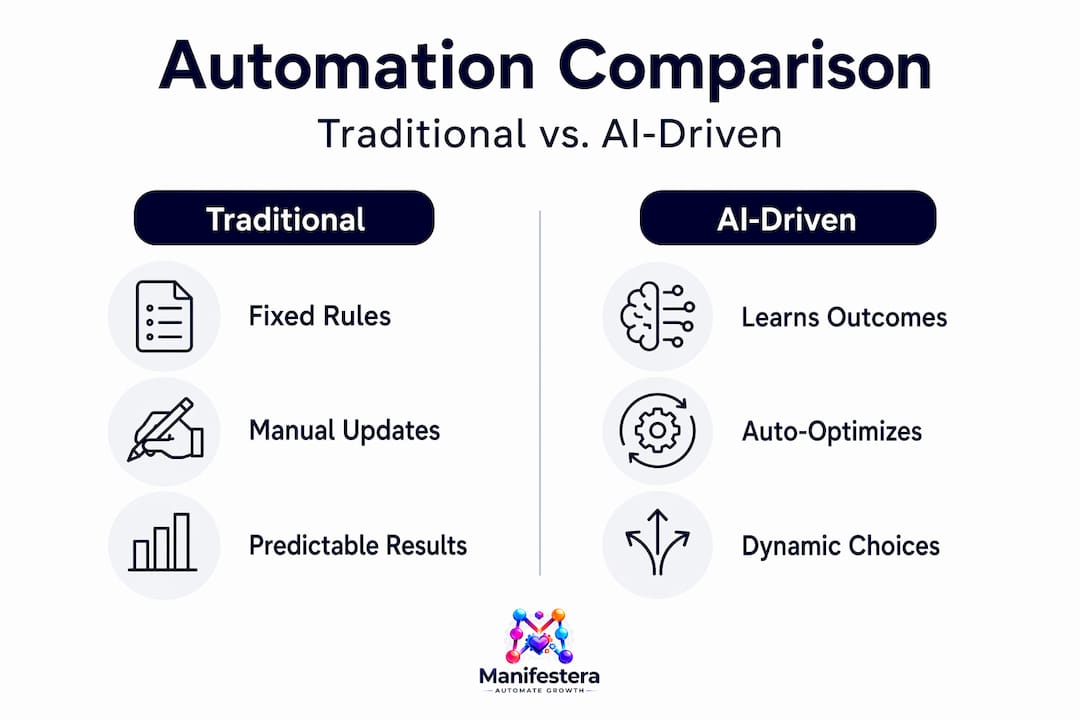
Traditional marketing automation is essentially a very efficient rule engine. You set the trigger, define the action, and the system executes it the same way every time. If a contact downloads a whitepaper, send email A. If they open email A, wait three days and send email B. Reliable, yes. Adaptive, no.
AI marketing automation operates on a fundamentally different architecture. According to research on AI agents vs. automation, AI marketing agents autonomously plan, execute, and adapt multi-step workflows based on goals, then learn from outcomes rather than replaying a fixed script. The system does not just follow your instructions. It interprets your objective, selects its approach, monitors what is working, and adjusts.
To make this concrete, consider a five-point test that distinguishes a true AI marketing agent from a tool that simply has AI features bolted on:
- Goal-oriented behavior: The system works toward an outcome (qualified leads, revenue, engagement) rather than just completing a task.
- Workflow planning: It selects and sequences the steps required to reach that goal without a human mapping every action.
- Dynamic channel selection: It chooses whether to contact a prospect via email, SMS, or paid retargeting based on predicted response, not a pre-set rule.
- Content adaptation: It modifies messaging in real time based on individual behavior and context.
- Learning from outcomes: It updates its own approach after each campaign cycle, improving without manual reprogramming.
The table below captures the core architectural contrast:
| Dimension | Traditional automation | AI marketing automation |
|---|---|---|
| Decision logic | Fixed rules set by humans | Goal-driven, learned from data |
| Content | Static templates | Dynamically generated or selected |
| Channel selection | Pre-defined sequence | Predicted based on individual behavior |
| Adaptation | Manual updates required | Continuous, autonomous learning |
| Oversight model | Set-and-forget | Requires governance and monitoring |
Pro Tip: Before evaluating any platform, ask the vendor specifically whether their AI learns from campaign outcomes and updates its own workflows. If the answer is no, you are looking at AI-enhanced automation, not an AI marketing agent. Both have value, but they solve different problems.
Gartner projects that 40% of enterprise applications will embed AI agents by the end of 2026, which means the distinction between these two categories will become one of the most important buying decisions you make this year.
Core benefits and strategic applications
The case for AI in marketing does not rest on hype. It rests on measurable outcomes across specific workflows. AI-powered email personalization can increase click-through rates by 41% and conversions by 29% compared to traditional campaigns. Those numbers come from behavioral personalization at the individual level, something that no human marketing team can execute manually at scale.
Here is where AI marketing automation creates the most significant impact in practice:
- Lead scoring and routing: AI systems analyze behavioral patterns to predict which prospects are closest to a purchase decision. Rather than applying a point-based score based on page visits alone, AI-driven lead scoring identifies richer intent signals. Think content consumption patterns, time-on-page sequences, and cross-channel behavior. This translates directly to better-qualified leads reaching your sales team.
- Email nurture sequences: Instead of sending the same sequence to every contact, AI selects the next message based on what each individual has responded to previously. Frequency, tone, and offer type all adjust automatically.
- Real-time audience segmentation: AI segments your audience based on current behavior, not static list criteria you defined months ago. A prospect who just visited your pricing page three times in one week gets treated differently than someone who has not engaged in 30 days.
- Campaign optimization: Platforms like Google Performance Max and Meta Advantage+ already use agentic AI elements to manage bids, creative selection, and budget allocation in real time. This is not a future capability. It is already running your paid campaigns if you use those platforms.
The top five workflows being transformed right now are lead scoring, email nurturing, lead routing, personalization, and campaign optimization. If any of those represent manual bottlenecks in your current operation, AI automation directly addresses the constraint.
Pro Tip: Start with lead scoring as your first AI automation pilot. It produces measurable results quickly, requires relatively clean data to implement, and creates immediate feedback you can use to validate your AI system before expanding to more complex workflows.

For a practical implementation walkthrough, Manifestera's guide on smart campaign automation covers how small and mid-sized businesses can structure their first AI workflows without overcomplicating the process.
Governance, risks, and human oversight
Here is the part most vendors gloss over: AI marketing automation can damage your brand, violate compliance requirements, and waste significant budget if deployed without proper governance. This is not theoretical. Gartner projects that 40% of agentic AI projects will fail by the end of 2027 due to poor governance and premature deployment. Only 6% of marketers described themselves as highly prepared to deploy agentic AI as of early 2026.
The risks are specific. An autonomous system with poorly defined guardrails can send off-brand messaging, target the wrong audience segments, overspend on a budget, or generate content that violates regulatory requirements in your industry. Without proper oversight, you may not catch these failures until real damage has been done.
Governance is the solution, and it has four practical pillars:
- Role-based access controls: Define exactly which actions the AI system can take autonomously, which require human approval, and which are off-limits entirely. An AI should be able to pause a low-performing ad automatically but should not be able to launch a new campaign without a human sign-off.
- Audit trails with context: Enterprise-grade AI audit logs must capture not just what action was taken, but which model version was used, what the prompt or input was, and who reviewed the output. Simple activity logs are not sufficient for compliance or troubleshooting.
- Policy-as-code and measurable KPIs: Document your rules in a form the system can reference, and define success metrics before deployment. Policy-as-code and measurable KPIs allow marketing teams to scale AI impacts safely without depending on slow engineering cycles for every adjustment.
- Data infrastructure readiness: Most marketing teams fail to deploy AI agents effectively because their customer data is fragmented and unreliable. Unified, identity-resolved behavioral data is the prerequisite, not the afterthought.
"Governance should be seen not as a barrier but as an accelerator for deploying AI agents safely, enabling marketers to innovate confidently within policy guardrails." — Everworker.ai
Human judgment remains the irreplaceable layer in this system. AI handles volume, speed, and pattern recognition. You provide strategic direction, brand values, ethical boundaries, and final accountability. Neither works well without the other.
Pro Tip: Before launching any AI automation pilot, build a one-page governance document that defines the system's scope, the metrics you will use to evaluate it, and the conditions under which you will pause or override it. That document forces clarity before a problem forces the conversation.
Adoption levels and practical steps for 2026
AI marketing automation is not a binary choice between your current tool and a fully autonomous system. It exists on a spectrum. Most current platforms operate somewhere between AI-enhanced automation and semi-autonomous campaign execution. Understanding where a tool sits on that spectrum helps you match capabilities to your current readiness.
Here is a practical sequence for adopting AI automation at the right pace:
- Audit your data infrastructure first. AI only performs as well as the data it receives. Identify where your customer data lives, whether it is unified, and whether behavioral signals are being captured accurately across channels. Fix data gaps before adding AI.
- Select one workflow to pilot. Lead scoring, email nurture sequencing, and ad bid management are the lowest-risk starting points. Pick the one that currently consumes the most manual effort or produces the most inconsistent results.
- Define success metrics before launch. Decide what a successful pilot looks like in measurable terms. Conversion rate improvement, time saved per week, cost per qualified lead. You need a baseline to compare against.
- Choose tools that integrate with your existing stack. AI marketing automation works best when it enhances what you already have rather than requiring a full platform replacement. The future of marketing automation is AI evolving existing systems into adaptive ones, not wholesale replacement.
- Review performance weekly for the first 90 days. AI systems benefit from human feedback during the early learning period. Catch and correct misalignments early before they compound.
For businesses evaluating the best AI workflow automation marketing tools, the selection criteria should center on three questions: Does the platform learn from outcomes? Does it support the governance controls your organization requires? And does it integrate cleanly with your current CRM and ad platforms?
Pro Tip: Pair your AI automation pilot with A/B testing integration to generate structured performance data. This gives you objective evidence of what the AI is actually improving, which builds internal confidence and makes the business case for broader deployment far easier.
My honest take on AI marketing automation
I have seen businesses fall into two opposite traps with AI marketing automation. The first group treats it as a magic layer you apply on top of a broken strategy. They buy an expensive platform, automate a dysfunctional funnel faster, and then wonder why results got worse. The second group waits for perfect conditions that never arrive. They spend two years preparing their data infrastructure while competitors run circles around them.
What I have learned, working across campaigns for dozens of businesses, is that the teams getting real returns are the ones who treat AI as a junior specialist with extraordinary capacity but narrow judgment. They give it clear goals, constrain its autonomy appropriately, and stay closely involved during the early stages. They do not hand off the strategy. They hand off the execution volume.
The governance question is where I push back hardest on the "just deploy it" crowd. Compliance failures and brand inconsistencies from unmonitored AI do not just cost money. They cost trust, and trust is the one thing no automation tool can rebuild for you. I genuinely believe that organizations with tight governance frameworks will outperform those without them, not despite the controls, but because of them. Guardrails create consistency, and consistency compounds.
The marketing professionals who thrive alongside AI are not the ones who know every technical detail of how large language models work. They are the ones who ask sharp questions, set meaningful KPIs, and know when to override the system. That skill set is more valuable now than it has ever been.
— Manifestera
Ready to implement AI automation for your business?
If this article helped clarify what is possible with AI marketing automation, the next step is knowing how to apply it specifically to your business goals and your current marketing infrastructure. Manifestera builds AI-powered marketing systems for small and mid-sized businesses across the country, including full governance frameworks, data unification, and workflow automation that actually ties to revenue.
Whether you are running paid ads, building a lead nurture system, or trying to scale organic traffic without scaling your headcount, Manifestera's AI automation services are designed to get you from concept to measurable results without the guesswork. If you are based in New York, the team also offers Manhattan-specific strategies tailored to local market dynamics and competitive positioning. Reach out to start with a focused audit of your current marketing stack.
FAQ
What is AI marketing automation in simple terms?
AI marketing automation refers to systems that set goals, plan campaign workflows, adapt their approach based on results, and learn continuously without manual reprogramming. It differs from traditional automation, which follows fixed rules a human defines in advance.
How does AI marketing automation differ from traditional automation?
Traditional marketing automation executes pre-set rules the same way every time. AI marketing automation adapts dynamically, selecting channels, adjusting content, and updating its own workflows based on what produces results.
What are the biggest risks of deploying AI marketing automation?
The primary risks include brand inconsistency, compliance violations, and budget waste when AI operates without proper governance. Gartner data indicates 40% of agentic AI projects will fail by end of 2027, largely due to poor oversight and premature deployment.
What are the best AI marketing automation platforms in 2026?
Most leading platforms, including those used for email, CRM, and paid media, now offer AI capabilities ranging from AI-enhanced features to semi-autonomous campaign execution. The best platform for your business depends on your data readiness, workflow goals, and governance requirements.
How do I start with AI marketing automation without overcomplicating it?
Start by auditing your customer data for gaps, then pilot AI automation in one workflow such as lead scoring or email nurturing. Define clear success metrics before you launch, review performance weekly, and expand only after the pilot produces validated results.