

Most marketing teams dramatically underestimate how much time they lose to manual, repetitive tasks every single week. When you calculate approvals, status checks, data entry, and follow-up sequences, the number adds up fast. That's exactly why automated workflows save marketing time at a scale most professionals don't expect until they see the data firsthand. According to HubSpot's 2026 State of Marketing report, approximately 65% of marketers save at least 10 hours per week through AI-driven automation. This article breaks down what's actually happening inside those workflows, what the research says, and how you can build the systems that reclaim your team's time.
Table of Contents
- Key Takeaways
- Why automated workflows save marketing time
- The hard data on automation's time savings
- Common misconceptions about marketing automation
- How to implement automated workflows for maximum time savings
- Manual workflows vs. agentic AI workflows
- My take on automation and real marketing productivity
- Ready to stop losing hours to manual marketing tasks?
- FAQ
Key Takeaways
| Point | Details |
|---|---|
| Automation saves 10+ hours weekly | Most marketers reclaim more than a full workday each week once workflows are properly deployed. |
| AI accelerates campaign creation | Agentic AI workflows run campaigns 10 to 15 times faster than traditional manual processes. |
| Broken workflows scale inefficiency | Automating a flawed process makes it worse. Map and fix workflows before you automate them. |
| Roles shift to supervision | Marketers become workflow designers and AI supervisors, not manual task executors. |
| Maturity drives ROI | Teams with higher automation maturity are twice as likely to see positive returns from AI investment. |
Why automated workflows save marketing time
At its core, an automated marketing workflow is a rule-based sequence of tasks that executes without manual input. You define a trigger, an action, and the conditions that connect them. The system does the rest.
Here's what that looks like in practice:
- Email sequencing: A lead fills out a form and immediately enters a multi-step nurture sequence without anyone pressing send.
- Lead scoring and routing: A contact reaches a scoring threshold and gets automatically assigned to a sales rep with a notification and context pulled from your CRM.
- Data synchronization: A new customer record in your e-commerce platform syncs instantly to your email tool, ad audiences, and reporting dashboard.
- Ad audience updates: Customers who purchase are removed from acquisition campaigns and added to upsell sequences automatically.
- Approval workflows: Content gets routed to the right reviewer based on type and deadline, then published upon approval without a single Slack message.
Each of these removes a human handoff. Multiply that across a week of operations and you start to see where those 10-plus hours go.
AI takes this further. Instead of fixed "if this, then that" logic, agentic AI workflows can interpret context, make decisions across multiple steps, and adapt based on real-time data. Think of it as the difference between a static decision tree and a system that reads the situation and responds intelligently.
Pro Tip: Before automating anything, document the manual version in full. You cannot build a reliable automated workflow around a process that exists only in someone's head.
The hard data on automation's time savings
The numbers behind automated marketing efficiency are harder to ignore than most case studies suggest.
HubSpot's 2026 research breaks down the time savings specifically: 32.82% of marketers save between 10 and 14 hours weekly, while roughly 33% save over 15 hours. That is nearly half a workweek recovered per person, every week.
The speed gains at the campaign level are equally significant. McKinsey research on agentic AI shows that organizations using agentic marketing workflows are achieving 10 to 15 times faster campaign creation and execution compared to manual processes. A campaign that took a team two weeks to build and launch can be operational in less than a day.

| Metric | Manual Workflows | Automated/Agentic AI Workflows |
|---|---|---|
| Campaign creation speed | Baseline | 10 to 15x faster |
| Weekly hours saved per marketer | 0 | 10 to 15+ hours |
| Efficiency gain (org-wide) | Baseline | Up to 22% |
| Budget freed for growth reinvestment | 0% | 15 to 20% |
| AI ROI probability | Baseline | 2x more likely with mature automation |
The budget implications matter just as much as the time savings. McKinsey's marketing efficiency data shows organizations with mature AI and automation adoption averaging 22% efficiency gains, freeing 15 to 20% of their marketing budget for reinvestment into growth activities.
That's not time saved. That's money recaptured from overhead and redeployed into campaigns that generate revenue. The impact of automation on marketing extends well beyond your team's calendar.
Common misconceptions about marketing automation
The biggest mistake teams make is treating automation as a passive solution. You build it, turn it on, and walk away. That assumption is how workflows quietly break and no one notices until a lead gets the wrong email 47 times.
Automated workflows require ongoing maintenance and regular monitoring. Triggers fire on bad data. Conditions stop matching reality as your business evolves. Integrations between tools update and break silent connections. None of this is catastrophic if you catch it early. It becomes catastrophic when you assume silence means success.
There are a few other misconceptions worth correcting directly:
- "We can automate our way out of a broken process." You cannot. Automating a broken process scales the dysfunction. If your lead handoff process is messy manually, it will be messier at volume.
- "AI will handle the workflow design." AI executes within workflows you design. It does not redesign your operations for you. Human judgment determines what gets automated and how.
- "Automation replaces the need for strategy." Automation handles execution. Strategy, creative direction, and audience insight still require human thinking. Automation makes your strategic decisions more impactful by executing them consistently and at scale.
The teams that get the most from automation treat it the way they treat any piece of infrastructure. They assign ownership, schedule audits, and take failures seriously.
Pro Tip: Assign a named owner to every automated workflow in your system. If no one is accountable for a workflow's health, it will eventually fail silently and no one will catch it.
How to implement automated workflows for maximum time savings
Getting started with automation is less about picking the right tools and more about the quality of your process documentation. Here is a practical path forward.
-
Map your existing workflows in full. Write down every marketing process your team performs regularly, including who does what, what triggers the task, and what happens next. Do not skip this step. Leading teams treat automation as infrastructure that requires thorough process documentation before any tool touches it.
-
Prioritize by frequency and effort. Score each process on how often it happens and how long it takes manually. High-frequency, high-effort tasks are your first automation targets. A daily reporting task that takes 45 minutes is a better candidate than a quarterly project that takes two hours.
-
Involve your frontline marketing staff. The people doing the work know exactly where the friction is. Ask your email manager which part of campaign setup they dread most. Ask your paid media buyer what they copy-paste every single week. Those are your automation entry points.
-
Build one workflow at a time and test it thoroughly. Resist the urge to automate everything at once. Build one workflow, test it across edge cases, confirm the outputs match what you expect, then move to the next. Speed of implementation is less important than reliability.
-
Schedule regular audits. Set a recurring calendar event every 30 to 60 days to review active workflows. Check for failed steps, data anomalies, or processes that no longer match how your team actually operates.
-
Shift your team's mindset toward supervision. Agentic AI reshapes marketing roles from manual operators to supervisors who manage AI agents. Your team's job becomes designing, monitoring, and improving automated systems rather than executing them manually. That is a meaningful cultural shift and it requires explicit conversation, not just new software.
For teams looking for a structured starting point, Manifestera's practical guide for SMBs covers workflow prioritization in detail.
Pro Tip: Start with your highest-volume, lowest-complexity task. A simple, perfectly functioning automation builds team confidence and proves ROI faster than an ambitious multi-step workflow that takes months to stabilize.
Manual workflows vs. agentic AI workflows
To understand the full benefits of automated workflows, it helps to see the contrast clearly.
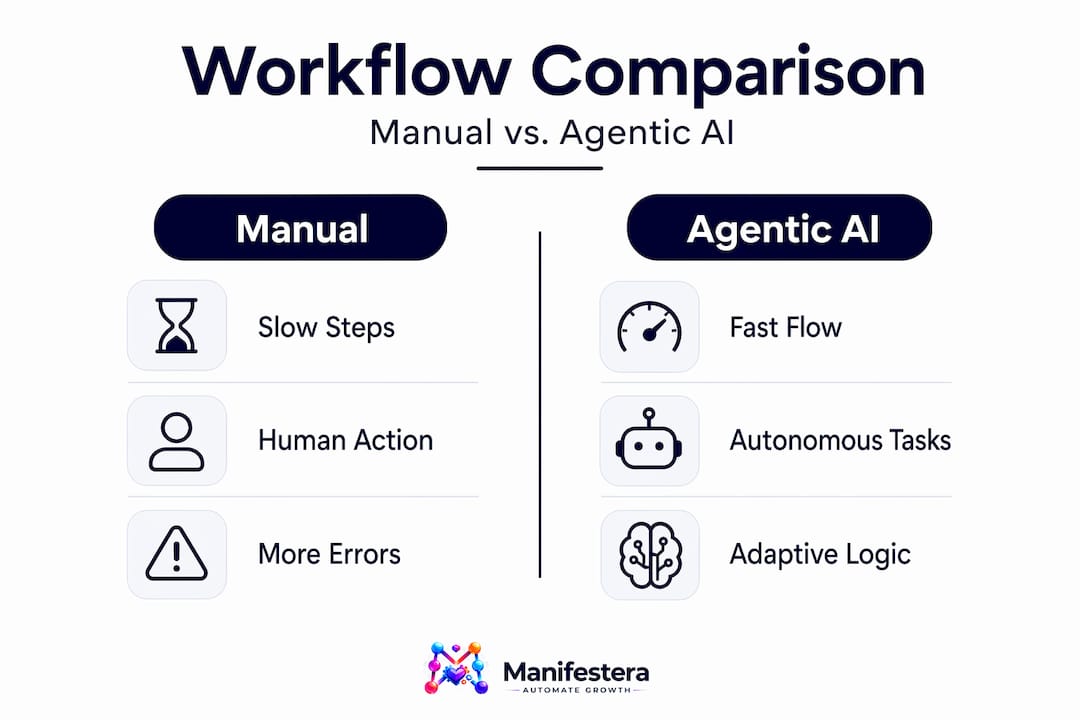
Manual workflows are slow by design. Every step requires a human to receive information, make a judgment, take action, and pass it forward. Each handoff is an opportunity for delay, miscommunication, or error. A lead captured on Monday might not get a follow-up email until Wednesday. By then, the window has narrowed.
Traditional automation improved this by handling discrete, predictable tasks automatically. An autoresponder fires instantly. A CRM record gets created without manual entry. These gains are real but often siloed, meaning each automation operates independently without awareness of the larger campaign context.
Agentic AI workflows operate differently. They handle multistep processes autonomously, adapting decisions based on real-time data across your entire marketing stack. A single agentic workflow can capture a lead, score it, segment it, personalize the first five touchpoints, notify the right team member, update the CRM, and adjust your paid audience exclusions. All of this happens without a human in the loop.
The BCG report on agentic marketing puts it plainly: agentic AI lets marketers focus entirely on strategy and creativity while agents handle multistep execution at scale. The long-term effect on team structure is significant. Smaller teams can manage larger campaign volumes. Budget shifts from headcount to technology. And automation maturity drives AI ROI in a way that tool adoption alone never will.
My take on automation and real marketing productivity
I've worked with enough marketing teams to say this plainly: most of them are trying to add AI onto a foundation that was never built for it. They buy the tools, set up a few triggers, and then wonder why their AI investment is underperforming.
What I've learned is that automation maturity is the actual determinant of AI returns. Teams with mature automation are twice as likely to see positive ROI from AI. That statistic isn't a coincidence. AI amplifies what's already in your system. If your system is clean and documented, AI scales your best practices. If your system is messy, AI scales the mess.
The contrarian view I hold is this: most marketing teams don't need more AI features. They need better process documentation and assigned workflow ownership. Every client I've guided through a workflow redesign reclaimed significant time within weeks, often before any AI was added.
The cultural piece is what most articles skip. Getting your team to think of themselves as workflow supervisors rather than task executors is a bigger shift than any software rollout. It changes how people measure their contribution. And when it works, it's the most sustainable efficiency gain you'll find in marketing.
— Manifestera
Ready to stop losing hours to manual marketing tasks?
If this article made you realize how much time your team is leaving on the table, that's exactly the right starting point. Manifestera builds and deploys AI-powered marketing automation systems for businesses that are serious about recovering that time and reinvesting it into growth.
From lead capture workflows to multi-channel nurture sequences and real-time analytics dashboards, Manifestera designs automation infrastructure that actually holds up over time. Whether you're in NYC, Brooklyn, Hawaii, or anywhere in between, the approach is the same: map your current processes, identify the highest-value automation targets, and build systems that run without you. Reach out to Manifestera and put those 10-plus weekly hours back to work.
FAQ
What are automated marketing workflows?
Automated marketing workflows are rule-based sequences that execute marketing tasks without manual input. Common examples include email nurture sequences, lead routing, ad audience updates, and CRM data synchronization.
How much time do automated workflows save marketers?
HubSpot's 2026 data shows that approximately 65% of marketers save at least 10 hours per week using AI-driven automation, with roughly a third saving over 15 hours weekly.
Can you automate a workflow that isn't working manually?
No. Automating a broken or poorly documented process scales the inefficiency rather than fixing it. Successful automation requires mapping and redesigning the workflow first before any tools are introduced.
How does agentic AI differ from basic marketing automation?
Basic automation handles single, predictable tasks in isolation. Agentic AI workflows execute multistep processes autonomously, adapting decisions based on real-time data across your entire marketing stack without manual intervention at each step.
What's the ROI of investing in marketing automation?
Marketing teams with mature automation are twice as likely to see positive ROI from AI investments, and McKinsey reports average efficiency gains of 22% with 15 to 20% of budget freed for reinvestment.