

Digital marketing for small business is the practice of using online channels — websites, SEO, social media, and email — to reach customers cost-effectively and grow revenue. The industry term is digital marketing, and it covers every tactic your business uses to attract, engage, and convert customers through the internet. Unlike traditional advertising, digital marketing for SMBs includes clear goals and KPIs that connect every dollar spent to a measurable outcome. Tools like Google Business Profile and Google Analytics give even the smallest businesses access to data that was once reserved for large corporations. The result: you can compete for customers online without a massive budget.
What is digital marketing for small business and why does it matter
Digital marketing is defined as the use of online platforms, tools, and strategies to promote products or services to a specific audience. For small businesses, the most common channels are websites, search engine optimization (SEO), social media, email campaigns, and paid advertising. Each channel serves a different purpose in the customer journey, from discovery to purchase to repeat business.
The cost advantage is real. Social media ads can start at as little as $5 per day, making measured campaigns accessible without large budgets. That means a local bakery in Brooklyn and a national e-commerce brand can both run targeted campaigns, but the bakery can now do it without a six-figure media budget.

Small business online marketing also gives you precision that print or broadcast advertising cannot. You can target customers by location, age, interest, and past behavior. You can see exactly which ad drove a phone call or a purchase. That level of accountability changes how you allocate resources and make decisions.
Setting goals before you launch any campaign is non-negotiable. A plan without defined KPIs produces activity, not results. Whether your goal is 20 new leads per month or a 15% increase in online orders, your KPIs should connect directly to revenue.
What are the core digital marketing channels for small business?
Understanding the main channels helps you decide where to invest your time and money. Each one works differently, and the right mix depends on your business type, location, and customer behavior.
-
Website and SEO: Your website is your digital storefront. SEO improves rankings through content quality, site speed, mobile-friendliness, and interactivity. A well-optimized site attracts visitors who are already searching for what you sell, making them far more likely to convert than cold audiences reached through ads. Guest posting and locally relevant content help small businesses stand out in competitive search results.
-
Google Business Profile: For local and service-oriented businesses, Google Business Profile is a critical digital storefront that improves discoverability on Google Search and Maps. A complete, optimized profile with photos, hours, and customer reviews drives foot traffic and phone calls without any ad spend.
-
Social media marketing: Platforms like Instagram, Facebook, and LinkedIn are powerful for brand discovery, but the real value comes from lead generation. Social media marketing should focus on generating leads and sales, not just visibility. Consistent, authentic posts with strong calls to action convert followers into paying customers. Social media also supports SEO by increasing brand mentions and driving traffic back to your website.
-
Email marketing: Email marketing allows personalized communication and remains one of the most effective tools for customer retention. A monthly newsletter, a post-purchase follow-up sequence, or a re-engagement campaign for lapsed customers all deliver results at a very low cost per contact.
-
Paid advertising: Google Ads and Facebook Ads let you reach customers at the exact moment they are searching or browsing. Paid campaigns produce fast results and are especially useful when you are launching a new product or entering a new market. You can explore Google Ads for small business to understand how to structure campaigns that generate leads without wasting budget.
Pro Tip: Start with Google Business Profile before anything else. It is free, takes less than an hour to set up, and immediately improves your visibility in local search results.
How should small businesses select and prioritize digital marketing strategies?
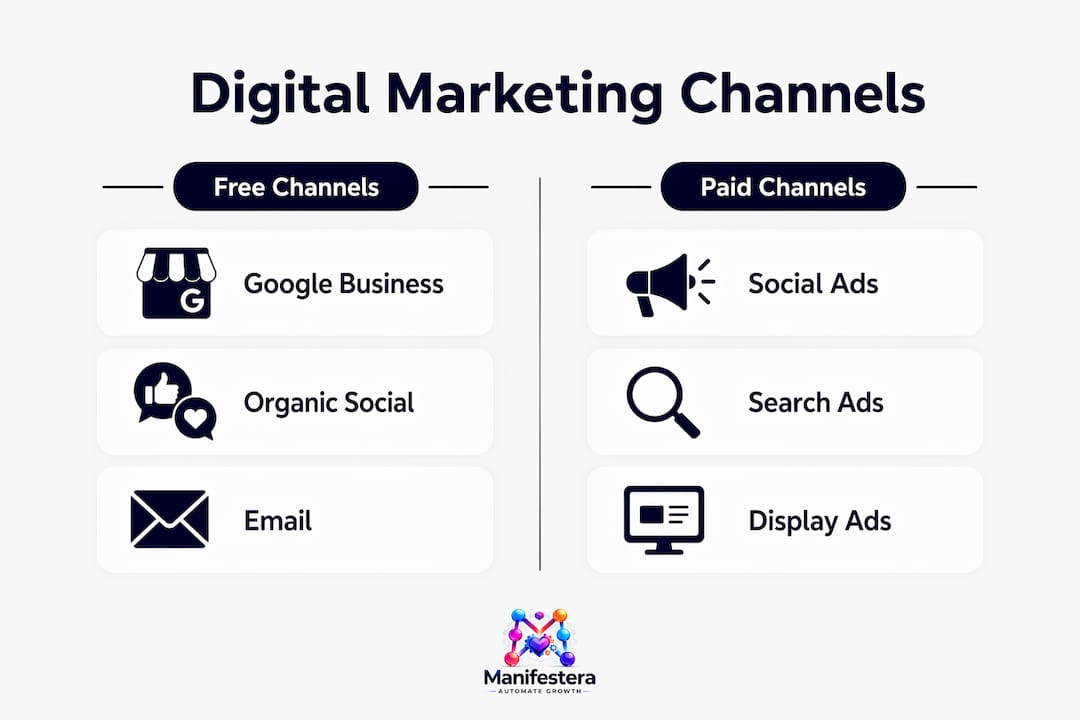
Choosing the right strategy is where most small business owners get stuck. The instinct is to be everywhere at once. That approach produces thin, inconsistent execution across every channel and strong results on none.
The smarter path is to start focused and expand deliberately. Here is a practical framework:
-
Define your primary goal. Are you trying to generate leads, drive foot traffic, grow an email list, or increase online sales? Your goal determines which channel deserves your first investment.
-
Identify where your customers spend time. A B2B service firm will find more traction on LinkedIn than on TikTok. A local restaurant will benefit more from Google Business Profile and Instagram than from a complex email automation sequence.
-
Start with 1 to 2 channels. Capacity constraints mean starting with one or two channels that can be well-executed before expanding. Poor execution across five channels produces worse results than excellent execution on two.
-
Prioritize local SEO first if you serve a geographic area. Local SEO and one social media platform is the recommended starting point for most service-based small businesses. You can read more about effective local SEO to understand the specific tactics that drive local search rankings.
-
Iterate based on data. After 60 to 90 days, review your KPIs. Double down on what is working and cut what is not. Digital marketing strategies for small business are not set-and-forget plans. They require regular adjustment as platforms change and customer behavior shifts.
Pro Tip: If your budget is tight, a low-budget digital marketing strategy built around local SEO and organic social content can generate consistent leads before you spend a dollar on paid ads.
What metrics and tools should small businesses use to measure success?
Measurement separates businesses that grow from those that spin their wheels. The most common mistake is tracking vanity metrics: likes, impressions, and follower counts. These numbers feel good but rarely correlate with revenue.
Meaningful KPIs are those aligned with conversion and business goals. The table below shows the difference between vanity metrics and revenue-driving KPIs:
| Vanity metric | Revenue-driving KPI |
|---|---|
| Social media likes | Lead form submissions |
| Page impressions | Website conversion rate |
| Email open rate | Revenue per email sent |
| Follower count | Customer acquisition cost (CAC) |
| Ad clicks | Cost per qualified lead |
Google Analytics 4 (GA4) is the standard tool for tracking website behavior and conversion events. Linking Google Ads to GA4 enables data-driven attribution, which shows you exactly which touchpoints in the customer journey contributed to a sale. This reduces wasted ad spend and improves return on investment.
Many small business owners track website traffic but miss tracking the conversion events tied to revenue goals. Setting up goal completions in GA4, such as phone call clicks, form submissions, and purchase confirmations, gives you the data you need to allocate budget with confidence.
Pro Tip: Set up at least three conversion events in GA4 before running any paid campaign. Without conversion tracking, you are flying blind on which ads are actually generating revenue.
How can small businesses implement an effective digital marketing plan?
A plan that sits in a document produces nothing. Execution is where results are made. Here is how to move from strategy to action:
-
Claim and optimize your Google Business Profile. Add photos, complete every field, select accurate business categories, and respond to every review. This single step improves your local search visibility immediately and costs nothing.
-
Build or audit your website. Your site needs to load in under three seconds, display correctly on mobile devices, and have clear calls to action on every page. If your site is slow or hard to navigate, every other marketing effort you make will underperform.
-
Develop a consistent social media content schedule. Consistency matters more than volume. Two well-crafted posts per week with strong calls to action outperform daily posts with no clear purpose. Authentic content that shows your team, your process, or your customers builds trust faster than polished promotional graphics.
-
Launch a simple email campaign. Start with a welcome sequence for new subscribers and a monthly newsletter for existing customers. Tools like Mailchimp or Klaviyo make this manageable even without a dedicated marketing team.
-
Test paid advertising once your organic foundation is in place. Google Ads and Facebook Ads work best when your website and tracking are already optimized. Running paid traffic to a slow, unclear website wastes budget. Once your foundation is solid, even a modest daily budget on Facebook Ads can generate qualified leads quickly.
-
Review and adjust every 30 days. Pull your KPIs, identify the top-performing content or campaign, and allocate more resources toward it. Cut anything that has not produced measurable results after 90 days.
For a deeper look at which channels to prioritize, the top digital marketing channels guide breaks down each option with specific recommendations for different business types.
Key takeaways
Digital marketing for small business works when you focus on a few well-executed channels, track revenue-driving KPIs, and adjust your strategy based on real data rather than vanity metrics.
| Point | Details |
|---|---|
| Start with Google Business Profile | It is free, fast to set up, and immediately improves local search visibility. |
| Focus on 1 to 2 channels first | Concentrated execution on fewer channels outperforms thin effort across many. |
| Track conversion events, not likes | KPIs tied to revenue, like cost per lead, reveal what is actually working. |
| Use GA4 and data-driven attribution | Linking Google Ads to GA4 shows the full customer journey and reduces wasted spend. |
| Iterate every 30 to 90 days | Regular review and adjustment keeps your strategy aligned with results and platform changes. |
What we have learned from working with small businesses on digital marketing
The single biggest mistake we see small business owners make is treating digital marketing as a volume game. More posts, more platforms, more ads. The businesses that grow consistently do the opposite. They pick two channels, execute them well, and measure obsessively.
At Manifestera, we have worked with businesses that had zero online presence and built them to the top of local search results within six months. The pattern is always the same: Google Business Profile first, website SEO second, then one paid channel once the organic foundation is producing results. Skipping steps to get to paid ads faster almost always costs more in the long run.
The other pattern we see consistently is small business owners who confuse activity with progress. They post on Instagram every day but have never set up a single conversion event in GA4. They have no idea which posts, if any, are driving customers through the door. Measurement is not optional. It is the mechanism that turns marketing spend into a predictable growth engine.
Be patient. Organic SEO takes three to six months to show meaningful results. That timeline frustrates owners who want immediate returns. But the businesses that commit to it build a compounding asset that keeps generating leads long after the initial work is done. Paid ads stop the moment you stop paying. SEO keeps working.
— Manifestera
Ready to grow your business with expert digital marketing?
Manifestera specializes in helping small and medium-sized businesses build digital marketing systems that generate consistent, measurable growth. From local SEO services that put your business at the top of Google Search to AI-powered lead capture and high-performance paid campaigns, every solution is built around your specific goals and market.
Whether you are starting from scratch or looking to scale what is already working, Manifestera's team brings the data, tools, and experience to get you there faster. Explore digital marketing services in Manhattan and see how a focused, results-driven strategy can transform your online presence into your most reliable source of new customers.
FAQ
What is digital marketing for a small business?
Digital marketing for small business is the use of online channels, including websites, SEO, social media, email, and paid advertising, to attract and convert customers. It gives small businesses access to targeted, measurable marketing at a fraction of traditional advertising costs.
How much should a small business spend on digital marketing?
There is no fixed number, but social media ads can start at $5 per day, making digital advertising accessible at almost any budget. The more important factor is tracking your cost per lead so you can scale spend on channels that produce results.
Which digital marketing channel is best for small businesses?
Google Business Profile is the highest-priority starting point for local and service-based businesses because it is free and directly improves search visibility. After that, the best channel depends on where your customers spend time and what your primary business goal is.
How do small businesses measure digital marketing success?
Meaningful measurement focuses on revenue-connected KPIs like conversion rate, customer acquisition cost, and cost per qualified lead rather than vanity metrics like likes or impressions. Google Analytics 4 is the standard tool for tracking these outcomes.
How long does it take to see results from digital marketing?
Paid advertising can produce leads within days of launching a campaign. Organic SEO typically takes three to six months to generate meaningful traffic, but it builds a compounding asset that continues to deliver results long after the initial investment.