
An NYC same-day delivery SEO strategy is the practice of optimizing your online presence to capture local search queries that signal urgent purchase and rapid fulfillment intent. This discipline sits at the intersection of local SEO, structured data implementation, and hyperlocal content, and it is now shaped heavily by AI-driven platforms like Google Search Generative Experience (SGE) and ChatGPT. Businesses that get this right appear in AI-generated local recommendations, Google's local pack, and transactional search results where customers are ready to buy. The core tools are Google Business Profile, schema markup (specifically Product, ShippingDetails, and LocalBusiness schemas), and neighborhood-targeted content clusters. This guide walks you through each layer of execution so your delivery service shows up when New Yorkers search for it.
How to build your NYC same-day delivery SEO strategy on Google Business Profile
Your Google Business Profile (GBP) is the single most visible local SEO asset you control, and it directly determines whether you appear in Google's local pack for same-day delivery searches. Profiles with consistent data and verified reviews consistently outperform competitors in local rankings. Treat your GBP as a living document, not a one-time setup task.
Start with the fundamentals:
- NAP consistency: Your Name, Address, and Phone number must match exactly across your GBP, website, and every directory listing. Even a minor discrepancy (like "St." vs. "Street") signals unreliability to Google's algorithm.
- Service attributes: Add "same-day delivery" explicitly as a service attribute. Specify your delivery hours and cutoff times (for example, "Order by 3 PM for same-day delivery in Brooklyn").
- Service area: Define your coverage at the borough and neighborhood level. List Manhattan, Brooklyn, Queens, the Bronx, and Staten Island individually if you serve them. Granular service areas improve your visibility for neighborhood-specific queries like "same-day delivery Astoria."
- Posts and updates: Publish weekly GBP posts about delivery promotions, new service areas, or seasonal cutoff changes. Active Google Business Profiles with frequent posts and review responses are significantly more likely to appear in Google's local AI recommendations.
- Review strategy: Ask customers to mention delivery speed and reliability in their reviews. Phrases like "arrived in two hours" or "same-day to the Upper West Side" embed natural keywords into your profile and build social proof simultaneously.
Pro Tip: Respond to every review within 24 hours. Google treats review engagement as a trust signal, and your responses are indexed. Use your reply to naturally include neighborhood names and delivery-related keywords without sounding robotic.
Focusing on transactional keywords with local modifiers like "same-day delivery Manhattan" consistently outperforms broad generic terms in NYC's competitive search environment. Your GBP is where that specificity pays off first.

Does schema markup actually improve visibility for delivery services?
Yes. AI-driven search platforms like Google SGE and ChatGPT now rely heavily on structured data to generate local delivery recommendations. Without the right schema, your business is simply invisible to these systems regardless of how good your content is.
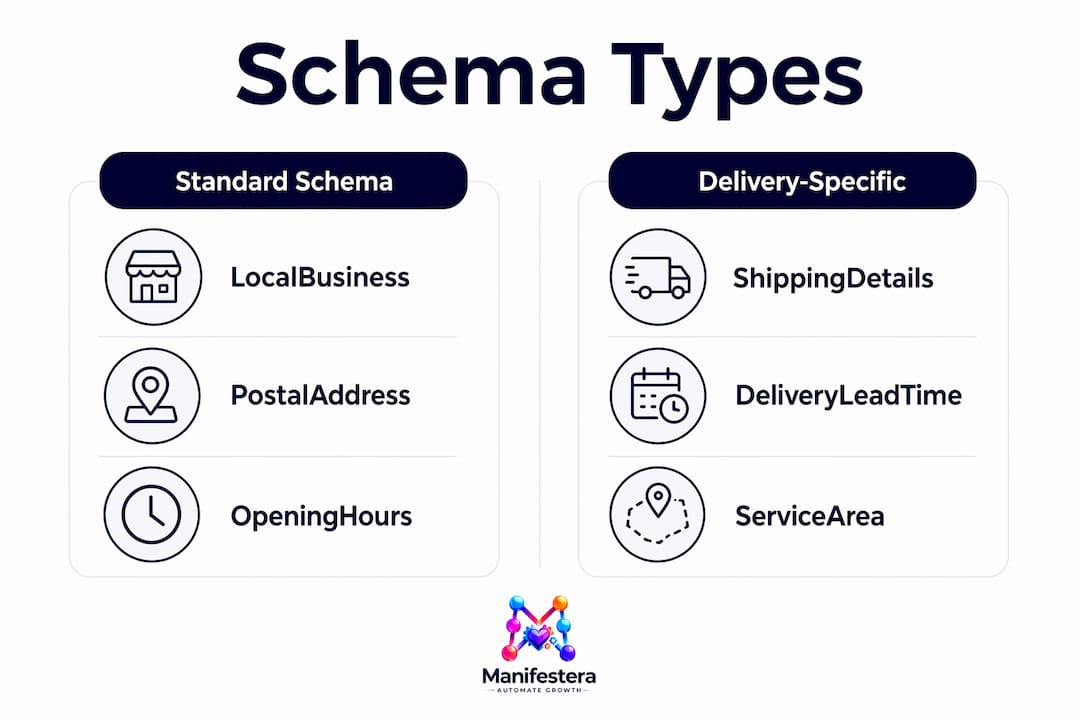
Here are the four schema types every NYC delivery business needs:
- LocalBusiness schema: Defines your business name, address, phone, and service area. Include neighborhood-level "areaServed` properties listing specific NYC neighborhoods like Williamsburg, Harlem, or Astoria.
- Product schema: Marks up individual products with pricing, availability, and offer details. Nest an
Offerobject within each product to specify delivery options. - ShippingDetails schema: This is the most critical for same-day delivery. Specify
deliveryTime,shippingRate, anddoesNotShipexclusions. In 2026, product and delivery page schema must include nested offer objects with precise shipping details reflecting actual same-day cutoffs per neighborhood to maximize AI visibility. - MerchantReturnPolicy schema: Signals trustworthiness to AI systems evaluating whether to recommend your business. Include return windows and conditions clearly.
| Schema Type | Primary Purpose | NYC-Specific Application |
|---|---|---|
| LocalBusiness | Establishes location and service area | List boroughs and neighborhoods in areaServed |
| ShippingDetails | Communicates delivery speed and cutoffs | Set cutoff times per delivery zone (e.g., Manhattan by 2 PM) |
| Product + Offer | Connects products to delivery options | Nest same-day availability flags per product |
| MerchantReturnPolicy | Builds AI trust signals | Specify return eligibility for same-day orders |
Technical and schema-based SEO optimizations typically take 4 to 6 months to reflect in traditional search results. However, AI citation visibility can happen within 4 to 8 weeks if you publish authoritative first-party data alongside your schema. That gap matters: implement schema now and pair it with original delivery performance data to accelerate your results.
Pro Tip: Use Google's Rich Results Test and Schema Markup Validator to check your implementation before publishing. Errors in ShippingDetails schema are the most common reason delivery businesses fail to appear in AI-generated local recommendations.
For implementation, platforms like Shopify offer native schema support through apps like JSON-LD for SEO. WordPress sites can use RankMath or Yoast SEO's schema builder. For custom builds, work directly with a developer to implement JSON-LD in the <head> of each product and delivery page.
How do neighborhood-specific landing pages win same-day delivery searches?
Local landing pages with unique delivery cutoff times, inventory details, and neighborhood-specific FAQs outperform generic pages because they address actual user intent rather than approximate it. A page titled "Same-Day Delivery in Brooklyn" that lists your Williamsburg warehouse cutoff time, available product categories, and real customer testimonials from Brooklyn residents is fundamentally different from a generic delivery page with a borough name swapped in.
Structure your content as a hub-and-spoke model:
- Hub page: A central "NYC Same-Day Delivery" page that covers your full service area, delivery promise, and links to all borough pages.
- Spoke pages: Individual pages for Manhattan, Brooklyn, Queens, the Bronx, and Staten Island. Each spoke page should then link to neighborhood-level pages (e.g., "Same-Day Delivery in Astoria, Queens").
- Neighborhood pages: The most granular level. These pages should include specific cutoff times, available inventory for that area, local FAQs, and delivery testimonials from customers in that neighborhood.
The internal linking between hub, spoke, and neighborhood pages builds topical authority. Google reads this structure as a signal that you are the definitive resource for same-day delivery in NYC, not just a business that mentions it once.
| Generic page | Neighborhood-specific page |
|---|---|
| "We deliver across NYC" | "Same-day delivery in Astoria, Queens by 4 PM" |
| No cutoff times listed | "Order by 2 PM for delivery before 6 PM" |
| Generic product availability | "Electronics and groceries available for same-day in this area" |
| No local social proof | Testimonials from Astoria customers with delivery times |
Original first-party data unique to your business, like delivery performance stats or customer satisfaction scores by neighborhood, creates defensible SEO content that AI systems cite frequently. Publish your average delivery time per borough. Share your on-time delivery rate. These numbers cannot be replicated by competitors and they give AI systems a concrete reason to recommend you. You can also find complementary approaches in hyperlocal digital marketing to reinforce this neighborhood-level strategy.
Avoid doorway pages at all costs. Google defines doorway pages as multiple pages targeting similar queries with minimal differentiation. If your Brooklyn and Queens pages share 80% of the same copy with only the borough name changed, they will be penalized. Every neighborhood page must earn its existence with genuinely unique content.
Quick SEO wins and common pitfalls to fix right now
Fast improvements exist that do not require months of content production. Start with your title tags. Optimizing title tags to include your brand and primary keywords under 60 characters directly improves click-through rates in search results. A title like "Same-Day Delivery in Manhattan | YourBrand" is specific, under 60 characters, and signals exactly what the page delivers.
Additional quick wins worth prioritizing:
- Meta descriptions: Write 150 to 160 character descriptions that include your delivery cutoff time and a call to action. "Order by 3 PM for same-day delivery across Manhattan. Shop now." This copy appears in search results and directly influences click-through.
- Mobile-first performance: INP (Interaction to Next Paint) is now a Core Web Vital with an optimal threshold under 200ms. Slow, unresponsive pages lose rankings and customers simultaneously. Use Google PageSpeed Insights to identify and fix INP issues on your delivery and product pages.
- Crawl error audits: Use Google Search Console to identify 404 errors, redirect chains, and pages blocked by robots.txt. Delivery service pages that cannot be crawled cannot rank.
Common pitfalls that undermine NYC delivery SEO include outdated delivery hours on your website (especially around holidays), inconsistent NAP data across Yelp, Google, and your own site, and duplicate content across borough pages. Each of these is fixable within a week with the right audit process.
Pro Tip: Set a monthly calendar reminder to audit your delivery hours, cutoff times, and service area pages. NYC delivery logistics change frequently, and outdated information not only hurts rankings but also destroys customer trust when someone orders expecting same-day delivery and does not receive it.
AI-driven search requires businesses to shift from keyword stuffing to structured, transparent, and easily parsable content for local visibility. That means clean page architecture, accurate data, and content that answers specific questions rather than padding pages with repeated keyword variations. Tools like Google Search Console, Screaming Frog, and Ahrefs give you the data to make these fixes with precision. For a broader view of why this matters for your business specifically, the NYC business SEO landscape in 2026 has shifted significantly toward AI-mediated discovery.
Key takeaways
A winning NYC same-day delivery SEO strategy requires Google Business Profile optimization, precise schema markup, and neighborhood-specific content that reflects real delivery capabilities.
| Point | Details |
|---|---|
| Google Business Profile is foundational | Keep NAP consistent, add same-day delivery attributes, and respond to reviews within 24 hours. |
| Schema markup drives AI visibility | Implement ShippingDetails, LocalBusiness, and Product schemas with neighborhood-level delivery cutoff data. |
| Neighborhood pages must be genuinely unique | Differentiate each page with real cutoff times, local testimonials, and neighborhood-specific inventory details. |
| First-party data creates defensible content | Publish your own delivery stats and satisfaction scores to earn AI citations competitors cannot replicate. |
| Quick technical fixes compound fast | Fix title tags, INP scores, and NAP inconsistencies first for the fastest ranking improvements. |
Why most NYC delivery businesses are still leaving visibility on the table
From Manifestera's experience working with NYC-based e-commerce and delivery brands, the most common failure is not a lack of effort. It is a lack of specificity. Businesses publish a "same-day delivery" page, add a borough name, and expect results. What Google and AI systems actually reward is operational transparency: real cutoff times, real service zones, real customer outcomes.
The shift to AI-mediated search has made this more urgent. AI models boost visibility for transactional, same-day delivery focused queries specifically because users asking those questions have high purchase intent. If your structured data and content are not precise enough for an AI system to extract and present your delivery promise confidently, you will not be recommended.
The businesses we see winning in 2026 treat their SEO as an operational reflection of their actual service. Their schema matches their logistics. Their landing pages reflect their real delivery windows. Their GBP posts announce actual changes to their service. That alignment between operations and content is what builds the trust signals that both Google and AI systems reward. SEO is not a checklist you complete once. It is an ongoing commitment to accurately representing what you actually deliver, and in NYC's competitive market, that accuracy is your competitive advantage.
— Manifestera
How Manifestera helps NYC businesses dominate delivery search
Manifestera specializes in local SEO and AI-driven search optimization for NYC businesses, with deep expertise in same-day delivery marketing and neighborhood-level targeting.
If your delivery business is not appearing in Google's local pack or AI-generated recommendations, the gap is almost always in schema implementation, GBP optimization, or content specificity. Manifestera builds the full stack: structured data, neighborhood landing pages, and GBP management tailored to your actual delivery zones. Our NYC SEO services are built around measurable outcomes, not generic tactics. For businesses operating in or targeting Manhattan specifically, our Manhattan digital marketing team brings borough-level expertise to every campaign. Get in touch to see exactly where your current strategy is leaving visibility behind.
FAQ
What is an NYC same-day delivery SEO strategy?
An NYC same-day delivery SEO strategy is the process of optimizing your website, Google Business Profile, and structured data to appear in local search results for urgent, transactional delivery queries. It combines local SEO, schema markup, and neighborhood-specific content to capture customers searching for rapid fulfillment in specific NYC boroughs and neighborhoods.
How long does it take to see results from delivery SEO?
Schema and technical SEO changes typically take 4 to 6 months to fully reflect in traditional rankings, but AI citation visibility can appear within 4 to 8 weeks when paired with authoritative first-party data. Google Business Profile improvements often show results faster, sometimes within days of updating service attributes and hours.
Which schema types matter most for same-day delivery businesses?
ShippingDetails schema is the most critical because it communicates your delivery speed and cutoff times directly to AI systems. Pair it with LocalBusiness schema for service area definition and Product schema with nested Offer objects to connect individual products to your same-day availability.
How do I avoid creating doorway pages for NYC neighborhoods?
Each neighborhood page must contain genuinely unique content: specific cutoff times for that area, local customer testimonials, neighborhood-specific inventory availability, and FAQs that reflect real questions from customers in that location. Pages that share more than 20% of their body copy with other borough pages risk being treated as doorway pages by Google.
What are the fastest SEO wins for a NYC delivery business?
Optimizing title tags to under 60 characters with specific delivery keywords, fixing NAP inconsistencies across all directory listings, and adding same-day delivery attributes to your Google Business Profile deliver the fastest measurable improvements. Addressing INP performance issues on mobile product pages is also a high-impact fix that improves both rankings and conversion rates simultaneously.