

If you run a retail shop or local service in New York City, why NYC shoppers need local targeting is not an abstract question. It is the difference between your Google Ads budget reaching someone three blocks away who is ready to buy and burning that same money on someone in a different borough who will never walk through your door. NYC shoppers do not search the way shoppers in other cities do. They search by neighborhood, by proximity, and by the specific culture of where they live. Broad marketing misses all of that.
Table of Contents
- Key Takeaways
- Why NYC shoppers need local targeting: the core case
- How NYC shopper behavior makes hyperlocal targeting non-negotiable
- NYC regulations and what they mean for your targeting strategy
- Practical ways to optimize local targeting for your NYC business
- Measuring what works and avoiding common mistakes
- My take on hyperlocal versus broad reach in NYC
- How Manifestera helps NYC retailers dominate their neighborhoods
- FAQ
Key Takeaways
| Point | Details |
|---|---|
| Neighborhood-level precision wins | NYC shoppers search by neighborhood terms, so targeting by ZIP code or district captures far more intent than citywide campaigns. |
| Local targeting lifts engagement significantly | 84% of marketers report higher engagement from location-targeted campaigns compared to broad approaches. |
| NYC regulations are reshaping ad strategy | New city council bills restrict personal data use for pricing, making transparent location-based targeting the safest and smartest path forward. |
| Offline and online presence work together | Combining direct mail, local events, and digital ads builds the neighborhood familiarity that converts NYC shoppers into repeat customers. |
| Measurement by neighborhood matters | Track foot traffic, engagement rates, and conversions at the neighborhood level to refine spend and eliminate wasted budget. |
Why NYC shoppers need local targeting: the core case
Let's define the terms before getting into strategy. Geo-targeting means showing ads or content to users based on their geographic location, whether that is a city, ZIP code, or radius around a specific address. Hyperlocal marketing takes that a step further, focusing on very tight geographic areas like a single neighborhood or even a few city blocks. Geotagging attaches location metadata to content, making it discoverable by people searching in that area.
In most American cities, targeting at the city level works reasonably well. New York City is not most cities. It contains over 300 distinct neighborhoods, each with its own shopping culture, income profile, and commuter behavior. A campaign targeting "New York City" treats Flushing the same as the West Village. That is not precision. That is guessing.
Location data for targeting comes from multiple sources:
- GPS signals from mobile devices provide the most accurate real-time location
- IP address data gives a general location, usually down to the ZIP code
- WiFi network data can place a user within a specific block or building
The importance of local SEO in this context is significant. When someone in Astoria opens Google and searches for a service, Google uses their location to surface the most geographically relevant results. If your business is not optimized for that neighborhood specifically, you will lose that click to a competitor who is. Neighborhood targeting reduces wasted ad spend and dramatically increases campaign relevance and conversion rates.
Pro Tip: Set your Google Business Profile to include the specific NYC neighborhoods you serve, not just your borough or city. Google uses this data to match you with hyperlocal searches.
How NYC shopper behavior makes hyperlocal targeting non-negotiable
The way people in New York City search for services tells you everything you need to know about how to market to them. They are intensely neighborhood-loyal. Residents of Astoria do not typically search "dentist New York City." They search "dentist Astoria". The same pattern holds for restaurants, dry cleaners, tutors, personal trainers, and virtually every local service category.
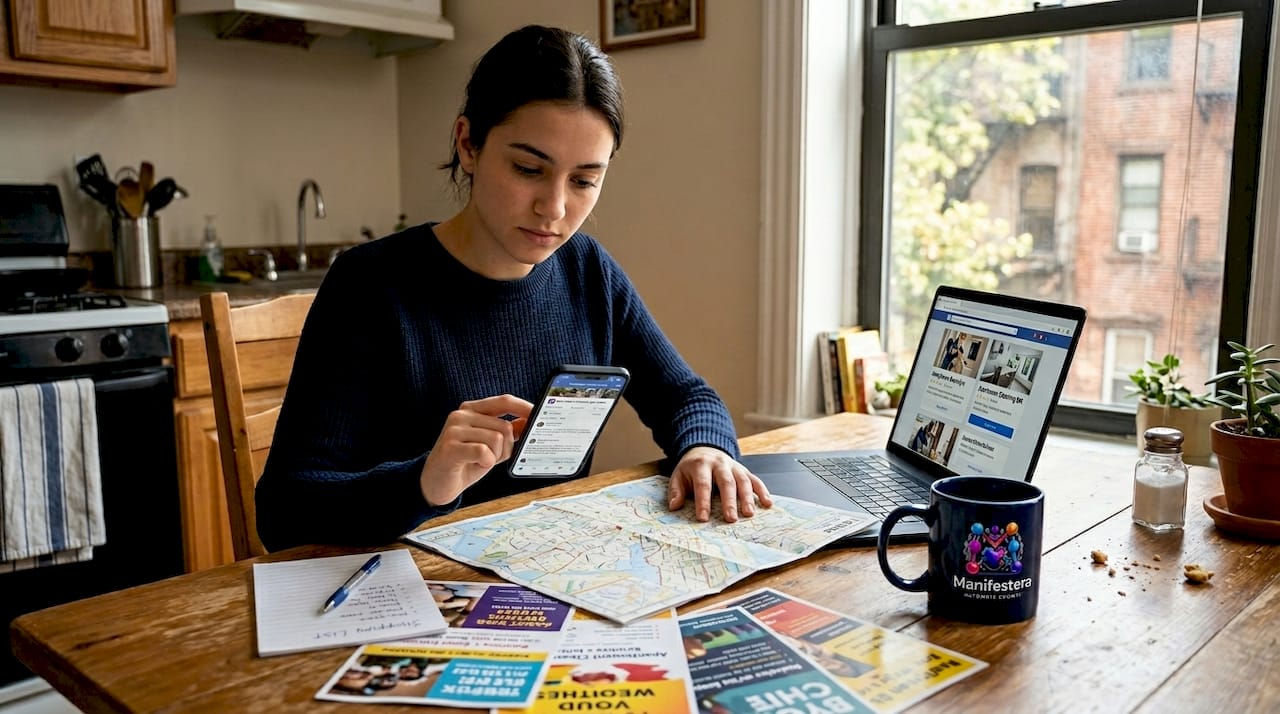
This behavior reflects how NYC residents actually navigate their city. Most New Yorkers have a tight daily radius. They commute by subway or on foot. Their gym, coffee shop, and doctor are all chosen based on what is close and convenient to either home or work. Shoppers preferences in NYC are shaped by neighborhood identity and transit access, not by which business has the slickest citywide campaign.
Here is what happens when you ignore this and run broad targeting:
- You pay for clicks that will never convert. Someone in the Bronx clicking your ad for a Brooklyn boutique is almost never going to make that trip. That click costs you the same as one from someone two blocks away.
- You lose trust signals. NYC shoppers look for businesses that feel like they belong to the neighborhood. Generic ads that do not reference local landmarks, streets, or community culture feel distant and irrelevant.
- You fall behind competitors who are targeting precisely. A competitor running neighborhood-specific ads with location-specific copy will consistently outperform a broad campaign on both cost-per-click and conversion rate.
- Your ad spend does not scale efficiently. Enhancing sales through local targeting requires spending money on people who can actually reach you. Wasted impressions inflate your costs without building real revenue.
Consider a hypothetical case. A Williamsburg coffee shop runs Google Ads targeting "Brooklyn." Its budget gets split across Canarsie, Bay Ridge, and Flatbush, neighborhoods where nobody is going out of their way to visit an artisan coffee shop they have never heard of. Switch that same budget to a one-mile radius around the shop, layered with neighborhood-specific keywords, and the cost-per-conversion drops sharply while foot traffic increases.
"The businesses that win in NYC are not the ones with the biggest budgets. They are the ones who know exactly which three neighborhoods they own and show up consistently in those places."
NYC regulations and what they mean for your targeting strategy
Local targeting benefits NYC businesses in another critical way that most retailers have not considered. New York City is actively restricting the kind of personalized, data-heavy pricing and advertising that many retailers have come to rely on.
NYC council bills now restrict retailers from using personal data to set individualized prices and limit how frequently algorithm-driven price changes can occur. The legislation specifically targets what city officials call "surveillance pricing," the practice of adjusting what individual customers pay based on their browsing history, purchase behavior, or personal profile data. Digital shelf labels and algorithmic pricing in NYC grocery stores have already triggered scrutiny, even before surge pricing became widespread.
For retailers and service providers, this creates a clear strategic direction:
- Move away from personal data-dependent ad personalization toward location-based and contextual targeting
- Use ZIP code and neighborhood targeting as your primary geographic signal instead of behavioral profiles
- Prioritize transparency in your pricing and promotions to align with consumer trust expectations and avoid regulatory exposure
- Adopt a compliant marketing approach that builds your brand reputation rather than extracting short-term gains from invasive data practices
The compliance angle is actually good news for local targeting strategy. Location-based marketing does not rely on sensitive personal data. It uses geography, which is far less invasive and far more acceptable to the privacy-conscious NYC consumer. When you show someone an ad because they are physically near your store, that feels relevant and helpful. When you show someone an ad because you have been tracking their online behavior across dozens of websites, that feels intrusive. NYC shoppers are increasingly aware of the difference, and they respond better to the former.
Practical ways to optimize local targeting for your NYC business
Getting local targeting right in NYC requires more than simply drawing a circle on a map. Here is a step-by-step approach that works for retailers and service providers in this market.
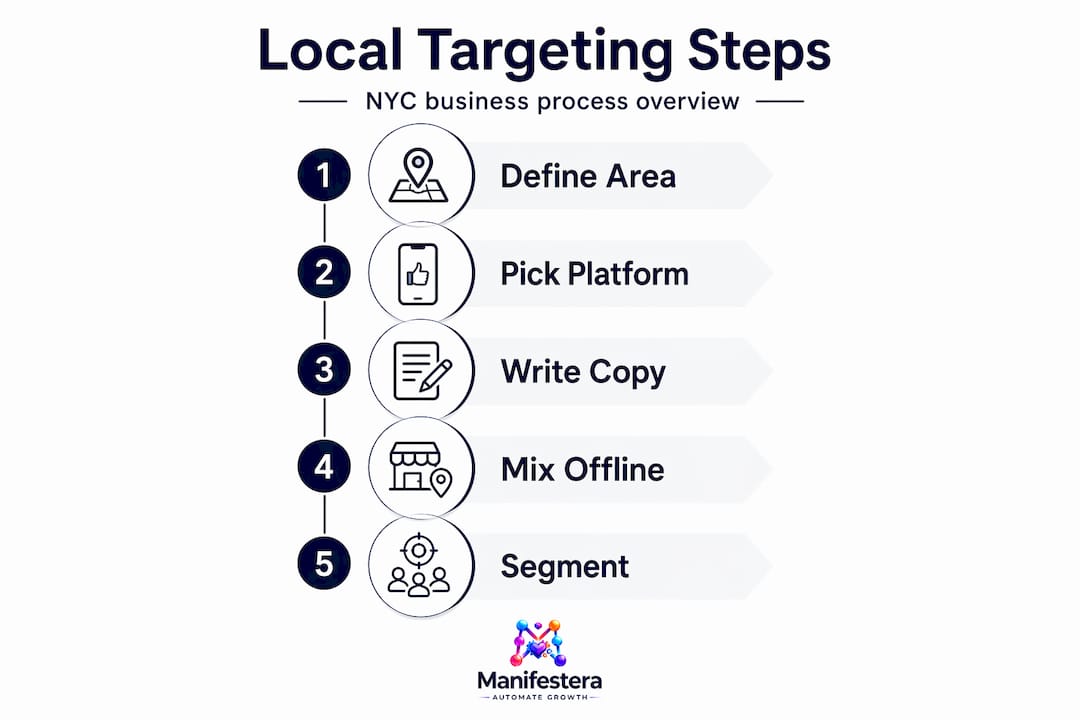
Step 1: Define your geographic goals at the neighborhood level. Identify which two or three neighborhoods represent your highest-value customers. Use your current sales data, Google Analytics geographic reports, or simply your own knowledge of where your regulars come from.
Step 2: Choose your platforms strategically. Different platforms offer different local targeting capabilities.
| Platform | Best for | NYC-specific strength |
|---|---|---|
| Google Ads | High-intent local searches | ZIP code and radius targeting with local search terms |
| Meta Ads (Facebook/Instagram) | Awareness and retargeting | Neighborhood-level audience segmentation |
| LinkedIn Ads | B2B local services | Industry and location filters for NYC professionals |
Step 3: Write location-specific ad copy. Reference actual streets, subway stops, or neighborhood landmarks in your ads. An ad that says "Two blocks from the L train in Bushwick" speaks directly to the person searching from that area. Generic copy does not.
Step 4: Combine digital with offline presence. Direct mail combined with digital ads creates a feedback loop that builds brand familiarity and increases both online engagement and foot traffic. Send a postcard to a specific ZIP code and run a coordinated Google Ads campaign to the same area at the same time. The dual exposure reinforces recognition.
Step 5: Use customer visit history for retargeting. If you have a loyalty program or email list, segment it by neighborhood and run retargeting campaigns to customers within a specific area. This is one of the strongest applications covered in an NYC retargeting checklist for local businesses.
Pro Tip: For NYC audience segmentation on Meta Ads, use the "People who live in this location" option rather than "People recently in this location" when building your core neighborhood audience. This filters out tourists and commuters passing through.
PPC geo-targeting also improves conversion rates by delivering ads only in areas where your budget can generate real foot traffic. Do not pay to reach people who are physically unable to act on your offer.
Measuring what works and avoiding common mistakes
The benefits of hyperlocal targeting in NYC only materialize if you are measuring the right things. Many retailers track impressions and clicks, but those numbers tell you very little about whether local targeting is actually working.
Focus on these metrics:
- Foot traffic lift: Use Google Business Profile insights to track direction requests and calls from specific areas after campaign launches
- Neighborhood-level conversion rates: Break your Google Analytics data down by ZIP code to see which areas are actually converting versus just browsing
- Cost per store visit: Google Ads offers store visit conversion tracking for eligible accounts, giving you a direct connection between digital spend and physical visits
- Response rates by neighborhood: If you are running direct mail alongside digital, track redemption rates by ZIP code to identify your strongest markets
The most common mistakes NYC businesses make in local targeting campaigns come down to three things. First, they set a radius that is too large, often five or ten miles, which in NYC spans multiple boroughs and dozens of irrelevant neighborhoods. Second, they use outdated or inaccurate location data, targeting ZIP codes that no longer reflect their customer base. Third, they run campaigns without consistent timing, missing the specific windows when NYC shoppers are most active, such as lunch hours near office districts or weekend mornings in residential neighborhoods.
Combining digital and physical presence consistently improves brand recognition and trust among local customers. NYC consumer behavior rewards businesses that feel embedded in the community, not just visible on a screen.
My take on hyperlocal versus broad reach in NYC
I have worked with retailers and service businesses across multiple NYC neighborhoods, and the pattern I see consistently is this: the businesses that insist on citywide campaigns because they want "maximum exposure" almost always underperform the businesses that go deep on two or three neighborhoods first.
Broad reach sounds logical. More people, more chances. But in NYC, breadth without proximity is noise. A resident of Park Slope who sees your ad for a specialty butcher in Astoria is not going to make that trip on a Wednesday evening. You spent money to remind them that your shop exists somewhere far away.
What actually builds a customer base in this city is repeated, relevant exposure within a tight geographic area. When someone in your target neighborhood sees your ad, gets a flyer in their mailbox, walks past your storefront, and sees you tagged in a local Instagram post, you become familiar. Familiarity drives trust. Trust drives purchase decisions. Analytics-driven marketing can help you measure exactly where that familiarity is building and where it is not.
The other thing I push back on is the idea that big data replaces local knowledge. Knowing that Astoria has a large Greek-American community, that Williamsburg skews young and creative, or that the Upper East Side has a high concentration of medical professionals changes how you write copy, which platforms you prioritize, and even what products you feature. No algorithm hands you that context automatically. You have to build it deliberately.
— Manifestera
How Manifestera helps NYC retailers dominate their neighborhoods
Winning with local targeting in NYC requires the right tools, the right data, and a team that actually understands how this city works at the neighborhood level.
Manifestera builds local SEO strategies tailored to specific NYC neighborhoods and boroughs, from Manhattan to the Bronx. The agency runs Google Ads and Facebook Ads campaigns with precise ZIP code and radius targeting, combined with AI-powered lead capture systems that work around the clock. Whether you need to own the search results in your neighborhood or build a retargeting pipeline that converts nearby shoppers into loyal customers, Manifestera delivers measurable ROI at every step. Explore how a NYC-focused digital marketing partner can help your business grow in the neighborhoods that matter most to you.
FAQ
What is hyperlocal targeting in NYC marketing?
Hyperlocal targeting means delivering ads or content to consumers within a very tight geographic area, such as a specific neighborhood or ZIP code. In NYC, this approach captures the neighborhood-centric search behavior that drives most local purchase decisions.
Why does local targeting matter more in NYC than other cities?
NYC's density and neighborhood diversity mean that a citywide campaign wastes significant budget on consumers who are unlikely to visit your location. Neighborhood-level targeting reaches people with actual intent and proximity to act.
How does local SEO improve visibility for NYC retailers?
Local SEO optimizes your online presence for searches that include neighborhood or ZIP code terms, helping you appear in Google Maps results and local search packs. This directly connects you to nearby shoppers at the moment they are looking to buy.
Does NYC's algorithmic pricing regulation affect digital advertising?
The regulations restrict using personal data for individualized pricing, which pushes retailers toward location-based targeting as a compliant and consumer-friendly alternative. Geographic targeting does not rely on sensitive personal data and remains fully permissible.
How do you measure the success of a local targeting campaign in NYC?
Track foot traffic through Google Business Profile insights, monitor ZIP code-level conversion rates in Google Analytics, and measure cost per store visit through Google Ads. Breaking performance down by neighborhood reveals exactly where your budget is working and where it needs adjustment.