

A marketing automation platform is software that uses workflows and triggers to automatically execute marketing actions across email, SMS, social, and other channels without manual intervention. Platforms like Salesforce Marketing Cloud, HubSpot, and Klaviyo have made this technology accessible to businesses of every size, turning what once required a full marketing team into a set of rules that run around the clock. The core promise is simple: define your customer journey once, and the platform delivers the right message to the right person at the right time. For business owners and marketing professionals focused on lead generation and customer engagement, understanding how these tools work is the first step toward using them effectively.
What is a marketing automation platform and how does it work?
A marketing automation platform is defined as a software system that automates marketing actions via workflows based on customer behaviors and timelines, removing the need for manual message sending. Think of a workflow as a set of instructions: if a contact fills out a form, the platform sends a welcome email, waits two days, then sends a follow-up if no reply was recorded. The platform executes those instructions without anyone pressing send.
The industry also uses the term marketing automation software interchangeably with "platform," though "platform" typically implies broader capabilities including CRM integration, analytics dashboards, and multi-channel orchestration beyond basic email. Knowing this distinction helps when you are comparing marketing automation solutions from vendors who position their products differently.
Workflows represent the core operational logic of these systems. Workflows define what action to take and when, making the platform an instructions-driven execution engine rather than just a bulk email sender. Triggers can be behavioral (a contact clicks a link, visits a pricing page, or goes inactive for 30 days) or time-based (send a renewal reminder 14 days before a subscription expires).

The result is that your marketing operates continuously. A lead who downloads a whitepaper at 2 a.m. on a Sunday enters a nurture sequence immediately, not when someone checks their inbox Monday morning.
How does marketing automation work across channels?
Modern platforms go well beyond email. Klaviyo unifies channels including email, SMS, push notifications, WhatsApp, and social media to deliver personalized, automated experiences from a single interface. This matters because customers do not live in one channel, and a platform that only handles email forces you to manage separate tools for each touchpoint.
The mechanism behind multi-channel delivery is customer data integration. The platform pulls behavioral data from your website, e-commerce store, CRM, and mobile app, then uses that data to decide which channel and message fits each contact at a given moment. A contact who ignores three emails but opens every SMS gets routed to the text message path automatically.
Here is how a typical multi-channel workflow operates:
- Trigger: Contact submits a lead form on your website
- Day 0: Automated welcome email with a resource link
- Day 2: If email unopened, send an SMS follow-up
- Day 5: If no engagement, add contact to a retargeting audience on Facebook
- Day 10: If still inactive, move contact to a re-engagement sequence or suppress from active campaigns
CRM integration is what connects marketing automation to your sales team. When a contact reaches a qualifying lead score, the platform can create a task in Salesforce or HubSpot CRM, notify a sales rep, and pause marketing messages so the rep can take over. This handoff prevents the awkward scenario where a prospect receives a promotional email the same day a salesperson calls them.
Pro Tip: Map every channel your customers actually use before selecting a platform. If your audience skews toward SMS and WhatsApp, a platform strong only in email will limit your reach from day one.
What features differentiate marketing automation platforms?
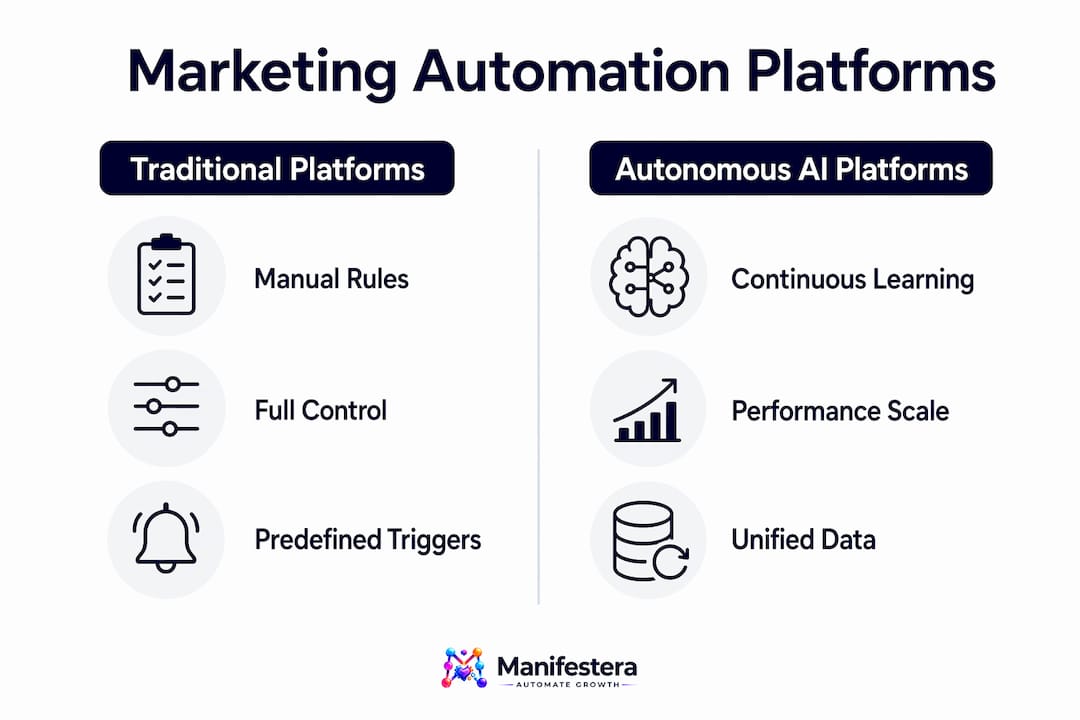
Not all marketing automation tools are built the same way. The clearest dividing line in 2026 is between traditional rule-based platforms and autonomous AI-driven platforms.
| Feature | Traditional platforms | Autonomous AI platforms |
|---|---|---|
| Workflow setup | Manual, predefined rules | AI agents build and adjust rules automatically |
| Optimization | Static until manually updated | Continuous, real-time adjustment |
| Personalization | Segment-based | Individual-level, behavior-driven |
| Operation hours | Executes rules 24/7 | Analyzes and decides 24/7 |
| Data requirement | Moderate | High quality, unified data required |
| Best for | Predictable, structured journeys | Dynamic, high-volume customer bases |
Traditional platforms like HubSpot and Klaviyo give you full control over every rule and trigger. You decide what happens at each step, which works well when your customer journey is predictable and your team has the bandwidth to build and maintain workflows. These are still the best marketing automation software options for most small and mid-sized businesses starting out.
Autonomous platforms, like ActiveCampaign's AI-powered system, operate differently. AI agents continuously analyze customer behavior and adjust messaging, timing, targeting, and budget allocation without waiting for a human to update a rule. The platform does not just execute your instructions. It learns what works and changes course on its own.
The trade-off is real. Autonomous platforms deliver higher performance at scale, but they require clean, unified data and clear governance to function correctly. If your contact database is fragmented or your goals are poorly defined, an AI-driven platform will optimize toward the wrong outcomes just as efficiently as the right ones.
Pro Tip: If you are evaluating AI-driven platforms, ask vendors specifically how their system handles conflicting signals, such as a contact who is both a re-engagement target and a new upsell candidate. The answer reveals how mature their decision logic actually is.
How to use marketing automation platforms effectively
Getting value from a marketing automation platform depends less on the tool you choose and more on how you implement it. These are the practices that separate high-performing programs from ones that generate noise.
-
Define your customer lifecycle stages first. Before building a single workflow, map out the stages a contact moves through from first touch to closed customer to loyal advocate. Mapping customer events to lifecycle stages and lead scores creates the foundation that makes downstream automation meaningful. Without this, your workflows operate in isolation.
-
Use journey automation instead of isolated workflows. HubSpot's journey automation models customer engagement as stages with branching paths, keeping strategy, enrollment logic, and performance analysis in one unified view. This approach prevents the common problem of contacts entering five separate workflows that send conflicting messages.
-
Build guardrails into every journey. Exit criteria and suppression rules prevent contacts from re-enrolling in a journey they already completed or receiving messages that no longer apply. A contact who became a customer should exit the lead nurture sequence immediately, not after the next scheduled send.
-
Connect automation to sales handoffs explicitly. Define the lead score threshold or behavioral trigger that moves a contact from marketing to sales. Document it, build it into the platform, and review it quarterly. Automation that generates leads but never closes them is a cost center, not a growth driver.
-
Audit your data before launch. Duplicate records, missing fields, and inconsistent naming conventions will cause your automation to misfire. Spend time cleaning your CRM and contact database before connecting it to your platform. You can learn more about why clean workflows matter for long-term efficiency.
Pro Tip: Set a 90-day review cadence for every active journey. Contacts' behaviors change, and a workflow that performed well at launch can become irrelevant or counterproductive within a quarter.
Examples of marketing automation platforms and use cases in 2026
The best way to understand what a marketing automation platform delivers is to see it applied to real scenarios.
Lead generation and nurturing is the most common use case. A contact downloads a guide from your website, enters a nurture sequence, receives three educational emails over two weeks, and is flagged for sales outreach when they visit your pricing page. This sequence runs without any manual involvement after the initial setup.
Customer re-engagement targets contacts who have gone quiet. A platform like Klaviyo can identify customers who have not purchased in 90 days and automatically send a personalized offer via email and SMS. Unified customer data across channels makes this kind of targeted re-engagement possible without building separate lists for each channel.
Personalized content delivery uses behavioral data to serve different messages to different segments. A SaaS company might send onboarding tips to new users, feature announcements to power users, and upgrade prompts to users approaching plan limits, all from the same platform running simultaneously.
Here is a snapshot of leading platforms and their primary strengths:
| Platform | Primary strength | Best for |
|---|---|---|
| Salesforce Marketing Cloud | Enterprise-scale CRM integration | Large organizations with complex sales cycles |
| HubSpot | All-in-one marketing and CRM | SMBs wanting one unified system |
| Klaviyo | E-commerce personalization | D2C and retail brands |
| ActiveCampaign | AI-driven autonomous marketing | Growing businesses needing dynamic optimization |
Emerging trends shaping these tools in 2026 include AI-powered personalization at the individual level, unified cross-channel reporting that ties revenue to specific automation sequences, and B2B outreach automation that removes the need for manual prospecting sequences. For a deeper look at how AI is reshaping these tools, the AI marketing automation guide covers the full picture.
Key takeaways
A marketing automation platform delivers measurable results only when workflows are built on clean data, mapped to defined lifecycle stages, and governed with clear goals.
| Point | Details |
|---|---|
| Core definition | A platform automates marketing actions via workflows and triggers across multiple channels. |
| Traditional vs. AI-driven | Rule-based platforms offer control; autonomous AI platforms optimize continuously but require clean data. |
| Journey design matters | Model campaigns as staged journeys with branching paths, not isolated workflows, for better performance. |
| CRM integration is critical | Connecting automation to your CRM enables proper sales handoffs and closes the loop on lead management. |
| Governance prevents failure | AI-driven platforms need defined goals and quality data inputs to avoid optimizing toward wrong outcomes. |
Manifestera's take on marketing automation in practice
After working with dozens of businesses on automation implementation, the pattern that separates successful programs from stalled ones is almost never the platform choice. It is the quality of the thinking that goes into the setup.
Most teams rush to build workflows before they have answered the foundational questions: What does a qualified lead look like? What lifecycle stage triggers a sales conversation? What does re-engagement actually mean for this specific customer base? Without those answers, even the best marketing automation software produces a lot of activity with limited revenue impact.
The other thing worth saying plainly: autonomous AI platforms are genuinely powerful, but they are not a shortcut around strategic thinking. AI agents require governance including defined goals, acceptable actions, and quality data to optimize effectively. Handing an AI platform a messy contact database and vague objectives is a reliable way to automate mediocre results at scale.
What we have found works consistently is starting with two or three high-impact journeys, getting the data clean, and measuring rigorously before expanding. The businesses that scale automation successfully treat it as a system to be refined, not a switch to be flipped. The efficiency gains are real, and the benefits of automated workflows compound over time. But they require the same discipline as any other growth strategy.
— Manifestera
How Manifestera helps you implement marketing automation
If you are ready to move from evaluating platforms to actually generating leads and revenue from them, Manifestera builds and manages the full system for you.
Manifestera is a New York City-based digital marketing agency that specializes in AI-powered lead capture, multi-channel nurture sequences, and CRM-connected campaign management for small and mid-sized businesses. The team handles platform selection, data cleanup, journey design, and ongoing optimization so you are not starting from scratch or guessing at best practices. Whether you need a complete automation build or want to improve an existing program, explore Manifestera's AI automation services to see how the agency approaches implementation for businesses ready to scale.
FAQ
What is a marketing automation platform in simple terms?
A marketing automation platform is software that sends the right marketing message to the right person at the right time, automatically, based on rules you define. It replaces manual tasks like sending individual emails or follow-ups by executing them through workflows triggered by customer actions.
How does marketing automation work with a CRM?
Marketing automation platforms integrate with CRM systems to sync lead data, update contact records, and trigger sales handoffs when a lead reaches a qualifying score or behavior. This connection ensures marketing and sales teams work from the same information without manual data transfers.
What are the main features of a marketing automation platform?
Core features include workflow builders, behavioral triggers, multi-channel messaging (email, SMS, push), lead scoring, CRM integration, journey analytics, and audience segmentation. AI-driven platforms add continuous optimization, autonomous decision-making, and predictive personalization on top of these foundations.
What is the difference between traditional and autonomous marketing automation?
Traditional platforms execute predefined rules you set manually, while autonomous AI platforms like ActiveCampaign continuously analyze behavior and adjust messaging, timing, and targeting without human input. Autonomous platforms perform better at scale but require clean data and clear governance to avoid optimizing toward the wrong goals.
Which marketing automation platform is best for small businesses?
HubSpot and ActiveCampaign are consistently strong choices for small businesses because they combine ease of use with deep functionality. HubSpot works well when you want marketing and CRM in one place, while ActiveCampaign suits businesses that want AI-driven optimization without enterprise-level complexity or cost.