

Account-based marketing gets misread more often than almost any other B2B strategy. Most marketing professionals hear "ABM" and picture a slightly fancier version of personalized email outreach. In reality, understanding account-based marketing means recognizing it as a full revenue strategy where sales and marketing stop operating in separate lanes and start targeting specific high-value accounts together. And in 2026, with AI agents now actively conducting enterprise buying research, the classic ABM playbook is being rewritten faster than most teams realize.
Table of Contents
- Key takeaways
- What is account-based marketing and how it differs from traditional strategies
- How AI and agent-based marketing are changing ABM
- Key components of a modern account-based marketing strategy
- Implementing ABM: frameworks, workflows, and collaboration models
- The measurable benefits of account-based marketing
- My take on where ABM is actually headed
- Ready to put ABM strategy into practice?
- FAQ
Key takeaways
| Point | Details |
|---|---|
| ABM targets accounts, not audiences | You focus resources on specific high-value companies rather than broad demographic segments. |
| Sales and marketing must align formally | A shared SLA with defined handoff criteria separates true ABM from generic demand generation. |
| AI is reshaping buyer research | AI agents now handle B2B procurement research, requiring content optimized for machine readability. |
| Account-level KPIs replace lead counts | Pipeline-influenced revenue and engagement scores matter more than MQL volume in modern ABM. |
| ABM delivers measurable ROI gains | Aligned teams using ABM report up to 2-3x higher win rates compared to traditional approaches. |
What is account-based marketing and how it differs from traditional strategies
Account-based marketing is a focused B2B strategy where you treat each account as a market of one. Instead of casting a wide net to generate as many leads as possible, ABM flips the model. You identify your best-fit accounts first, then build campaigns specifically designed to engage the decision-makers inside those companies.

Traditional inbound and outbound marketing casts broadly. You create content, run ads, or cold-call prospects and then hope the right people convert. ABM removes that uncertainty. Your team defines which companies you actually want to win, and every dollar of budget and every hour of effort goes toward those named accounts.
The core difference comes down to specificity and collaboration. Traditional marketing hands off leads to sales after the fact. ABM requires sales and marketing to work together from day one, jointly identifying target accounts, agreeing on messaging, and tracking engagement in real time.
Here is what ABM is NOT:
- A one-off personalized email campaign
- A marketing-only initiative that sales reviews occasionally
- A tool only enterprise companies with massive budgets can use
- A replacement for a strong product or clear value proposition
ABM is a unified revenue strategy. When it works, it is because the whole organization treats target account engagement as a shared priority, not a marketing department project.
How AI and agent-based marketing are changing ABM
This is where understanding account-based marketing in 2026 gets genuinely different from what most guides cover. AI agents are now performing a significant share of B2B buying research. These agents do not browse your website the way a human prospect does. They pull data, cross-reference third-party sources, and surface recommendations to buyers without ever clicking a paid ad or filling out a contact form.
The numbers are striking. AI-driven traffic to B2B vendor research pages grew 269% year over year. That shift forces a hard rethink of how you structure your content and where you maintain your brand presence.
Practitioners are starting to call this evolution agent-based marketing, and it represents the next phase of ABM. Instead of just reaching human buyers, you now need to optimize for the AI intermediaries those buyers trust. Four critical shifts are underway:
- Move from ads to authority. AI agents prioritize expert third-party reviews, technical documentation, and authoritative citations over paid placements. Your content needs to be context-rich and structured for machine interpretation.
- Govern your digital footprint. AI agents pull data from across the web. Inconsistent brand information across platforms creates noise that harms how you appear in AI-generated summaries.
- Separate human and machine touchpoints. Your website UX, chatbot flows, and gated content serve human buyers. AI-readable data feeds, schema markup, and structured knowledge serve machine agents. Both need dedicated attention.
- Rethink success metrics. Traditional click-through rates and form fills do not tell you whether an AI agent surfaced your brand favorably during a procurement review.
Pro Tip: Audit your brand presence on platforms like G2, Capterra, and industry analyst databases. These are the primary sources AI agents reference when researching B2B vendors. A weak or inconsistent profile there can cost you deals before a human buyer ever gets involved.
For a deeper look at how AI is reshaping marketing automation, Manifestera's overview of AI marketing automation covers the mechanics in practical terms.
Key components of a modern account-based marketing strategy
An effective account-based marketing strategy has distinct building blocks. Skipping any one of them usually means your ABM effort eventually collapses back into generic demand generation.
Target account selection and ICP development
Your Ideal Customer Profile (ICP) is the foundation. This is a data-backed description of the company type that buys from you, stays with you, and expands over time. Firmographics like industry, revenue range, and headcount matter, but so do behavioral signals: how companies engage with content, how fast they move through procurement, and whether they have the internal structure to actually implement your solution.
Once your ICP is defined, you build a named account list. Tier your accounts based on fit and potential revenue:
- Tier 1: Highest-value targets, receiving fully personalized 1:1 programs
- Tier 2: Strong-fit accounts receiving industry-specific or persona-specific content
- Tier 3: Broader fit accounts receiving scaled programmatic outreach
Formal SLAs between sales and marketing
This is where most ABM programs quietly fail. Without a formal SLA, ABM risks becoming indistinguishable from standard demand generation. Your SLA should define which accounts are in scope, what constitutes a marketing-qualified account, when sales takes ownership, and what response time is expected at each handoff stage.
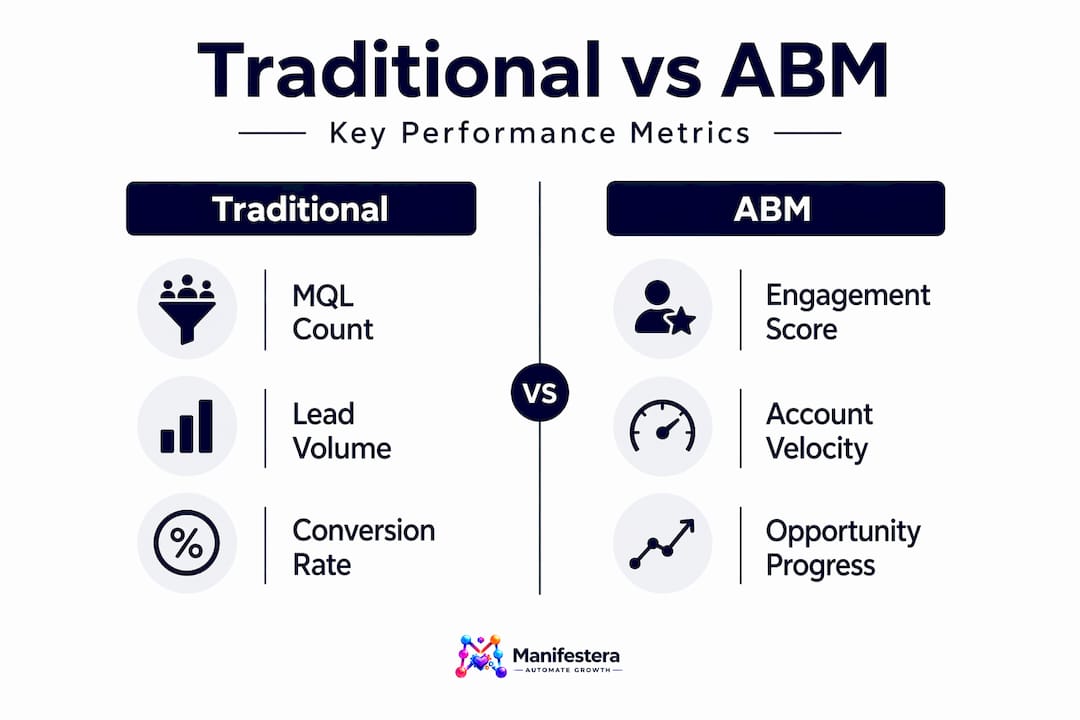
Account-level KPIs you should actually track
Traditional lead generation metrics are inadequate for measuring ABM success. Shift your focus to these account-level indicators:
| Traditional Metric | Modern ABM Equivalent |
|---|---|
| MQL count | Account engagement score |
| Lead volume | Pipeline-influenced revenue by account tier |
| Cost per lead | Cost per account opportunity created |
| Form fill rate | Buying committee coverage percentage |
| Open rates | Multi-stakeholder engagement rate |
Pro Tip: Track "account progression velocity," meaning how quickly target accounts move from first engagement to sales conversation. This single metric often reveals more about your ABM health than any individual channel metric.
Implementing ABM: frameworks, workflows, and collaboration models
Translating ABM theory into daily practice requires structure. A weekly operating rhythm combining sales and marketing is the cornerstone of effective ABM execution. Here is a proven framework:
- Define and document your ICP. Pull data from your top 20 existing customers to identify patterns. Use that as the baseline for account selection.
- Build your tiered account list. Use intent data, CRM history, and firmographic data to rank accounts by fit and buying readiness.
- Assign account ownership. Every Tier 1 account should have a named AE and a named marketing contact responsible for that account.
- Create account-specific content. Personalize landing pages, case studies, and outreach sequences to each account's industry, pain points, and stakeholder roles.
- Run multi-channel engagement. Coordinate LinkedIn ads, email sequences, direct mail, and event invitations so all touchpoints reinforce the same message.
- Hold weekly 30-minute joint reviews. Sales, marketing, and BDR teams review ranked accounts together, share engagement signals, and adjust tactics in real time.
- Score accounts by engagement. Assign scores based on website visits, content downloads, email opens, and sales interactions across all stakeholders at the account.
- Trigger escalation workflows. When an account hits a defined engagement threshold, trigger automated follow-up sequences and alert the assigned AE immediately.
- Measure and iterate quarterly. Review which account tiers are converting, which content is driving engagement, and adjust your ICP and account list accordingly.
Common pitfalls to avoid:
- Selecting accounts based on wish-list thinking rather than data
- Running ABM without executive buy-in, leaving sales free to ignore the process
- Over-personalizing too early before you have enough data on an account's buying committee
- Relying on automated workflows alone without human judgment to interpret engagement signals
The measurable benefits of account-based marketing
The business case for ABM is backed by consistent data. ABM strategies deliver 21 to 50% higher ROI than traditional marketing approaches. When sales and marketing teams operate with shared goals and formal alignment, win rates climb sharply.
"86% of aligned sales and marketing teams report better win rates, and 71% of practitioners already use ABM as a core strategy." — Account-Based Marketing Performance Data
Beyond ROI, ABM drives better customer engagement because your outreach is actually relevant. You are not sending a generic whitepaper to a VP of Engineering. You are sending content that speaks directly to their company's specific challenge, backed by intelligence about where they are in their buying process.
ABM also shortens sales cycles for high-value accounts. When marketing has already educated and warmed multiple stakeholders inside a target account before sales ever makes contact, the first sales conversation starts at a higher level. The result is stronger account engagement and less time spent on education that should have happened before the call.
The benefits compound over time. The data you gather from each account interaction improves your ICP, sharpens your account scoring, and makes each subsequent campaign more precise.
My take on where ABM is actually headed
I've watched ABM get positioned as a silver bullet more times than I can count, and that framing consistently sets teams up for disappointment. What I've learned working in data-driven marketing is that ABM fails most often not because of the strategy itself, but because organizations underestimate how much internal alignment it demands.
The AI shift is real, and I think most ABM teams are dangerously underprepared for it. The governance challenge in agent-based marketing requires separating how you show up for human buyers from how you appear to AI procurement agents. These are fundamentally different problems, and conflating them wastes resources.
My honest assessment: the teams winning with ABM in 2026 are not the ones with the most sophisticated tech stack. They are the ones that have solved the human problem first. Weekly joint account reviews, shared definitions of what a good account looks like, and sales reps who trust the marketing signals because they helped build the scoring model. That operational discipline is what I've consistently seen separate programs that scale from ones that stall after the pilot.
If you are just starting with ABM, do not start with technology. Start with a list of your ten best-fit accounts and ask sales and marketing to get in a room and agree on why those ten are the right ten.
— Manifestera
Ready to put ABM strategy into practice?
Knowing what account-based marketing is and building a system that executes it are two very different things. Manifestera specializes in AI-powered targeting, automated lead nurturing, and performance-driven campaigns designed for B2B teams that want to move fast without sacrificing precision.
Whether you are building your first ABM program or scaling an existing one, Manifestera's AI automation services and SEO capabilities give you the infrastructure to reach target accounts through every channel that matters. Explore what Manifestera can do for your growth at manifestera.pro.
FAQ
What is account-based marketing in simple terms?
Account-based marketing (ABM) is a B2B strategy where sales and marketing teams work together to target specific high-value companies rather than broad audiences, personalizing outreach for each named account.
How does account-based marketing work?
ABM works by identifying your best-fit target accounts using ICP data, then coordinating personalized multi-channel campaigns across those accounts while tracking engagement at the account level rather than the individual lead level.
What is the difference between ABM and traditional marketing?
Traditional marketing generates leads from a wide audience and passes them to sales. ABM starts with a defined list of target companies and aligns sales and marketing from the beginning to engage decision-makers inside those specific accounts.
What are the main benefits of account-based marketing?
ABM delivers 21 to 50% higher ROI than traditional approaches, improves win rates when teams are aligned, and produces stronger customer engagement through relevant, account-specific outreach.
What is agent-based marketing and how does it relate to ABM?
Agent-based marketing is the evolution of ABM in response to AI agents conducting enterprise buying research. It requires brands to optimize their content and digital presence for machine readability, not just human buyers.