

Most marketing professionals think inbound marketing is just blogging and social media posts. It is much more than that. What is inbound marketing methodology, really? It is a customer-first growth system built around earning attention through value rather than interrupting people with ads they never asked for. Known formally as the inbound methodology, this approach covers the full customer lifecycle: attracting the right people, converting them into leads, and turning customers into advocates who fuel your next wave of growth. This article breaks down every stage, the tools that make it work, and how to measure results that actually matter.
Table of Contents
- Key takeaways
- What is inbound marketing methodology, and how it differs from outbound
- The inbound flywheel: attract, engage, and delight explained
- Core inbound marketing techniques and the tools behind them
- Measuring performance and avoiding common pitfalls
- My honest take on inbound marketing after years in the field
- How Manifestera helps you build a real inbound system
- FAQ
Key takeaways
| Point | Details |
|---|---|
| Inbound is a full lifecycle system | It covers attract, engage, and delight stages, not just content creation or traffic generation. |
| The flywheel replaced the funnel | Delighted customers generate referrals and momentum that feed earlier growth stages. |
| Metrics differ by stage | Track traffic for attraction, conversion rates for engagement, and NPS for delight separately. |
| Content alone is not enough | Distribution, lead nurturing, and conversion assets are required to turn attention into revenue. |
| Sales and marketing alignment matters | A smooth handoff from marketing to sales reduces friction and improves lead quality. |
What is inbound marketing methodology, and how it differs from outbound
The inbound methodology is a strategic, customer-first approach to growth that earns attention through value rather than buying or interrupting for it. Instead of pushing messages at audiences who did not ask for them, inbound pulls qualified buyers toward your brand by meeting them where they already are: search engines, industry blogs, YouTube, email newsletters, and social feeds.
Contrast that with traditional outbound marketing. Outbound pushes messages at unqualified audiences through cold calls, TV spots, display ads, and unsolicited emails. The audience has no context and no prior interest. Inbound, on the other hand, focuses on visibility where buyers are already researching, so the leads who arrive are warmer and more informed.
Here is what defines the key principles of inbound marketing:
- Relevance over reach. You target people with a specific problem your product or service solves, not just a large demographic.
- Trust built over time. Inbound creates relationships through consistent, helpful content before the sales conversation starts.
- Two-way engagement. Unlike broadcast advertising, inbound creates dialogue through comments, email replies, and personalized follow-ups.
- Long-term compounding returns. A well-written blog post or SEO-optimized landing page keeps generating traffic and leads for years.
"Inbound is not a campaign. It is an operating system for growth. You build assets that work continuously, not ads that stop the moment you pause the budget."
The practical implication for your business is significant. Outbound requires constant spending to maintain results. Inbound builds equity over time, meaning the content, rankings, and relationships you create today compound in value.
The inbound flywheel: attract, engage, and delight explained

The most important structural shift in understanding inbound marketing is moving from a funnel mindset to a flywheel mindset. A funnel treats customers as the output of a linear process. The flywheel, introduced by HubSpot, treats delighted customers as momentum that fuels the next cycle of growth through referrals, reviews, and repeat business.
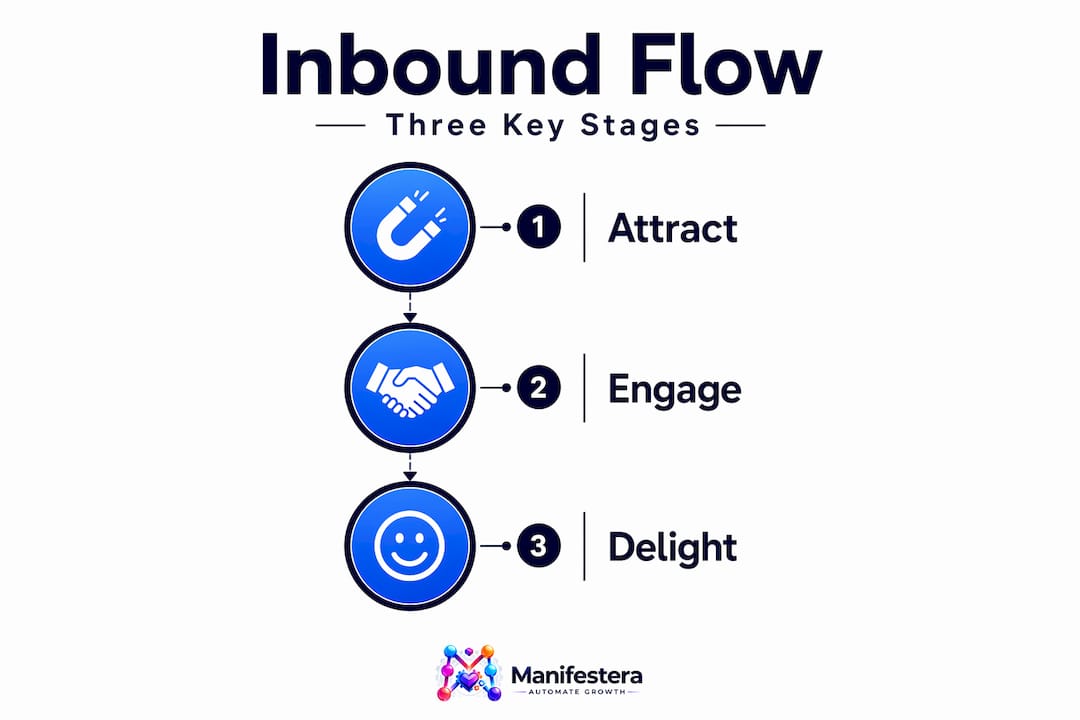
The flywheel has three stages, each with specific goals and metrics.
The attract stage
The goal here is generating qualified traffic from people who match your ideal customer profile. You do this through SEO-optimized content, social media, paid search (used selectively), and organic reach.
Key attract-stage metrics include keyword rankings, organic sessions, and social reach. A B2B software company, for example, might publish detailed comparison guides targeting buyers already evaluating solutions. That content ranks on Google, attracts decision-makers, and drives them to the site without a single cold call.
The engage stage
Attracting visitors is only the start. The engage stage converts unknown visitors into known leads through intentional value exchanges: gated content, email sign-ups, free trials, and consultation requests. After capture, lead nurturing sequences keep prospects engaged with personalized email workflows tied to their behavior and buyer journey stage.
Engage-stage metrics include conversion rate, cost per lead, email open rates, and sales cycle length.
The delight stage
This is where most businesses underinvest. Delight covers everything that happens after the sale: onboarding, customer success check-ins, loyalty programs, and proactive support. When customer success efforts work well, happy customers leave reviews, refer colleagues, and expand their own contracts. These actions feed the attract stage organically, reducing your cost to acquire new customers over time.
| Stage | Primary goal | Key metrics |
|---|---|---|
| Attract | Drive qualified traffic | Keyword rankings, organic sessions |
| Engage | Convert visitors to leads | Conversion rate, cost per lead |
| Delight | Build loyalty and referrals | NPS, retention rate, referral volume |
Pro Tip: Do not wait until a customer churns to focus on delight. Schedule a 30-day check-in call after every new sale. This single touchpoint catches friction early and dramatically improves retention.
Core inbound marketing techniques and the tools behind them
Knowing the framework is one thing. Executing it requires a connected set of tactics and technologies working together. Here is how each layer of the inbound marketing process operates in practice.
-
Content creation aligned to buyer personas. Every piece of content should map to a specific persona at a specific stage. A first-time visitor in the awareness stage needs an educational blog post. A lead who downloaded your pricing guide needs a case study or demo invitation. Producing random content without persona mapping wastes time and produces poor results.
-
SEO for sustained organic visibility. Search engine optimization is the distribution engine for inbound content. Without it, your best articles sit unseen. This means keyword research, on-page optimization, internal linking, and technical SEO maintenance. For businesses in competitive markets, working with specialists in organic traffic growth often accelerates results significantly.
-
Lead capture through forms, CTAs, and landing pages. Every page that attracts traffic needs a path to conversion. That means clear calls to action (CTAs), dedicated landing pages for specific offers, and forms calibrated to ask only for what is necessary. Asking for too much information too soon kills conversion rates.
-
Lead nurturing with email automation and lead scoring. Capturing a lead is not the finish line. Lead nurturing keeps prospects engaged through personalized email sequences triggered by their behavior: page visits, content downloads, or email clicks. Lead scoring assigns numerical values to these behaviors so your sales team knows exactly when a prospect is ready for a conversation.
-
Marketing automation and CRM integration. Automated workflows remove the manual work of follow-up and segmentation. A CRM ties everything together, giving your sales team full context on what a prospect has read, downloaded, and clicked before the first sales call. This context is what separates inbound sales from cold outreach: the handoff starts with educational, context-driven touches rather than a pitch.
-
Analytics and reporting dashboards. You cannot improve what you do not measure. Inbound requires stage-specific reporting that shows traffic, lead volume, pipeline contribution, and customer health scores in one view.
Pro Tip: Use AI-powered automation tools to personalize nurturing sequences at scale. AI can detect behavioral signals and trigger the right message at the right time without requiring your team to manually segment every contact.
Measuring performance and avoiding common pitfalls
The most common mistake businesses make with inbound is treating content production as the finish line. Publishing great articles without conversion assets, distribution strategy, or nurturing workflows means you are generating awareness and nothing else. Successful inbound requires a full system built beyond content alone.
Here are the most common pitfalls and how to address them:
- Over-indexing on traffic. High traffic numbers feel good but mean little without conversions. Prioritize traffic from qualified buyer searches, not broad informational queries that never convert.
- Neglecting the middle of the funnel. Many teams pour resources into attracting visitors and then ignore them. Build nurturing sequences that progressively move leads toward a decision.
- Skipping the delight stage. Retention is cheaper than acquisition. One unhappy customer who posts a negative review costs you multiple future leads.
- Siloed marketing and sales teams. Inbound sales alignment requires marketing and sales to share data, agree on lead definitions, and coordinate handoff timing. Without this, qualified leads fall through the cracks.
Stage-specific metrics give your team clarity on where to optimize. Use this as your baseline performance tracker:
| Metric | Stage | Target benchmark |
|---|---|---|
| Organic sessions | Attract | Month-over-month growth |
| Lead conversion rate | Engage | 2-5% of site visitors |
| Email open rate | Engage | 20-30% for B2B |
| Net Promoter Score (NPS) | Delight | 40+ |
| Customer retention rate | Delight | 85%+ for SaaS |
Pro Tip: Run a quarterly audit of all three flywheel stages. Score each one on a scale of 1 to 10 based on current performance data. This reveals which stage is creating drag and where your next dollar of effort will have the highest return.
My honest take on inbound marketing after years in the field
I have worked with businesses that spent thousands on content and saw almost no pipeline growth. When we dug into why, the answer was consistent: they built the attract stage but ignored everything else.
What I have learned is that inbound methodology is fundamentally about integration. The attract stage needs SEO. The engage stage needs conversion architecture and automation. The delight stage needs a customer success mindset baked into the company culture, not bolted on as an afterthought. When all three stages are connected and the data flows freely between marketing, sales, and service, growth becomes self-reinforcing.
The delight stage is the one I advocate for most strongly because it is the most underrated. I have seen a single high-profile customer referral generate three new contracts worth more than the original deal. That kind of result does not come from ads. It comes from genuinely serving people after they have already paid you.
My advice: stop thinking of inbound as a marketing tactic and start treating it as your company's core operating philosophy. It changes how you hire, how you onboard customers, and how you measure success. The businesses that do this well do not just grow faster. They grow more sustainably.
— Manifestera
How Manifestera helps you build a real inbound system
If you are ready to move from theory to execution, Manifestera builds the complete inbound infrastructure that most marketing teams struggle to assemble on their own.
Manifestera's SEO services lay the attract-stage foundation by driving qualified organic traffic to your site through technically sound, persona-aligned content strategies. The agency's AI automation capabilities power the engage and delight stages with intelligent lead nurturing workflows, behavioral triggers, and CRM integrations that keep prospects moving toward a decision without manual effort.
For businesses in New York City, Manifestera's Manhattan-specific marketing programs combine local SEO expertise with automation tools built for SMBs that need results without enterprise-scale budgets. Whether you are starting your inbound journey or fixing a system that is not converting, Manifestera delivers a strategy grounded in data, not guesswork.
FAQ
What is the inbound marketing methodology in simple terms?
The inbound marketing methodology is a customer-first growth system that earns attention through valuable content rather than paid interruption. It works across three stages: attract, engage, and delight, turning strangers into customers and customers into advocates.
How is inbound different from outbound marketing?
Inbound pulls qualified buyers toward your brand by meeting them during their research process, while outbound pushes messages at unqualified audiences through cold calls, ads, and unsolicited emails. Inbound generates warmer leads at lower long-term cost.
What metrics should I track for each inbound stage?
Track keyword rankings and organic sessions for the attract stage, conversion rates and cost per lead for the engage stage, and NPS and retention rates for the delight stage.
Why is content alone not enough for inbound marketing?
Content generates attention, but without conversion assets, lead nurturing workflows, and a delight strategy, that attention never becomes revenue. Inbound success requires a full system connecting all stages from awareness to customer loyalty.
How long does inbound marketing take to show results?
SEO and organic content typically take three to six months to build measurable traction. Lead nurturing workflows and delight programs can show results within weeks. Inbound is a long-term investment, but the compounding returns make it the most cost-effective growth channel for most businesses over a 12-to-24-month horizon.