

A marketing funnel is a visual and strategic model that maps the customer journey from first brand awareness to final purchase decision, with each stage containing fewer but more qualified prospects. Also called a purchase funnel or conversion funnel, this framework helps you organize messaging, allocate budget, and pinpoint exactly where potential customers drop off. Tools like HubSpot Marketing Hub and Salesforce use funnel models to help teams identify those dropout points and target improvements rather than guessing. Understanding this model is the difference between marketing that converts and marketing that simply spends.
What is a marketing funnel and how does it work?
A marketing funnel is an operational framework that organizes your entire customer acquisition process into distinct, measurable stages. Each stage represents a different level of buyer readiness, and your messaging, content, and calls to action must match that readiness precisely. The funnel shape itself is intentional: many people enter at the top, but only a fraction reach the bottom. That narrowing is not a failure. It reflects natural qualification, and your job is to make the narrowing as intentional as possible.
The core value of the funnel model is attribution and planning. When you know which stage a prospect is in, you know what they need to hear next. Amplitude explains that tailoring funnel messaging to buyer intent and readiness drives optimal engagement at each stage. This means a blog post written for someone who has never heard of your brand should look and sound completely different from a case study written for someone comparing your product against a competitor.

Funnels also create a shared language between marketing and sales teams. When both teams agree on what "awareness" and "consideration" mean, handoffs become cleaner and fewer leads fall through the cracks.
What are the key stages of a marketing funnel?
Most marketing funnels are structured around three core stages: top of funnel (TOFU), middle of funnel (MOFU), and bottom of funnel (BOFU). Each stage demands a different strategy, content format, and success metric.
Top of funnel (TOFU): Awareness
This is where strangers become prospects. Your goal is broad reach, education, and brand discovery. Content here includes blog posts, social media, YouTube videos, podcast appearances, and paid display ads. You are not selling yet. You are answering questions your audience is already asking and making sure your brand shows up in the answer.
Middle of funnel (MOFU): Consideration
Prospects in this stage know they have a problem and are actively evaluating solutions. Salesforce frames this stage as trust-building and qualification, where the goal is deepening the relationship and addressing objections. Content here includes webinars, email nurture sequences, comparison guides, and detailed case studies. This is the stage most businesses under-invest in, and it is where the majority of deals are won or lost.
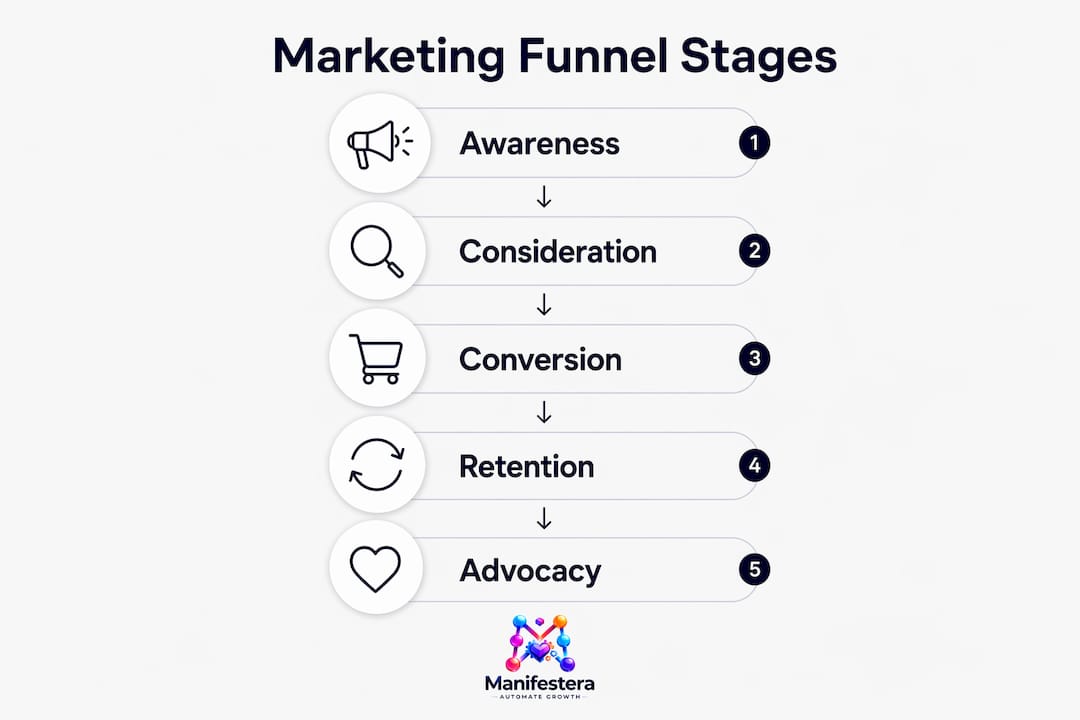
Bottom of funnel (BOFU): Conversion
Prospects here are ready to decide. Your messaging should remove friction, not add information. Free trials, demos, testimonials, pricing pages, and limited-time offers all belong at this stage. The call to action must be clear and direct.
Beyond these three stages, Shopify's full-funnel strategy includes post-purchase phases: loyalty and advocacy. Turning a buyer into a repeat customer and then into a referral source extends the funnel's value well past the initial sale.
- TOFU tactics: SEO content, social ads, influencer partnerships, PR
- MOFU tactics: Email sequences, retargeting ads, webinars, comparison content
- BOFU tactics: Free trials, demos, discount offers, customer testimonials
- Post-purchase tactics: Loyalty programs, referral incentives, upsell campaigns
Pro Tip: Map every piece of content you currently produce to a funnel stage. Most businesses discover they have 80% of their content at the top of the funnel and almost nothing in the middle. Fixing that imbalance often produces faster revenue results than creating more awareness content.
How does the AIDA model relate to the funnel?
The AIDA model is a classic communications framework that maps directly onto funnel stages. Smart Insights defines AIDA as Attention, Interest, Desire, and Action, representing the psychological progression a buyer moves through before making a purchase decision. Understanding AIDA helps you craft messaging that meets buyers where their minds actually are, not where you wish they were.
Here is how AIDA maps to funnel stages:
| AIDA stage | Funnel stage | Messaging focus |
|---|---|---|
| Attention | TOFU (Awareness) | Interrupt and educate; make the problem visible |
| Interest | MOFU (Consideration) | Build curiosity; show your solution is credible |
| Desire | MOFU (Consideration) | Create preference; differentiate from alternatives |
| Action | BOFU (Conversion) | Remove friction; make the next step obvious |
The limitation of AIDA, and of linear funnel models generally, is that real buyer journeys are rarely this clean. A prospect might discover your brand through a retargeting ad after visiting a competitor's site, which places them immediately in the Desire stage without ever passing through your Attention content. Oscom.ai notes that funnels should be designed as adaptable stage models with multiple entry points rather than fixed linear paths. The practical implication: build content for every stage, because you cannot predict where a buyer will first encounter your brand.
Pro Tip: Use AIDA as a copywriting checklist, not just a strategic model. Before publishing any piece of content, ask which AIDA stage it serves. If you cannot answer that clearly, the content probably lacks a focused purpose.
What are the main types of marketing funnels?
Not every funnel serves the same purpose, and choosing the wrong type wastes both budget and effort. The three most common funnel types are lead generation funnels, sales funnels, and full-funnel models.
Salesforce differentiates lead generation funnels from sales funnels by ownership and objective. Lead generation funnels are owned by marketing teams and focus on capturing and educating anonymous visitors. The output is a qualified lead. Sales funnels pick up from that point, managing qualified leads through closing and retention. That distinction matters because it defines who is responsible for what, and where the handoff between teams occurs.
- Lead generation funnels work best for B2B companies, professional services, and any business where the sales cycle is longer than a week. The goal is volume of qualified leads, not immediate transactions.
- Sales funnels are most relevant for ecommerce, SaaS, and direct-to-consumer brands where the path from interest to purchase can be compressed into days or hours.
- Full-funnel models combine both, extending from first awareness through post-purchase advocacy. Shopify and enterprise B2B companies typically operate full-funnel strategies because customer lifetime value justifies the investment across every stage.
- Webinar funnels and product launch funnels are specialized variations used for specific campaigns, particularly in online education and software launches.
The funnel type you choose also shapes your content strategy. A lead generation funnel for a B2B software company requires long-form educational content, gated assets, and multi-touch email sequences. An ecommerce sales funnel for a direct-to-consumer brand relies more heavily on paid social, product page optimization, and abandoned cart recovery. Knowing your funnel type before you build prevents misaligned content and wasted ad spend.
How to create and optimize an effective marketing funnel
Building a funnel that actually converts requires more than mapping stages on a whiteboard. Here is a practical process for building and improving one.
-
Start with customer research. Interview existing customers and lost prospects. Identify the questions they had at each stage of their decision, the objections that nearly stopped them, and the moment they decided to buy. This research defines your funnel's content requirements more accurately than any template.
-
Map content and CTAs to each stage. Every piece of content should have one primary purpose tied to one funnel stage. A blog post targeting a top-of-funnel keyword should not pitch your product in paragraph two. An automated email workflow for middle-funnel prospects should deepen trust, not rush to close.
-
Identify drop-off points with analytics. HubSpot stresses using funnels to identify dropout points so you can target improvements with precision. Set up conversion tracking at every stage transition: from visitor to lead, from lead to marketing-qualified lead, from MQL to sales-qualified lead, and from SQL to customer. The stage with the largest drop-off is your highest-leverage optimization target.
-
Align marketing and sales teams. Salesforce highlights that marketing owns early funnel stages and sales manages later stages, requiring alignment to prevent funnel breaks. Define shared lead definitions, agree on handoff criteria, and hold regular pipeline reviews together.
-
Nurture the middle funnel deliberately. Cometly's research shows that linking middle-funnel engagement signals to revenue KPIs is a critical fix for funnel underperformance. Tracking email opens and webinar attendance is useful only if those signals connect to actual deal progression. Build nurture sequences that advance prospects toward a decision, not just keep them engaged.
Pro Tip: Use a marketing automation platform to score leads based on behavior. A prospect who visits your pricing page three times in a week is signaling BOFU readiness even if they entered your funnel through a TOFU blog post. Behavioral scoring surfaces those signals automatically.
Here is a simple funnel performance tracking framework:
| Funnel stage | Key metric | Optimization lever |
|---|---|---|
| Awareness (TOFU) | Organic traffic, ad impressions | SEO content, paid reach campaigns |
| Consideration (MOFU) | Email open rate, content downloads | Nurture sequence quality, offer relevance |
| Conversion (BOFU) | Demo requests, purchase rate | Landing page copy, friction reduction |
| Post-purchase | Repeat purchase rate, referrals | Loyalty programs, customer success |
Key takeaways
A marketing funnel works because it forces you to match your message to your buyer's readiness at every stage, turning a broad audience into qualified customers through deliberate, stage-specific content and measurement.
| Point | Details |
|---|---|
| Three core stages | TOFU, MOFU, and BOFU each require distinct messaging, content formats, and success metrics. |
| AIDA maps to the funnel | Attention, Interest, Desire, and Action align with funnel stages to guide persuasion and copywriting. |
| Funnel type determines strategy | Lead gen funnels, sales funnels, and full-funnel models serve different business models and team structures. |
| Middle funnel is the weak link | Most businesses under-invest in MOFU; fixing this stage typically produces the fastest revenue gains. |
| Analytics drive optimization | Tracking drop-off at every stage transition reveals your highest-leverage improvement opportunity. |
The part of the funnel most businesses get wrong
At Manifestera, we have audited funnels for dozens of businesses across industries, and the pattern is almost always the same. Companies pour budget into awareness and then wonder why their cost per acquisition is so high. The answer is almost always a neglected middle funnel.
The consideration stage is where trust is built or destroyed. A prospect who found you through a Google search is not ready to buy. They are ready to be educated, to compare, and to decide whether you are credible. If the next thing they encounter after your blog post is a hard sales pitch, you have skipped the most important part of the conversation.
We have also seen funnels fail because marketing and sales operate as separate silos. Marketing celebrates lead volume. Sales complains about lead quality. Neither team has agreed on what a qualified lead actually looks like. The fix is not a new tool. It is a shared definition and a weekly conversation.
The other mistake we see consistently is treating the funnel as a one-time build. Real buyer journeys are not linear, as Oscom.ai's research confirms. Prospects enter at different stages, loop back, go cold, and re-engage months later. Your funnel needs to accommodate that reality with flexible entry points and re-engagement sequences, not just a straight line from ad click to purchase.
Build the funnel, measure every stage, fix the middle, and align your teams. That sequence, done consistently, produces compounding results.
— Manifestera
How Manifestera builds funnels that generate real results
If you want a funnel that does more than look good on a slide, Manifestera builds and automates the entire system for you.
Our team combines SEO-driven awareness at the top of the funnel with AI-powered lead nurturing through the middle stages and high-performance Google Ads and Facebook Ads campaigns at the bottom. Every stage is tracked through real-time analytics dashboards so you can see exactly where leads convert and where they drop off. We work with small and medium-sized businesses nationwide, building custom funnel workflows that capture, qualify, and convert leads automatically. If you are ready to stop guessing and start measuring, contact Manifestera to build a funnel strategy built around your specific growth goals.
FAQ
What is a marketing funnel in simple terms?
A marketing funnel is a model that shows the stages a customer moves through from first hearing about your brand to making a purchase. Each stage narrows as prospects self-qualify, leaving fewer but more ready-to-buy leads at the bottom.
How many stages does a marketing funnel have?
Most funnels use three core stages: awareness (TOFU), consideration (MOFU), and conversion (BOFU). Extended models add post-purchase stages like loyalty and advocacy to drive repeat business and referrals.
What is the difference between a lead generation funnel and a sales funnel?
A lead generation funnel is owned by marketing and focuses on capturing and educating anonymous visitors to produce qualified leads. A sales funnel picks up from that point and manages qualified leads through closing and retention.
How do I know if my marketing funnel is working?
Track conversion rates at every stage transition: visitor to lead, lead to MQL, MQL to SQL, and SQL to customer. The stage with the largest drop-off is where your funnel needs the most attention.
What tools help manage a marketing funnel?
HubSpot Marketing Hub, Salesforce, and marketing automation platforms all support funnel visualization, lead scoring, and stage-specific tracking. Pairing these with a structured inbound marketing methodology gives you both the strategy and the infrastructure to run a high-performing funnel.