

Programmatic advertising is defined as the automated buying and selling of digital ad inventory through real-time auctions, using AI and machine learning to match the right ad to the right user at the precise moment. This method now accounts for over 90% of US digital display ad spending in 2026, making it the dominant force in paid media. Platforms like The Trade Desk, Amazon DSP, and Google Ad Manager sit at the center of this ecosystem, giving marketers the ability to reach specific audiences across display, video, audio, and connected TV at a scale that manual buying simply cannot match.
What is programmatic advertising and how does it work?
Programmatic advertising works through a layered technology stack that connects advertisers to publishers in milliseconds. Three components power the process: demand-side platforms (DSPs), supply-side platforms (SSPs), and ad exchanges.

A DSP is the tool advertisers use to set budgets, define audiences, and place bids. The Trade Desk and Amazon DSP are two of the most widely used DSPs in the market. An SSP is the publisher's counterpart. It makes ad inventory available and maximizes revenue by connecting to multiple buyers simultaneously. An ad exchange is the marketplace where DSPs and SSPs meet to execute transactions.
Here is how a single ad impression is served:
- A user loads a webpage or app that contains an ad slot.
- The publisher's SSP sends a bid request to the ad exchange, including data about the user, the page, and the available placement.
- Every eligible DSP receives the request and evaluates it against advertiser campaign criteria.
- DSPs submit bids in real time. The entire auction completes in under 100 milliseconds, faster than a human blink.
- The winning bid's creative is served to the user instantly.
This process repeats for every single impression across millions of placements simultaneously. Traditional manual ad buying required days or weeks of negotiation with individual publishers. Programmatic replaces that entirely with dynamic, auction-based pricing.
There are three main auction types you need to understand. Open exchange auctions are open to all buyers and offer the lowest cost-per-thousand impressions (CPMs). Private marketplaces (PMPs) are invitation-only auctions where premium publishers offer inventory to select advertisers at negotiated rates. Programmatic guaranteed deals combine automation with fixed inventory and pricing, giving brands certainty over placement without manual negotiation.
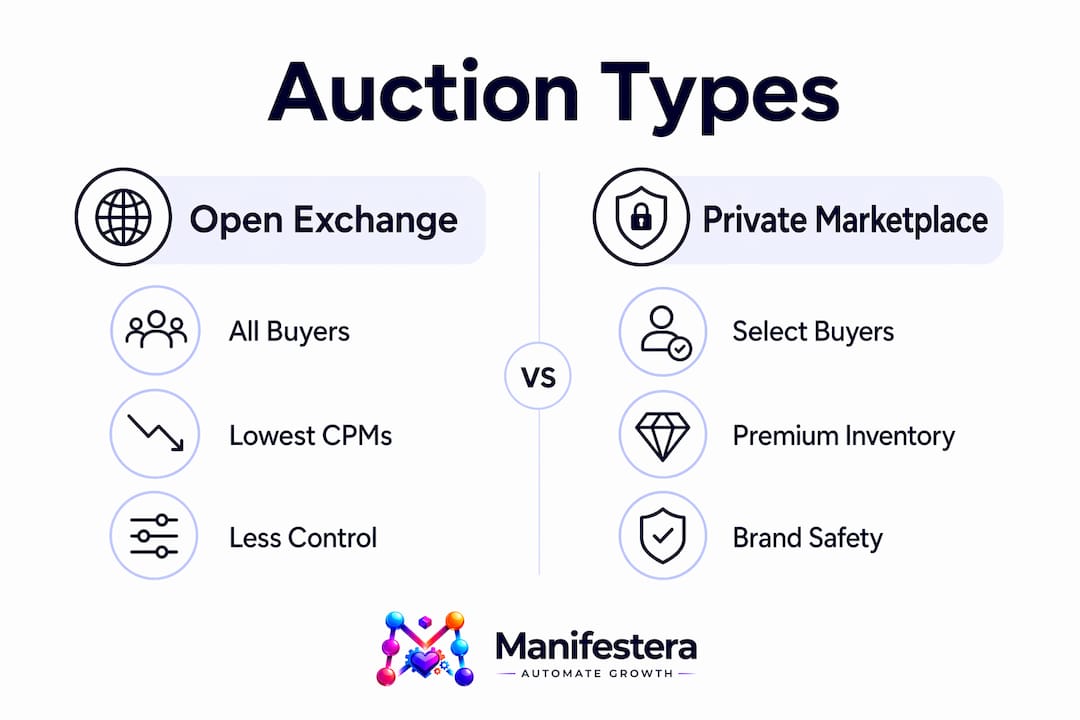
Pro Tip: If you are new to programmatic, start with a private marketplace deal rather than an open exchange. You get better placement quality and far more control over where your ads appear.
What are the main benefits and tradeoffs of programmatic ads?
Programmatic advertising delivers four core advantages over traditional media buying.
- Speed. Campaigns can launch in hours, not weeks. The near-instant campaign launch capability means you can respond to market events, competitor moves, or seasonal demand without waiting for a sales rep to return your call.
- Precision targeting. You buy audiences, not websites. Programmatic lets you target users by demographics, browsing behavior, purchase intent, location, and device type. A furniture retailer in Brooklyn can reach users who recently searched for home renovation services, regardless of which site those users are visiting.
- Real-time optimization. Reporting is granular and immediate. You can see which audience segments, creatives, and placements are performing and reallocate budget within the same campaign flight.
- Scale. A single DSP campaign can reach inventory across thousands of publishers simultaneously, something no direct-buy relationship can replicate.
The tradeoffs are real and worth knowing before you commit budget. Open exchange auctions offer the lowest CPMs but less control over exact placements, which creates brand safety risk. Your ad could appear next to content that conflicts with your brand values. Ad fraud is also more prevalent in open exchanges, where bot traffic can inflate impression counts without delivering real views.
Pro Tip: Use inclusion lists and brand safety tools within your DSP to restrict placements to vetted publishers. Most enterprise DSPs, including The Trade Desk, offer pre-built brand safety segments from verification vendors like DoubleVerify and Integral Ad Science.
Private marketplaces address most of these concerns. They offer premium placements with better brand safety while still automating the transaction. The tradeoff is higher CPMs, but for most brand-conscious advertisers, the premium is worth it.
How does programmatic buying compare to traditional digital ads?
The most common misconception about programmatic advertising is that it is a type of ad. It is not. Programmatic is a buying method, not an ad format. It can deliver display banners, pre-roll video, podcast audio, connected TV spots, and digital out-of-home placements. The format is separate from the transaction method.
The table below clarifies the key differences between traditional manual buying and programmatic buying.
| Factor | Traditional manual buying | Programmatic buying |
|---|---|---|
| Transaction method | Direct negotiation with publisher sales teams | Automated auction via DSP and SSP |
| Speed to launch | Days to weeks | Hours |
| Targeting capability | Site-level or demographic packages | User-level, behavioral, and contextual |
| Pricing model | Fixed CPM negotiated in advance | Dynamic, real-time auction pricing |
| Optimization | Manual, post-campaign | Real-time, in-flight |
| Minimum spend | Often high, publisher-set | Flexible, set by advertiser |
Google Ads deserves a specific note here because it causes frequent confusion. Google Ads operates within Google's own walled garden, covering Search, YouTube, and the Google Display Network. Programmatic advertising, as practiced through platforms like The Trade Desk or Amazon DSP, accesses inventory across the open web and premium publisher networks outside of Google's ecosystem. Both are forms of digital advertising, but they serve different strategic purposes. Google Ads excels at capturing demand through search intent. Programmatic excels at building and converting audiences across a broader media environment.
How to start using programmatic advertising effectively
Getting programmatic right requires a deliberate approach. Here are the steps that separate marketers who see strong returns from those who waste budget.
- Choose your DSP based on your goals. The Trade Desk is the leading independent DSP for agencies and sophisticated in-house teams. Amazon DSP is the strongest choice if your audience shops on Amazon or if you want access to Amazon's first-party purchase data. Google's Display and Video 360 (DV360) is the right fit if you are already deep in the Google ecosystem.
- Shift from site-based to audience-based thinking. The shift to audience-focused buying is the single most important mindset change in programmatic. Stop asking "which websites do my customers read?" and start asking "what behaviors, interests, and signals define my best customer?" Pair this with NYC audience segmentation strategies if you are targeting local markets.
- Avoid confusing DSPs and SSPs. Mixing up DSP and SSP roles is one of the most common beginner mistakes. Advertisers use DSPs. Publishers use SSPs. If you are buying ads, you need a DSP. Trying to access an SSP as an advertiser leads to wasted time and misallocated budget.
- Match auction type to campaign goal. Use open exchange for broad awareness campaigns where cost efficiency matters most. Use private marketplaces for mid-funnel campaigns where placement quality and brand context matter. Use programmatic guaranteed for high-stakes brand campaigns where you need confirmed placement on specific premium publishers.
- Build in brand safety from day one. Set up inclusion lists, exclusion lists, and viewability thresholds before your campaign goes live. Retroactive brand safety fixes are expensive and slow.
Understanding AI-driven automation in marketing gives you a stronger foundation for managing programmatic campaigns, since the same machine learning principles that power programmatic bidding also drive modern marketing automation broadly.
Key takeaways
Programmatic advertising is the most efficient method for buying digital media at scale, but it requires mastery of DSPs, auction types, and audience strategy to deliver strong ROI.
| Point | Details |
|---|---|
| Core definition | Programmatic is automated, auction-based ad buying using AI, not a specific ad format. |
| Auction types matter | Open exchange offers low CPMs; private marketplaces offer control and brand safety at higher cost. |
| Speed advantage | Campaigns launch in hours and optimize in real time, replacing weeks of manual negotiation. |
| Audience over site | Targeting users by behavior and intent outperforms site-level buying for ROI. |
| Platform literacy | Mastering DSPs like The Trade Desk or Amazon DSP is required to avoid wasted spend. |
Programmatic advertising in 2026: what we have learned from running it
The most persistent mistake we see from marketers entering programmatic is treating it like a smarter version of display advertising. It is not. Programmatic is a fundamentally different operating model. When Manifestera builds programmatic strategies for clients, the first conversation is never about creative or budget. It is about data. Specifically, what first-party audience signals does the client own, and how do we use those signals to build lookalike and retargeting pools that actually convert?
The automation handles the bidding. What it cannot do is define a sharp audience or write a compelling creative. Those remain human responsibilities, and they determine whether a programmatic campaign performs at a 2x ROAS or a 6x ROAS.
Brand safety is the other area where we push back against conventional thinking. Most articles tell you to use private marketplaces as a safety measure. That is correct, but incomplete. The real risk in open exchanges is not just adjacent content. It is measurement fraud. Impression counts on open exchanges can be inflated by invalid traffic in ways that make campaigns look like they are performing when they are not. Combining private marketplace deals with third-party verification through tools like DoubleVerify gives you a much cleaner picture of actual performance.
The 2026 market also demands real-time agility in ways that were not true three years ago. Audience behavior shifts faster now. A campaign that was performing well in Q1 can stall by Q2 if you are not monitoring frequency, saturation, and creative fatigue on a weekly basis. The technology gives you the data. The discipline to act on it is what separates strong programmatic operators from average ones.
— Manifestera
Ready to put programmatic advertising to work for your business?
Programmatic advertising gives you the targeting precision and speed that manual buying cannot. But the technology only performs as well as the strategy behind it. Manifestera builds data-driven programmatic campaigns that connect your brand to the right audiences at the right moment, using AI-powered automation to manage bidding, optimization, and reporting in real time.
Whether you are launching your first programmatic campaign or looking to improve returns on an existing one, Manifestera's team brings the platform expertise and audience strategy to make your spend work harder. From DSP selection to private marketplace deal curation, we handle the complexity so you can focus on growth. Explore our Google Ads services to see how we integrate programmatic buying with search and paid social for full-funnel results.
FAQ
What is programmatic advertising in simple terms?
Programmatic advertising is the automated process of buying digital ad space through real-time auctions, using software to target specific audiences rather than negotiating directly with publishers.
How is programmatic advertising different from Google Ads?
Google Ads operates within Google's own ecosystem, covering Search, YouTube, and the Display Network. Programmatic advertising, through platforms like The Trade Desk or Amazon DSP, accesses inventory across the broader open web and premium publisher networks outside Google's properties.
What is real-time bidding in programmatic advertising?
Real-time bidding (RTB) is the auction process where DSPs bid on individual ad impressions as they become available. The entire process, from bid request to ad serving, completes in under 100 milliseconds.
What are the main risks of programmatic advertising?
The primary risks are ad fraud and brand safety exposure, both most common in open exchange auctions. Using private marketplaces and third-party verification tools like DoubleVerify significantly reduces both risks.
Do small businesses benefit from programmatic advertising?
Yes. Programmatic has no fixed minimum spend requirements set by publishers, and DSPs allow flexible budget control. Small businesses benefit most from the precision targeting, which reduces wasted impressions compared to broad, site-level buys.